Zing Forum

Reading

Application of Support Vector Machines in Classification of Children's Nutritional Status

A machine learning project using the Support Vector Machine (SVM) algorithm to classify children's nutritional status, demonstrating the application of SVM in public health data analysis.

支持向量机儿童营养机器学习公共卫生营养状况分类人体测量数据科学健康AI
Published 2026-05-21 04:15Recent activity 2026-05-21 04:25Estimated read 6 min
Application of Support Vector Machines in Classification of Children's Nutritional Status
1

Section 01

Introduction: Application of Support Vector Machines in Children's Nutritional Classification

This article introduces a machine learning project that uses the Support Vector Machine (SVM) algorithm to classify children's nutritional status, demonstrating the application value of data science in the public health field. The project covers the significance of children's nutritional assessment, the principles of the SVM algorithm, data preparation and model training, evaluation, and application prospects, aiming to provide technical support for large-scale nutritional screening.


2

Section 02

Public Health Background of Children's Nutritional Assessment

Child malnutrition is a global public health challenge: approximately 150 million children under five years old worldwide are stunted, and nearly 50 million are wasted, affecting health and national development. Traditional assessment relies on manual work, which is inefficient and difficult to cover large-scale populations; machine learning can automatically classify through analyzing indicators such as height and weight, improving screening efficiency. Accurate classification is crucial for resource allocation, intervention effect monitoring, and nutritional crisis early warning.

3

Section 03

Core Principles of the Support Vector Machine Algorithm

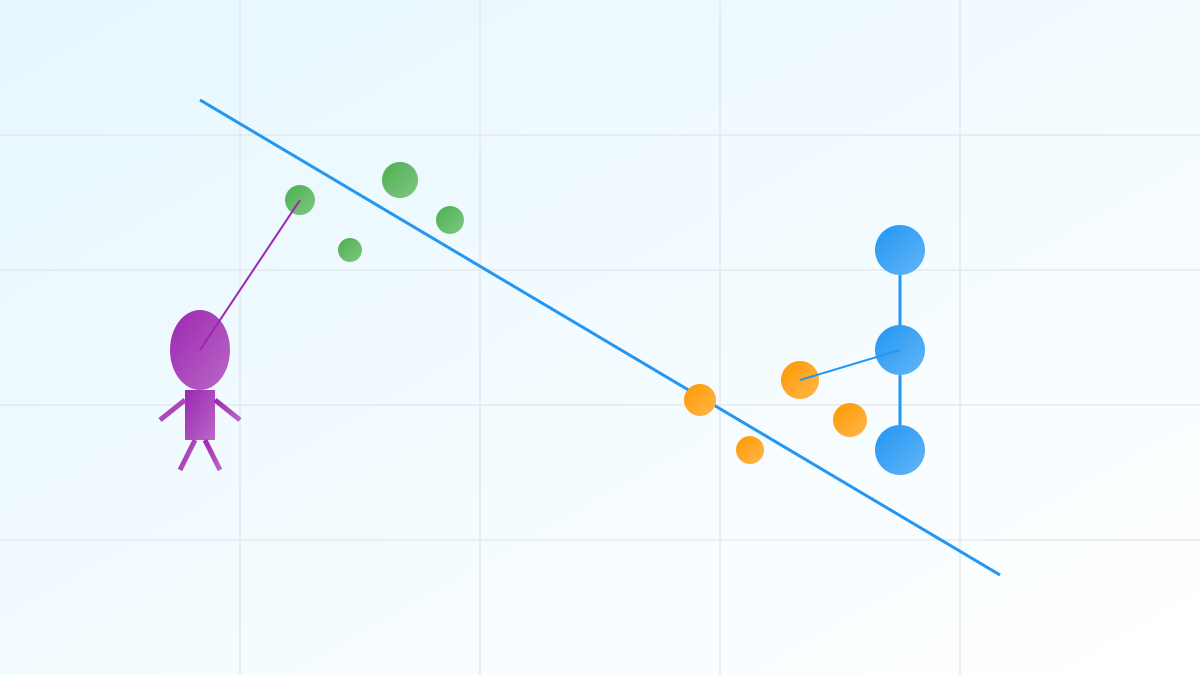
SVM is a classic supervised learning algorithm. Its core idea is to find the optimal hyperplane to maximize the classification margin, which has strong generalization ability and is not prone to overfitting. Non-linear data can be handled through kernel tricks (such as RBF kernel). The optimization problem is a convex optimization with a global optimal solution, and it relies on a small number of support vectors, resulting in high storage and prediction efficiency.

4

Section 04

Data Preparation and Feature Design of the Project

The project's features are based on anthropometric indicators: height-for-age (long-term nutrition), weight-for-age (comprehensive), and weight-for-height (acute). Z-scores are calculated against WHO reference standards (a Z-score below -2 is the threshold for malnutrition). Features such as gender and region may be added; preprocessing includes missing value handling, outlier detection, and feature standardization.

5

Section 05

Model Training and Evaluation Details

Model training uses tools like LIBSVM to solve quadratic programming; hyperparameter tuning (C, kernel function, gamma) is done through cross-validation (grid/random search). Class imbalance needs to be handled (oversampling/undersampling, weight adjustment). Evaluation emphasizes false negatives (to avoid missing malnourished children), with indicators including precision, recall, F1 score, and ROC-AUC; the model can be explained through support vectors and feature importance.

6

Section 06

Application Prospects and Social Value

Application prospects: auxiliary screening in primary healthcare, large-scale nutritional monitoring, and risk assessment in emergency rescue. Implementation needs to consider resource constraints (simplify features), regional applicability (avoid bias), and system integration. Technology needs to be combined with humanistic care and transformed into intervention actions (nutritional education, supplementary feeding, etc.) to realize public health value.

7

Section 07

Summary and Insights

The project demonstrates the application potential of machine learning in public health, which can amplify the capabilities of health workers, especially in resource-limited areas. It is a good entry project for learners (covering the complete process) and reflects the direction of 'technology for good'. We look forward to more health AI applications to improve human health.

