Zing Forum

Reading

Adversarial Robustness Transfer Learning: Research on Defense Strategies for Image Classification Neural Networks

This project provides complete experimental code and studies how to transfer the robustness gained from adversarial training from pre-trained models to target tasks, laying an empirical foundation for building safer AI systems.

对抗训练迁移学习鲁棒性神经网络图像分类PGD攻击形式化验证
Published 2026-05-15 04:26Recent activity 2026-05-15 04:35Estimated read 5 min
Adversarial Robustness Transfer Learning: Research on Defense Strategies for Image Classification Neural Networks
1

Section 01

[Introduction] Core Overview of Adversarial Robustness Transfer Learning Research

This project focuses on adversarial robustness transfer learning, exploring how to transfer knowledge from pre-trained robust models to new tasks to reduce the high computational cost of adversarial training. The project provides complete experimental code, laying an empirical foundation for building safer AI systems, covering key technologies such as adversarial training, transfer learning, PGD attacks, and formal verification.


2

Section 02

Research Background and Problem Definition

Deep learning models perform excellently in image classification tasks but are vulnerable to adversarial examples—tiny perturbations can lead to incorrect predictions, posing significant risks in safety-critical domains. Adversarial training is an effective defense method, but its computational cost is extremely high. Core question: Can the robustness of pre-trained robust models be transferred to new tasks to avoid adversarial training from scratch?

3

Section 03

Project Architecture and Experimental Workflow

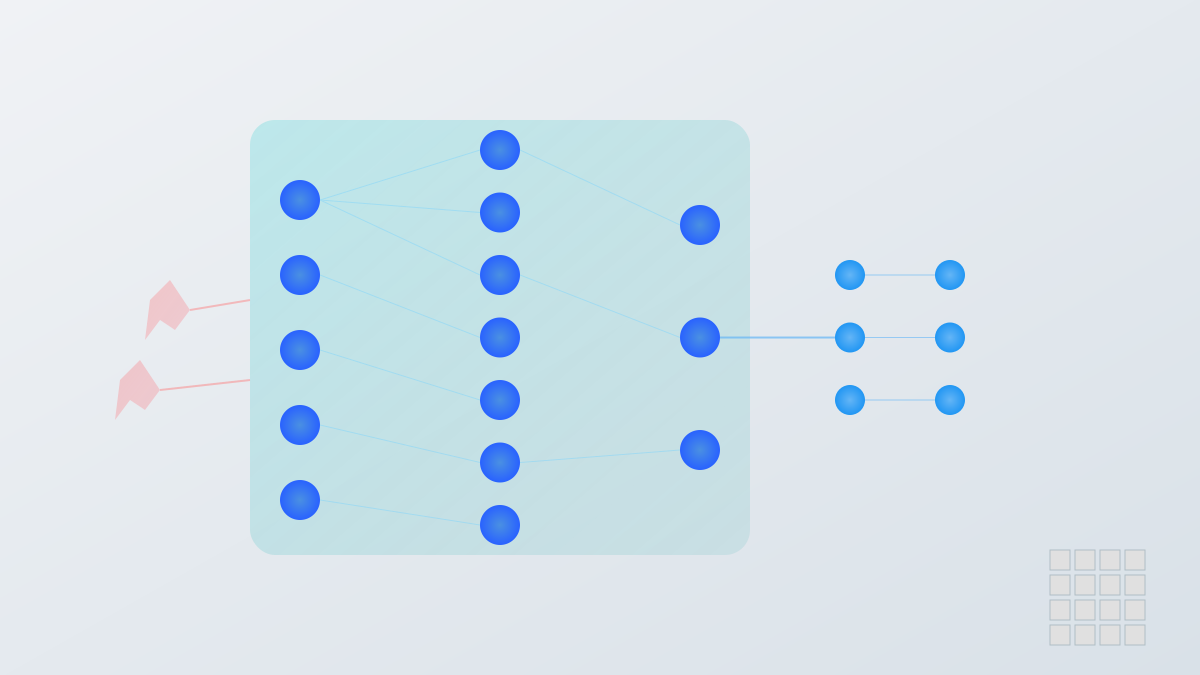
The project codebase is divided into three parts: 1. Adversarial training toolbox (scripts for standard/adversarial training and transfer learning variants); 2. Formal verification scripts (based on the VERONA framework, providing theoretical guarantees of robustness); 3. Plotting scripts (result visualization). Experimental workflow: Adversarial training on source task → Transfer to target task (strategies like direct fine-tuning/transfer + adversarial training) → Robustness evaluation (VERONA verification + PGD attack testing) → Result analysis.

4

Section 04

Technical Details and Research Findings

Technical choices: PGD as the main attack/training method (generating strong adversarial examples); VERONA for formal verification (mathematically guaranteeing robustness); datasets covering CIFAR and EMNIST to enhance generalization. Research findings: Robustness can be transferred; transfer efficiency is improved compared to training from scratch; different transfer strategies have varying effects; formal verification has practical value.

5

Section 05

Application Value and Impact

Industrial deployment: Pre-trained robust models in the cloud, transferred to edge devices to reduce costs; Academic research: Provides a complete experimental framework to facilitate subsequent expansion; Safe AI ecosystem: Promotes the popularization of robust AI in safety-critical fields such as autonomous driving and medical diagnosis.

6

Section 06

Limitations and Future Directions

Current limitations: Experiments are based on standard datasets, and the effect in real scenarios needs to be verified; high verification cost limits model scale; transfer effect is affected by task similarity. Future directions: Explore large-scale model transfer; study the impact of unsupervised/self-supervised pre-training; develop efficient verification algorithms; expand to complex tasks such as object detection.

