Zing Forum

Reading

From Perceptrons to Multi-Layer Neural Networks: An Interactive Learning Journey

A GitHub project that explores the evolution of neural networks from simple perceptrons to advanced MLPs through interactive learning.

感知机神经网络多层感知机交互式学习深度学习教育工具
Published 2026-05-01 03:44Recent activity 2026-05-01 03:49Estimated read 5 min
From Perceptrons to Multi-Layer Neural Networks: An Interactive Learning Journey
1

Section 01

[Main Post/Introduction] The perceptrons Project: Interactive Exploration of Neural Network Evolution from Perceptrons to MLPs

perceptrons is a GitHub project designed to help beginners understand the complete evolution of neural networks from basic perceptrons to multi-layer perceptrons (MLPs) through interactive learning. The project addresses the problem of abstractness and difficulty in traditional learning, which relies on mathematical formulas and static charts, allowing users to explore model evolution hands-on and cultivate intuitive understanding and an experimental spirit.


2

Section 02

Background: Pain Points in Traditional Neural Network Learning and the Birth of the Project

Neural networks and deep learning concepts are abstract; traditional learning relies on mathematical formulas and static charts, lacking intuitive experience. The perceptrons project was thus born to allow users to explore the evolution from perceptrons to MLPs in an interactive way, lowering the barrier to understanding.

3

Section 03

Methodology: Progressive Evolution Path and Advantages of Interactive Learning

The project starts with perceptrons (proposed by Frank Rosenblatt in 1957) and gradually demonstrates:

  1. Core ideas of perceptrons (weight adjustment, activation functions, weight update rules, and limitations of single-layer models);
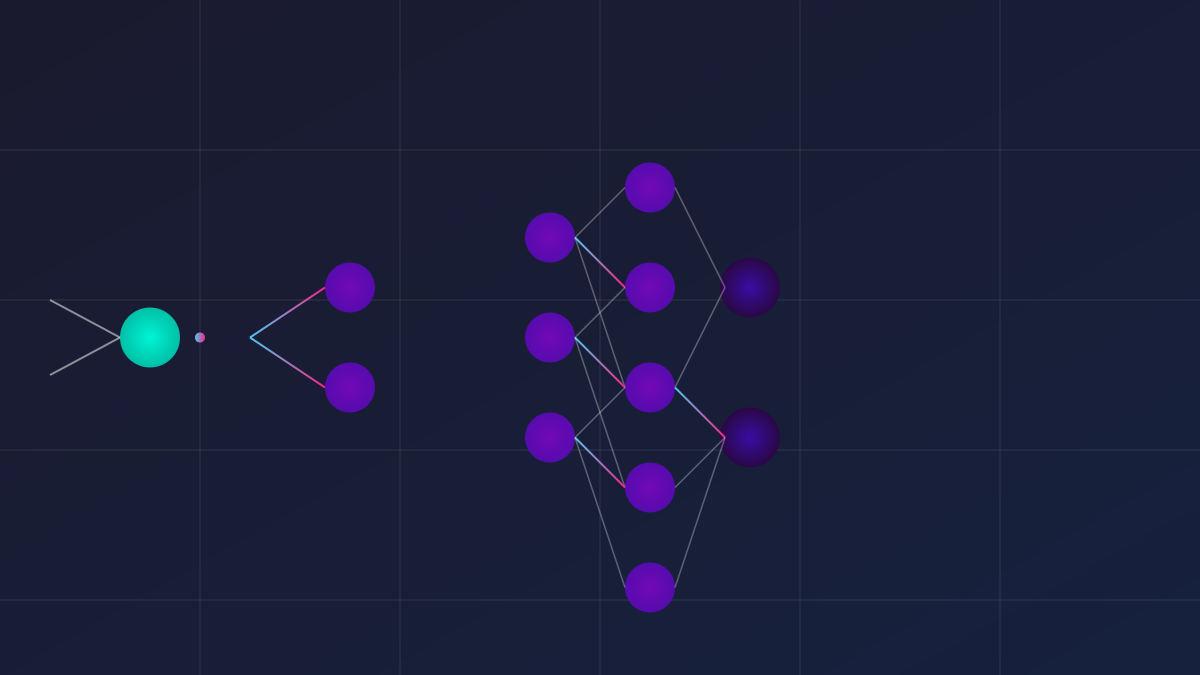
  2. Three stages of evolution: Basic perceptrons (binary classification, decision boundary visualization) → Nonlinear problems (XOR exposes single-layer limitations, leading to the introduction of hidden layers) → MLPs (adjusting architecture, understanding forward/backward propagation);
  3. Advantages of interactivity: Instant feedback, trial-and-error experiments, visualization of abstract concepts, and progressive difficulty design.
4

Section 04

Technical Implementation: Combining Underlying Principles with Teaching Design

The project's technical features include:

  • Pure NumPy implementation without advanced frameworks, revealing the essence of neural networks (matrix operations);
  • Modular design (separation of forward propagation, loss calculation, and backward propagation);
  • Rich example data (from logic gates to pattern recognition);
  • Detailed code comments to help understand implementation details.
5

Section 05

Target Audience and Learning Path: Covering Learners from Diverse Backgrounds

The project is suitable for:

  • Programming beginners: Modify parameters to observe effects and build intuitive understanding;
  • Students with basic knowledge: Read source code to understand internal implementation and lay a foundation for framework learning;
  • Teachers: Use as a classroom auxiliary tool;
  • Self-learners: Follow a complete learning path from basics to advanced levels.
6

Section 06

Practical Significance: The Importance of Understanding Basic Principles

In today's era of advanced deep learning frameworks, understanding basics (such as perceptrons) remains crucial:

  • Debugging ability: Quickly locate model anomalies;
  • Architecture design: Design appropriate structures for specific problems;
  • Foundation for innovation: Latest research stems from in-depth understanding of basics;
  • Professional competence: Basics are frequently tested in interviews, and solid theory supports career development.
7

Section 07

Conclusion: The Value of the Interactive Learning Paradigm

The perceptrons project transforms complex theories into interactive exploration experiences, making neural networks no longer a black box. For those who wish to truly understand deep learning, it is a valuable resource. By building and training simple networks with their own hands, learners gain knowledge, cultivate intuition and an experimental spirit, and lay a foundation for in-depth AI exploration.

