Zing Forum

Reading

Rainfall Prediction System Based on Random Forest Algorithm: A Machine Learning Practice in Meteorological Data Analysis

This project is a desktop application for rainfall prediction based on the random forest algorithm. By analyzing meteorological features such as temperature, humidity, and air pressure, it provides users with accurate rainfall predictions and visual analysis, suitable for scenarios like agricultural planning and disaster early warning.

随机森林机器学习气象预测降雨预测数据可视化决策树集成学习农业应用桌面应用开源项目
Published 2026-05-05 14:45Recent activity 2026-05-05 14:50Estimated read 6 min
Rainfall Prediction System Based on Random Forest Algorithm: A Machine Learning Practice in Meteorological Data Analysis
1

Section 01

[Introduction] Rainfall Prediction System Based on Random Forest: Making AI Meteorological Prediction Accessible

This project is a desktop application based on the random forest algorithm. It predicts rainfall probability and provides visual analysis by analyzing meteorological features such as temperature, humidity, and air pressure, suitable for scenarios like agricultural planning and disaster early warning. It lowers the technical threshold for machine learning-based meteorological prediction, enabling ordinary users to use AI to solve practical problems.


2

Section 02

Project Background: Rainfall Prediction Needs Under Climate Change and Opportunities for Machine Learning

Climate change has a profound impact on fields such as agricultural production, water resource management, and disaster prevention, making accurate rainfall prediction crucial. Traditional numerical weather forecasting, while highly accurate, requires massive computing resources and complex physical models. Machine learning, by learning feature patterns from historical data, provides a new path for meteorological prediction. As a desktop application for end-users, this project is based on the random forest algorithm, allowing ordinary users to use AI for rainfall prediction.

3

Section 03

Algorithm Approach: Principles of Random Forest and Its Advantages in Rainfall Prediction

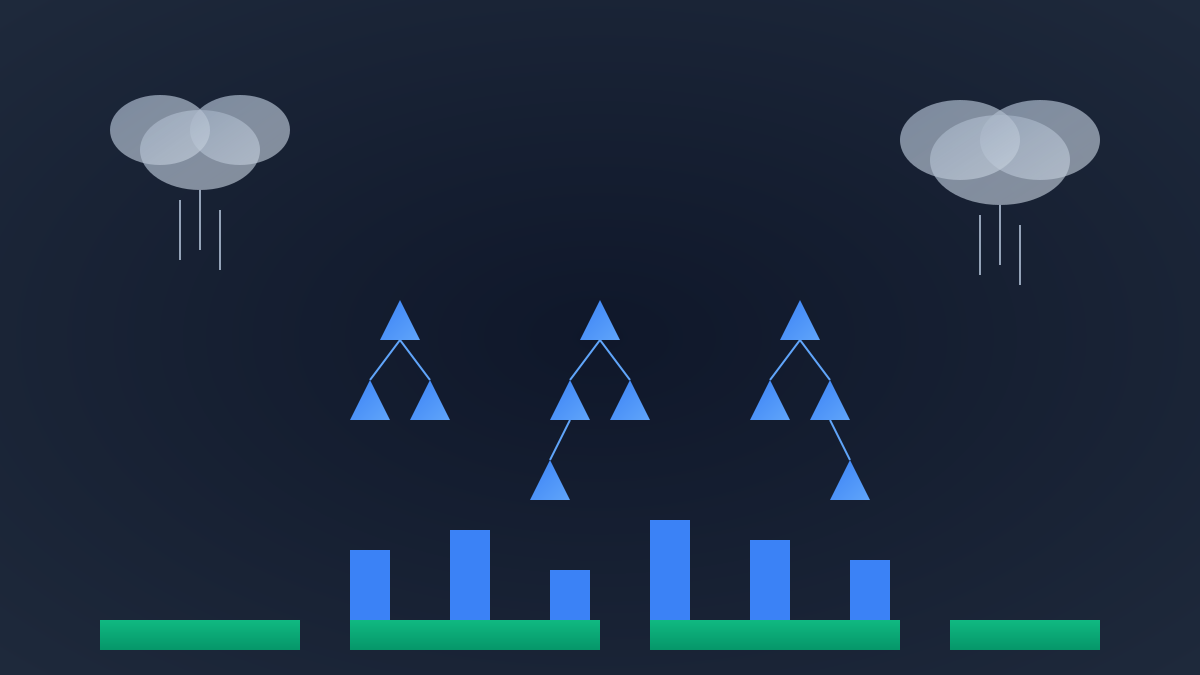
Random forest is an ensemble learning method whose core idea is to make comprehensive predictions through multiple decision trees. Key mechanisms include: Bagging (training multiple trees with replacement sampling), random feature selection (randomly selecting features during splitting), and voting/average mechanism (voting for classification, averaging for regression). Its advantages in rainfall prediction: handling high-dimensional meteorological features, capturing nonlinear relationships, strong noise resistance, and explaining decisions through feature importance analysis.

4

Section 04

System Functions and Technical Implementation Details

Function Modules: 1. Rainfall prediction (binary judgment + probability estimation); 2. User-friendly interface (CSV data upload, parameter configuration, result display); 3. Visualization (confusion matrix, feature importance chart, historical trend chart); 4. Performance evaluation (metrics like accuracy, precision, recall); 5. Automatic preprocessing (missing value filling, outlier detection, feature standardization, etc.). Technical Implementation: The input CSV must contain feature columns such as temperature, humidity, and air pressure; the model training process includes data collection, cleaning, feature engineering, training, hyperparameter tuning, evaluation, and saving; key hyperparameters include n_estimators (100-500), max_depth, min_samples_split, etc.

5

Section 05

Application Scenarios: Practical Value Across Multiple Fields

  1. Agricultural irrigation decision-making: Postpone irrigation based on predictions to save resources; 2. Outdoor activity planning: Quantify rainfall risk to choose plans; 3. Urban drainage management: Allocate resources in advance to prevent waterlogging; 4. Aviation and transportation: Assist in optimizing scheduling plans.
6

Section 06

Limitations and Improvement Directions

Current Limitations: Prediction quality depends on data accuracy; limited regional adaptability; mainly for short-term predictions; single model. Improvement Suggestions: Integrate multiple models such as XGBoost; introduce spatiotemporal features; connect to meteorological APIs for real-time data updates; design online learning mechanisms; develop mobile applications.

7

Section 07

Summary and Insights: Technology Serves Real Problems

This project demonstrates the practical value of machine learning in the meteorological field. Its successes lie in problem orientation, user-friendly design, interpretability, and open-source sharing. Insights for developers: Technology should serve people and focus on solving real-world problems.

