Zing Forum

Reading

End-to-End Clinical Prediction Machine Learning Pipeline: A Complete Practice from Data Preprocessing to Continuous Learning

This article introduces a complete clinical condition prediction machine learning pipeline project, covering key steps such as data preprocessing, feature engineering, multi-model training, hyperparameter optimization, data drift detection, and continuous learning, with an interactive Streamlit dashboard.

机器学习医疗AI临床预测数据漂移持续学习StreamlitScikit-Learn决策树SVM神经网络
Published 2026-06-02 16:15Recent activity 2026-06-02 16:19Estimated read 8 min
End-to-End Clinical Prediction Machine Learning Pipeline: A Complete Practice from Data Preprocessing to Continuous Learning
1

Section 01

Introduction: Complete Practice of End-to-End Clinical Prediction Machine Learning Pipeline

The Automated Clinical Prediction Pipeline project introduced in this article provides an end-to-end solution covering data preprocessing, feature engineering, multi-model training, hyperparameter optimization, data drift detection, and continuous learning, along with an interactive Streamlit dashboard. This project uses a Python tech stack with core dependencies including Scikit-Learn and Streamlit, aiming to address the challenge of converting medical data into reliable prediction models and ensuring the models maintain stable performance in production environments.


2

Section 02

Project Background and Significance

Data analysis in the healthcare field is an important application scenario for machine learning. Multi-dimensional data has the potential to predict disease risks, but processes like data cleaning, feature engineering, model selection, and monitoring are full of challenges. This project provides an end-to-end solution to implement the complete process from raw medical data to prediction models, and introduces data drift detection and continuous learning mechanisms to ensure the models maintain stable performance in production environments.
3

Section 03

Technical Architecture and Core Function Modules

Technical Architecture

This project uses a Python tech stack with core dependencies including:

  • Scikit-Learn: Provides algorithms like decision trees, SVM, and MLP
  • Streamlit: Builds interactive web dashboards
  • Pandas & NumPy: Data processing and numerical computation
  • Plotly, Matplotlib, Seaborn: Data visualization
  • Joblib: Model serialization

Core Function Modules

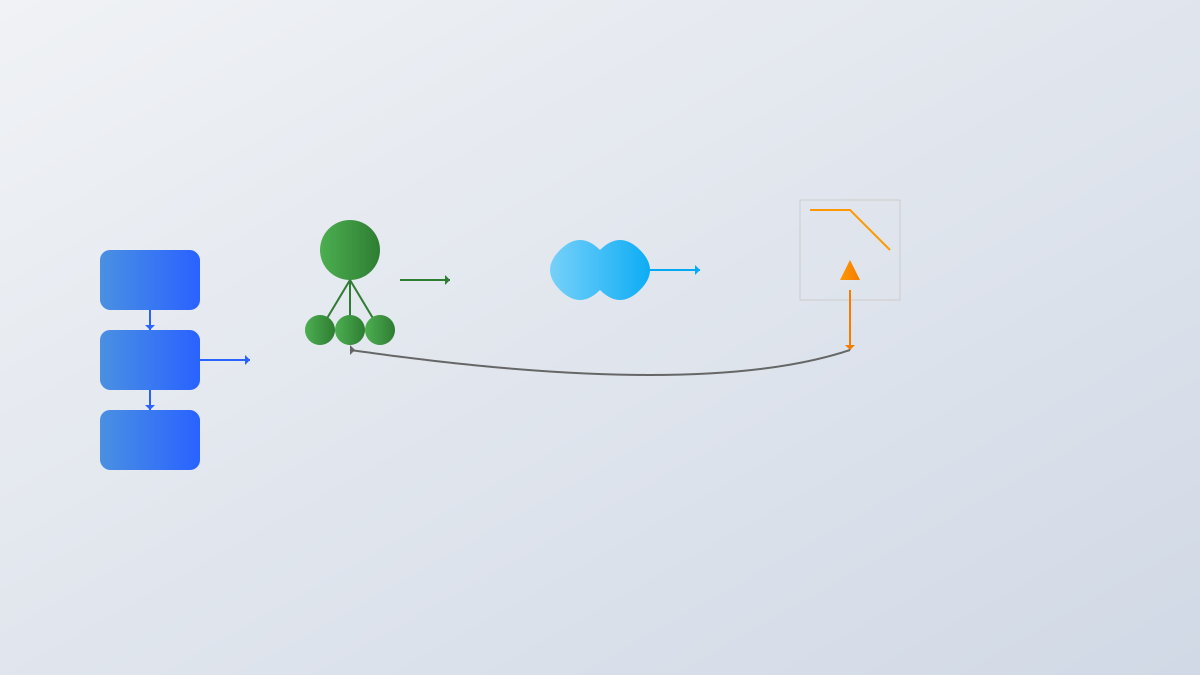
  1. Data Preprocessing and Feature Engineering: Automatically handles missing values, outliers, categorical feature encoding, numerical feature standardization, feature selection and dimensionality reduction, and extracts meaningful predictive features.
  2. Multi-Model Integrated Training: Simultaneously trains three models: decision trees (high interpretability), SVM (good performance in high-dimensional spaces), and MLP (captures non-linear relationships).
  3. Hyperparameter Optimization: Uses GridSearchCV for systematic parameter search.
  4. Class Imbalance Handling: Implements oversampling (SMOTE), undersampling, and hybrid strategies.
  5. Model Evaluation System: Uses multi-dimensional metrics such as accuracy, precision, recall, F1 Score, ROC-AUC, and confusion matrix.
4

Section 04

Data Drift Detection and Continuous Learning Mechanism

Data Drift Detection

  • Detection Methods: KS test and chi-square test to compare distribution differences; track changes in feature mean and variance; observe trends in prediction output distribution.
  • Alert Mechanism: Triggers an alert when significant drift is detected, prompting retraining or strategy adjustment.

Continuous Learning Workflow

  1. Incremental Learning: Updates the model when new data arrives without forgetting old knowledge.
  2. Model Version Management: Saves different versions and supports rollback.
  3. A/B Testing Framework: Compares the real performance of old and new models.
  4. Automated Retraining: Automatically triggers when performance declines or sufficient new data is accumulated.

This mechanism adapts to changes in medical practice, such as updates to diagnostic standards and introduction of new drugs.

5

Section 05

Interactive Streamlit Dashboard Features

To lower the barrier to use, the project developed a Streamlit dashboard with features including:

  • Data Upload: Supports CSV and Excel formats
  • Real-Time Prediction: Inputs patient information to get risk scores
  • Model Interpretation: Displays key features affecting predictions
  • Performance Monitoring: Visualizes the historical performance of models
  • Drift Report: Shows data drift detection results

This design enables machine learning models to truly serve clinical decision-making.

6

Section 06

Practical Insights and Future Directions

Practical Insights

  • Technical Aspect: End-to-end pipelines are more valuable than isolated models; monitoring and feedback are key to production deployment; interpretability is particularly important in medical scenarios.
  • Application Aspect: Automated predictions assist doctors in decision-making but do not replace professional judgment; data privacy and security need to be emphasized; regulatory compliance is a necessary path.

Future Directions

  • Introduce deep learning models (e.g., Transformer) to process complex medical data
  • Use federated learning to support multi-institution collaboration without sharing raw data
  • Add natural language processing modules to handle doctors' text records
7

Section 07

Conclusion: A Reference Example of Medical AI from Prototype to Production

The Automated Clinical Prediction Pipeline demonstrates how to transform machine learning from a laboratory prototype into a production-ready complete system, focusing not only on model accuracy but also on maintainability, monitorability, and continuous learning capabilities. For developers who want to apply machine learning to the medical field, this is a highly valuable technical example.