Zing Forum

Reading

Predicting Loan Defaults Using Artificial Neural Networks: A Complete Practice from Data Cleaning to Model Deployment

This article introduces a loan default prediction project based on TensorFlow/Keras, covering the entire workflow from data cleaning, feature engineering to ANN model construction and training, providing a reference for machine learning applications in the financial risk control field.

贷款违约预测人工神经网络TensorFlowKeras金融风控机器学习特征工程深度学习
Published 2026-06-07 00:42Recent activity 2026-06-07 00:49Estimated read 8 min
Predicting Loan Defaults Using Artificial Neural Networks: A Complete Practice from Data Cleaning to Model Deployment
1

Section 01

【Main Floor/Guide】Complete Practice Guide for Predicting Loan Defaults Using Artificial Neural Networks

Project Basic Information

Core Content

This article introduces a full-process loan default prediction project based on TensorFlow/Keras, covering data cleaning, feature engineering, ANN model construction and training, etc., providing a practical reference case for machine learning applications in the financial risk control field.


2

Section 02

Project Background and Significance

In the financial credit field, loan default prediction is a core part of risk control, which can help institutions reduce bad debts and optimize resource allocation. Traditional credit scoring models rely on simple statistics and manual rules, making it difficult to capture complex nonlinear relationships. With the development of deep learning, Artificial Neural Networks (ANN) have become an important tool for risk control due to their strong feature learning capabilities. This project demonstrates a complete prediction system, providing a reference for developers new to financial machine learning.

3

Section 03

Data Cleaning and Preprocessing Steps

Data quality is the cornerstone of project success; the cleaning phase includes:

  • Missing Value Handling: For numerical types, fill with mean/median; for categorical types, fill with mode or "Unknown" category;
  • Outlier Detection: Identify and handle via box plots, Z-score, or Isolation Forest;
  • Data Type Conversion: Convert dates, amounts, etc., to appropriate numerical formats;
  • Duplicate Record Handling: Delete duplicate application records to ensure data independence. High-quality cleaning can improve model generalization ability and reduce overfitting risk.
4

Section 04

Detailed Feature Engineering Strategies

Numerical Feature Processing

  • Debt-to-Income Ratio (DTI): Core indicator for evaluating repayment ability;
  • Credit History Length: Calculated from account opening date;
  • Loan Amount and Term: Calculate monthly payment pressure.

Categorical Feature Encoding

  • One-Hot Encoding: Suitable for low-cardinality features (e.g., loan purpose, housing status);
  • Target Encoding: Suitable for high-cardinality categories (e.g., occupation type);
  • Ordinal Encoding: Suitable for features with inherent order (e.g., credit rating).

Feature Scaling

  • Z-score Standardization: Mean 0, standard deviation 1;
  • Min-Max Normalization: Scale to [0,1] range (neural networks are sensitive to scale).
5

Section 05

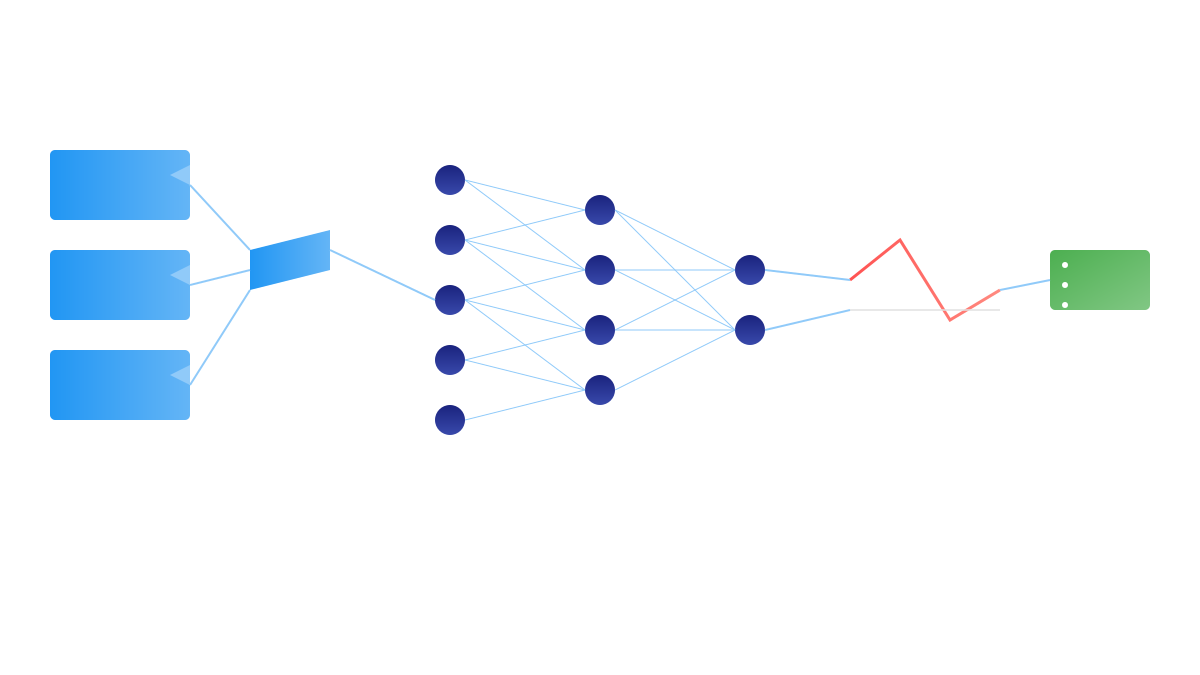
ANN Model Architecture and Training Optimization

Model Architecture

  • Input Layer: Dimension matches the number of features;
  • Hidden Layers: First layer with 64-128 neurons (ReLU activation), second layer with 32-64 neurons, Dropout layer (dropout rate 0.3-0.5) to prevent overfitting;
  • Output Layer: Single neuron + Sigmoid activation, output default probability (threshold 0.5 for binary classification).

Training Optimization

  • Loss Function: Binary Cross-Entropy;
  • Optimizer: Adam;
  • Data Split: 7:2:1 (training/validation/test);
  • Class Imbalance Handling: Class weights, SMOTE oversampling, undersampling;
  • Early Stopping: Monitor validation set loss to prevent overfitting.
6

Section 06

Model Evaluation Metrics and Business Value

Technical Metrics

  • Accuracy: Overall proportion of correct predictions (limited reference when class imbalance exists);
  • Recall: Proportion of actual default users correctly identified (related to risk control effectiveness);
  • Precision: Proportion of predicted default users who actually default (affects decision-making cost);
  • F1 Score: Harmonic mean of precision and recall;
  • AUC-ROC: Evaluate discrimination ability at different thresholds (closer to 1 is better).

Business Value

  • Identify high-risk customers in advance;
  • Optimize approval process and reduce labor costs;
  • Support differential pricing;
  • Reduce bad debt losses and improve asset quality.
7

Section 07

Summary and Future Exploration Suggestions

Project Summary

This project fully demonstrates the loan default prediction process from data preprocessing to neural network modeling; reasonable cleaning, feature engineering, and model design can build a practical credit risk tool.

Future Exploration Suggestions

  • Comparison between ensemble learning (XGBoost/LightGBM) and deep learning;
  • Application of time-series features in credit evaluation;
  • Practice of model interpretability techniques (e.g., SHAP values);
  • Potential of federated learning in collaborative risk control among multiple institutions.

Loan default prediction is an important scenario in fintech, and machine learning will play a greater role in risk management.

