Zing Forum

Reading

Road Traffic Accident Severity Prediction: An Intelligent Analysis Tool Based on Machine Learning

An open-source road traffic accident data analysis and severity prediction project that uses machine learning algorithms to identify key factors affecting casualty outcomes, providing data support for traffic safety management and accident prevention.

机器学习交通事故预测数据可视化决策树分类模型公共安全风险评估智能交通数据分析可解释AI
Published 2026-05-23 08:46Recent activity 2026-05-23 08:54Estimated read 7 min
Road Traffic Accident Severity Prediction: An Intelligent Analysis Tool Based on Machine Learning
1

Section 01

[Introduction] Road Traffic Accident Severity Prediction: An Intelligent Analysis Tool Based on Machine Learning

AlphaVizi's open-source project 'Road Traffic Accident Severity Prediction' is an intelligent analysis tool based on machine learning. It predicts accident casualty severity by analyzing road traffic data, identifies key influencing factors, and provides a zero-code desktop application to support traffic safety management, accident prevention, and related fields.


2

Section 02

[Background] Current Status of Road Traffic Accidents and Project Needs

Road traffic accidents are a major global public safety issue. According to WHO data, about 1.35 million people die from road traffic accidents each year, and tens of millions are injured. Effectively predicting accident severity and identifying high-risk factors are of great significance for accident prevention and emergency response, which is the demand this project addresses.

3

Section 03

[Methodology] Core Functions and Technical Architecture

Data Preprocessing Module

Automatically performs data cleaning, format standardization, feature encoding, and data splitting to ensure input data quality.

Exploratory Data Analysis (EDA)

Provides visualization functions such as statistical charts, trend analysis, geographic distribution, and multi-dimensional analysis to help understand data patterns.

Correlation Analysis

Identifies key factors related to accident severity through Pearson correlation coefficient, Spearman rank correlation, chi-square test, and heatmaps.

Classification Prediction Models

Supports algorithms like decision trees, random forests, SVM, logistic regression, and gradient boosting trees, and automatically completes training, validation, and evaluation.

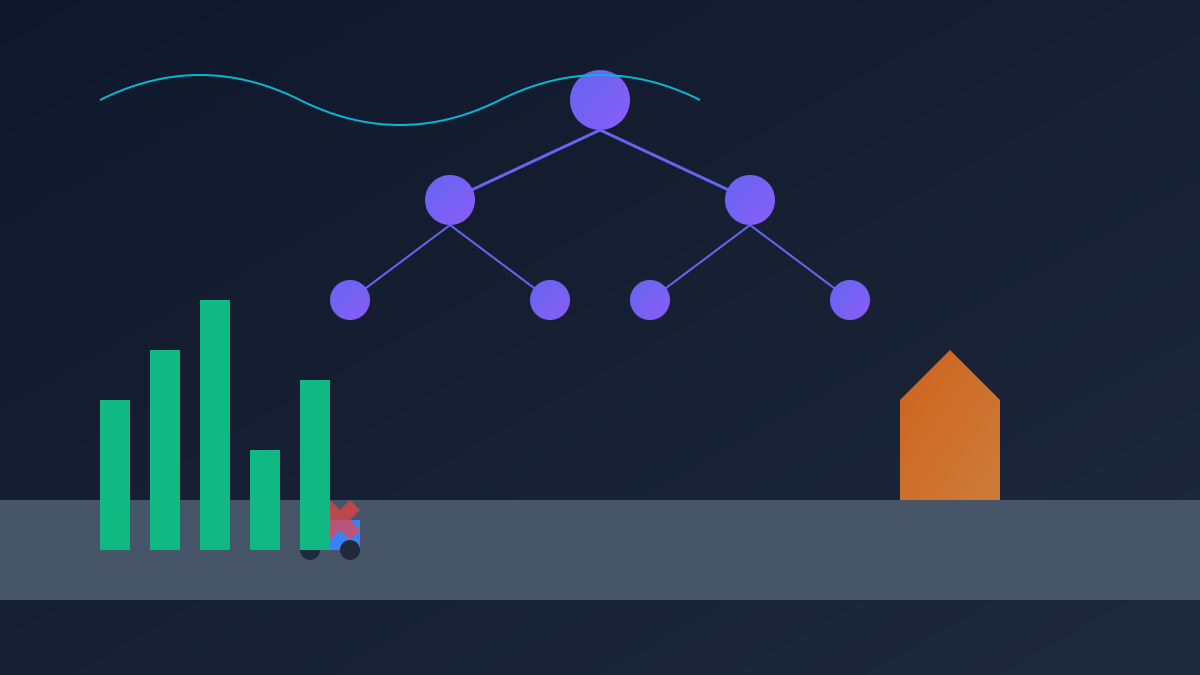
Decision Tree Visualization and Interpretation

Provides tree structure display, path tracking, feature importance quantification, and rule extraction to enhance model interpretability.

4

Section 04

[Applications] Value in Multiple Scenarios

Traffic Management Departments

Used for risk assessment (identifying high-risk road sections/time periods), accident prevention, resource allocation, and policy formulation.

Insurance Companies

Used for claim prediction, risk assessment (adjusting premiums), and fraud detection.

Academic Research Institutions

Used for hypothesis testing, feature engineering, model comparison, and paper publication.

5

Section 05

[Usage] System Requirements and Operation Process

System Requirements

  • OS: Windows 10+/macOS 10.14+/Linux
  • Memory: At least 4GB RAM
  • Disk: At least 500MB of space
  • Network: Required for downloading the application

Installation and Startup

  1. Download the installation package for your system from GitHub Releases
  2. Run the installer to complete installation
  3. Launch the application

Analysis Process

  1. Load CSV format data
  2. Click Analyze to generate a visualization report
  3. Select fields to predict severity
  4. View the results panel
6

Section 06

[Highlights] Technical Innovations and User-Friendly Design

  • Zero-code experience: Graphical interface, easy to use for non-technical users.
  • End-to-end automation: Fully automatic from data loading to result output (cleaning, feature engineering, model training, visualization).
  • Interpretability first: Features like decision tree visualization and feature importance help users understand the model's decision logic.
  • Cross-platform support: Compatible with Windows, macOS, and Linux systems.
7

Section 07

[Limitations and Improvements] Current Shortcomings and Future Directions

Current Limitations

  1. Data format limitations: Mainly supports CSV; limited support for databases/APIs.
  2. Algorithm selection: Advanced users cannot customize parameters.
  3. Real-time prediction: Focuses on batch analysis; weak real-time stream processing capability.
  4. Model deployment: Lacks export and integration functions.

Improvement Directions

  1. Expand data sources: Support databases, data warehouses, and real-time streams.
  2. AutoML: Automatic feature engineering and hyperparameter optimization.
  3. Model serviceization: Provide REST API for online prediction.
  4. Deep learning: Explore neural network applications.
  5. GIS integration: Combine map data for spatial analysis.
8

Section 08

[Summary] Project Value and Future Outlook

This project demonstrates the application potential of machine learning in the public safety field, lowering the threshold for AI use through an easy-to-use desktop application. Its interpretability design (e.g., decision tree visualization) is particularly important in personal safety scenarios. With the development of intelligent transportation in the future, we expect the project to integrate more data sources and algorithms to make greater contributions to road traffic safety, and hope more similar tools emerge to let AI serve social well-being.

