Zing Forum

Reading

Building an End-to-End Machine Learning Pipeline: Practices in Fairness and Interpretability for Recidivism Prediction Systems

This article introduces a complete machine learning pipeline project for recidivism prediction, covering the entire process from data preprocessing to model deployment, with a special focus on the technical implementation of classification models, neural networks, interpretability analysis, and fairness evaluation.

机器学习再犯预测公平性评估可解释AI司法AI分类模型神经网络算法偏见
Published 2026-05-17 13:38Recent activity 2026-05-17 13:48Estimated read 6 min
Building an End-to-End Machine Learning Pipeline: Practices in Fairness and Interpretability for Recidivism Prediction Systems
1

Section 01

Introduction: Practices in Fairness and Interpretability for End-to-End Recidivism Prediction Systems

This article introduces a complete machine learning pipeline project for recidivism prediction, covering the entire process from data preprocessing to model deployment. It focuses specifically on the technical implementation of classification models, neural networks, interpretability analysis, and fairness evaluation, providing a practical example for building responsible judicial AI applications.


2

Section 02

Project Background and Significance

In the judicial field, recidivism risk assessment is a key link in criminal justice decision-making. Traditional assessments rely on manual judgment, which has problems such as strong subjectivity and poor consistency. Machine learning-driven assessment systems have become a hot topic, but they face challenges in algorithm fairness and model interpretability. This project provides an end-to-end pipeline implementation, integrating fairness evaluation and interpretability analysis into the architecture, offering practical references for judicial AI.

3

Section 03

Overview of Technical Architecture

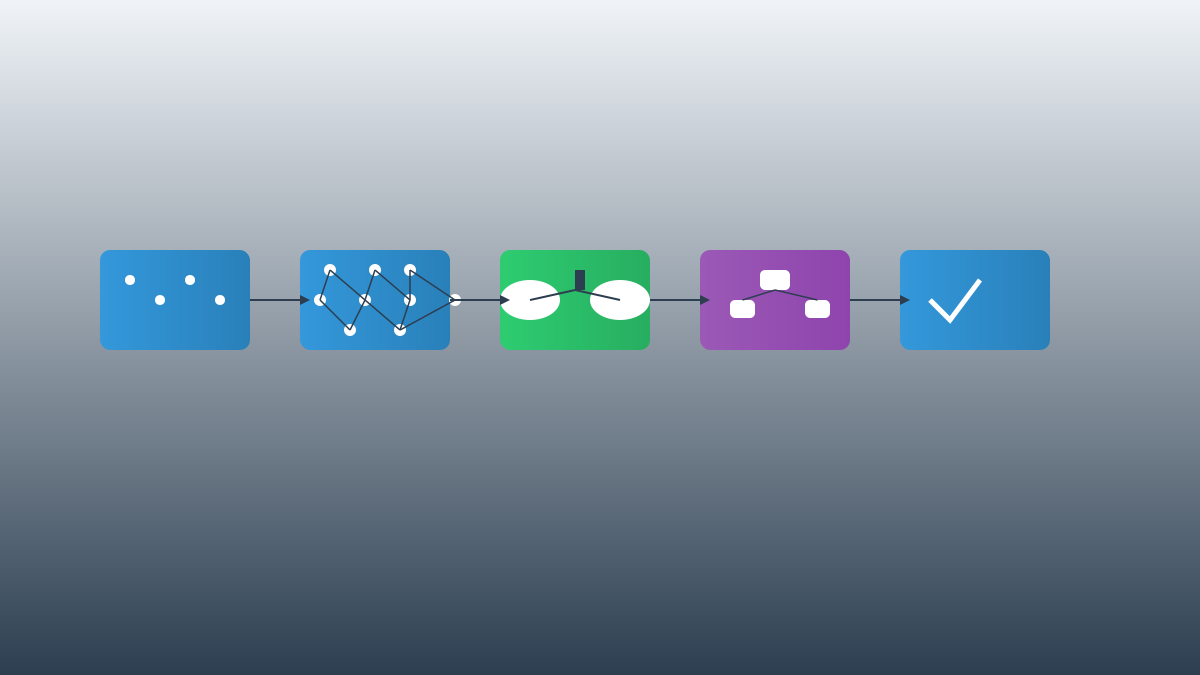
The pipeline adopts a modular design, with core layers including: data layer (loading, cleaning, feature engineering), feature engineering layer (standardization, encoding, feature selection), model layer (integrated classification models and neural networks), and evaluation layer (including modules for conventional metrics, fairness evaluation, and interpretability analysis).

4

Section 04

Selection and Application of Classification Models

The project implements a comparison of multiple classic algorithms: logistic regression (baseline model with strong interpretability), random forest (ensemble of decision trees for handling non-linear relationships), and gradient boosting trees (capturing complex patterns). Through cross-validation and independent test set evaluation, it focuses on performance differences across different subpopulations.

5

Section 05

Exploration of Neural Network Models

It explores the application of Multi-Layer Perceptrons (MLP) to capture high-order interaction effects of features; uses Dropout, L2 regularization, and early stopping to prevent overfitting; and optimizes hyperparameters through methods like grid search. Neural networks have strong predictive performance, but there is a tension between their black-box nature and the transparency requirements of the judiciary.

6

Section 06

Interpretability Analysis: Making AI Decisions Transparent

It integrates multiple interpretability techniques: feature importance analysis (revealing key variables), SHAP values (calculating feature contributions using a game theory framework), LIME (local interpretable model-agnostic explanations for individual predictions), and visualization tools (such as partial dependence plots to intuitively display model behavior).

7

Section 07

Fairness Evaluation: Preventing Algorithmic Bias

It implements fairness evaluation components: group fairness metrics (comparing performance differences across subpopulations), equal opportunity (equal true positive rates and false positive rates across groups), demographic parity (positive prediction proportion consistent with group representation), and fairness constraint optimization (adjusting predictions during training or post-processing).

8

Section 08

Practical Insights and Future Directions

Practical suggestions: Ensure data quality and representativeness, continuously monitor model fairness metrics, and maintain human-machine collaboration. Future directions: Use causal inference and federated learning technologies to enhance privacy protection and bias elimination capabilities; the open-source implementation of the project provides a foundation for domain innovation.

