Zing Forum

Reading

Neural Memory Operating System: An Acceleration Scheme for Large Model Inference on Low-VRAM Devices

Exploring how to achieve efficient inference acceleration for large language models on VRAM-constrained hardware through memory prefetching and speculative decoding techniques.

大语言模型显存优化内存预取推测解码推理加速边缘计算LLM部署低资源推理
Published 2026-04-28 08:39Recent activity 2026-04-28 08:48Estimated read 6 min
Neural Memory Operating System: An Acceleration Scheme for Large Model Inference on Low-VRAM Devices
1

Section 01

[Overview] Neural Memory Operating System: Acceleration Scheme for Large Model Inference on Low-VRAM Devices

The Neural Memory Operating System project addresses the bottleneck of large model inference on low-VRAM devices by proposing an innovative solution using memory prefetching and speculative decoding techniques. Without modifying the model itself, it significantly improves inference performance through intelligent memory management and inference strategy optimization, avoiding the problem of sacrificing model quality associated with traditional methods (such as quantization and pruning).


2

Section 02

Background: VRAM Wall and Limitations of Traditional Solutions

Modern large language models have massive parameter sizes, requiring loading of large amounts of weights and activation values during inference. Insufficient VRAM leads to frequent data exchange between CPU memory and GPU VRAM, forming a performance bottleneck. Traditional solutions like model quantization, pruning, and distillation usually come at the cost of model quality, whereas this project chooses to break through limitations via software-level optimization.

3

Section 03

Core Technology 1: Memory Prefetching Mechanism

Leveraging the predictability of LLM inference, the system monitors the generation state through lightweight prediction models or heuristic rules, and preloads model layers, attention heads, or KV cache blocks that may be needed later from CPU memory/SSD to GPU VRAM. The effectiveness of this strategy depends on the balance between prediction accuracy and prefetching timing, requiring fine-tuning and adaptive algorithm support.

4

Section 04

Core Technology 2: Collaborative Optimization of Speculative Decoding and Prefetching

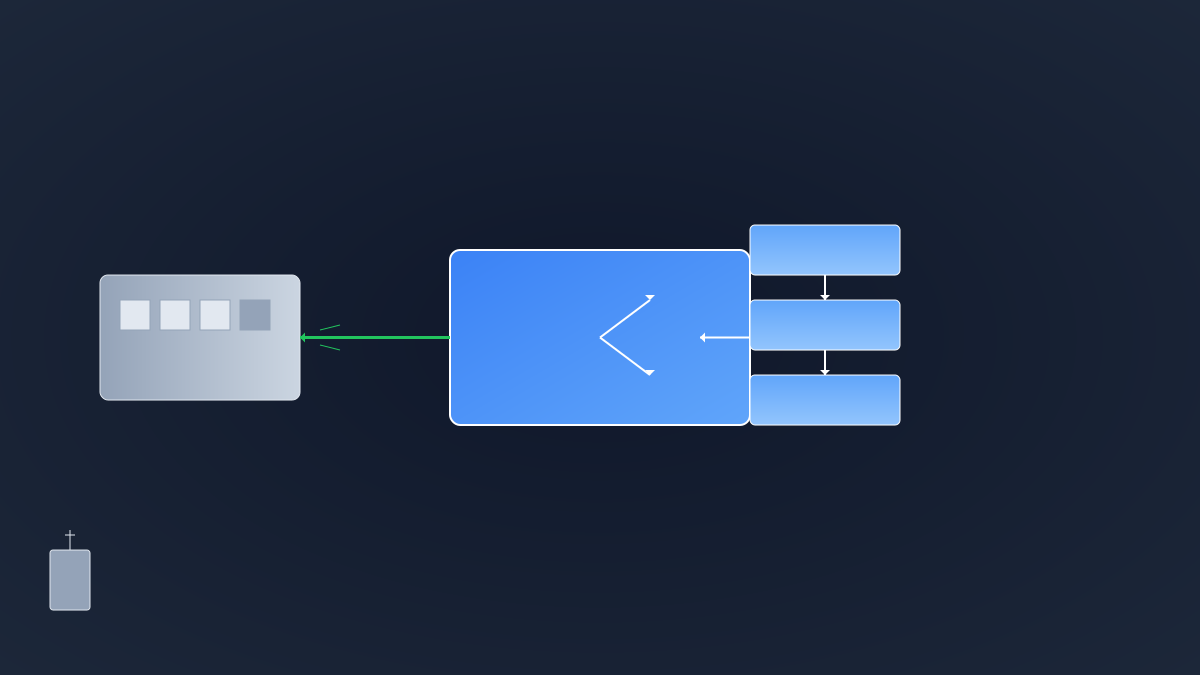
Speculative decoding allows generating multiple candidate tokens per step, which are confirmed or rejected via a single verification. The project combines this with memory prefetching: a lightweight draft model resides in VRAM to quickly generate candidates, while the main model performs parallel verification; different layers of the main model are dynamically loaded according to prefetching strategies, enabling support for larger main models in limited VRAM.

5

Section 05

System Architecture and Implementation Details

This system is an intermediate layer between the operating system and the LLM inference framework, responsible for VRAM allocation and recycling, data transmission scheduling, and coordination between draft generation and main model verification. Technical implementations include asynchronous data transmission (maximizing hardware utilization), paged/block memory management (fine-grained scheduling), and dynamic batching (improving throughput).

6

Section 06

Performance and Applicable Scenarios

In low-VRAM environments, the system can increase effective throughput several times. It is suitable for VRAM-scarce scenarios such as edge device deployment, personal workstation inference, and multi-tenant environments, where memory efficiency optimization is of higher value.

7

Section 07

Technical Limitations and Future Directions

Limitations: Prefetching relies on workload predictability, and accuracy decreases in dynamic/random tasks; the speedup ratio of speculative decoding is affected by the consistency between the draft model and the main model. Future directions: More intelligent prediction models, adaptive prefetching strategies, hardware co-design, and combining new memory technologies (CXL, HBM) to expand optimization space.

8

Section 08

Conclusion: The Value of Software Innovation

The Neural Memory Operating System is an important exploration direction for LLM inference optimization, proving that software-level innovation can significantly improve performance. It provides a reference implementation worthy of in-depth research for developers and researchers deploying large models in resource-constrained environments.

