Zing Forum

Reading

GenZ's GenAI: One-stop Generative AI Engineering Learning Resource Library — Full-Link Practice from LangChain to MCP

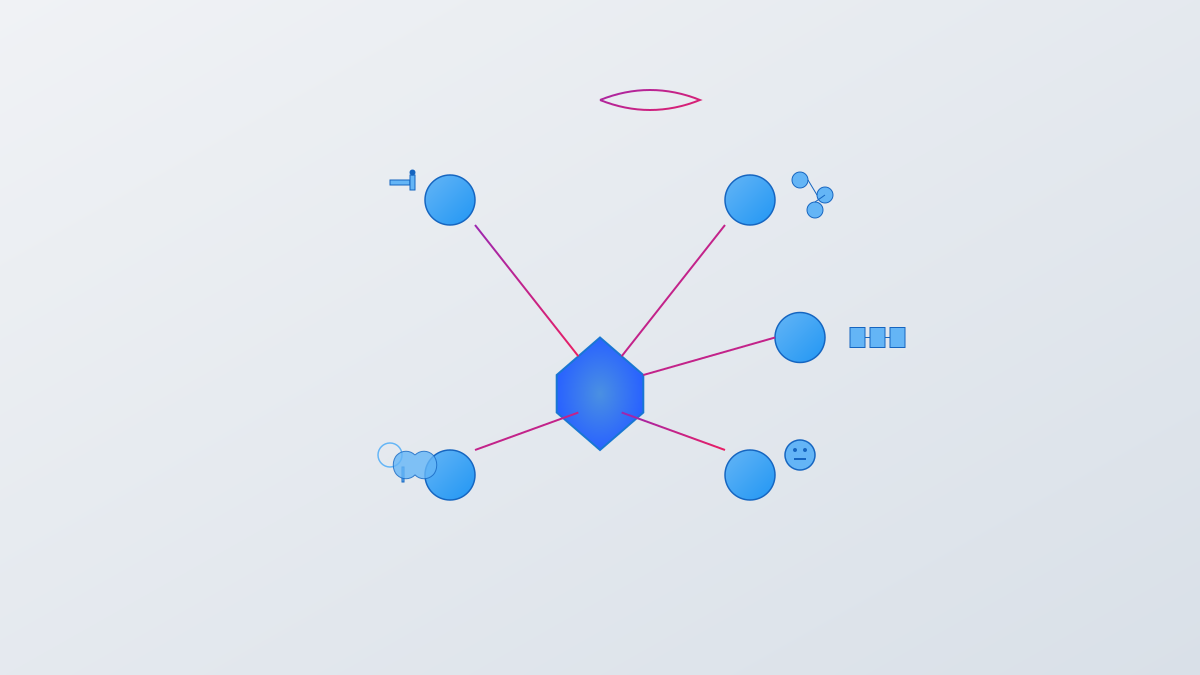
A complete generative AI engineering practice repository covering LangChain, LangGraph, LangSmith, and MCP, systematically encompassing core technologies for modern AI application development such as RAG, AI Agent, workflow orchestration, and observability.

LangChainLangGraphLangSmithMCP生成式AIRAGAI Agent工作流编排大语言模型开源项目
Published 2026-05-13 00:49Recent activity 2026-05-13 01:10Estimated read 7 min
GenZ's GenAI: One-stop Generative AI Engineering Learning Resource Library — Full-Link Practice from LangChain to MCP
1

Section 01

GenZ's GenAI: Guide to the One-stop Generative AI Engineering Learning Resource Library

GenZ's GenAI is a generative AI engineering practice repository built by developer Prathamesh, using Jupyter Notebooks as the carrier. It fully covers four core frameworks: LangChain, LangGraph, LangSmith, and MCP, systematically explaining core technologies for modern AI application development such as RAG, AI Agent, workflow orchestration, and observability. It addresses the fragmentation issue of learning resources on the market and provides a full-link learning path from basic model calling to production-level AI application deployment.


2

Section 02

Demand for Generative AI Engineering and Current State of Resources

With the rapid development of Large Language Model (LLM) technology, the engineering capabilities of generative AI applications have become a core competency for developers. However, learning resources on the market are often highly fragmented: some only cover Prompt Engineering, some only discuss RAG (Retrieval-Augmented Generation), and others only show the basics of Agent construction. For developers who want to systematically master the full-link skills from basic model calling to production-level AI application deployment, a structurally complete, hands-on learning resource library is particularly valuable.

3

Section 03

Positioning and Overall Architecture of GenZ's GenAI

GenZ's GenAI is not a single-function AI application but a systematic learning and experimentation platform. It is organized modularly, with each core framework as an independent chapter, and each chapter is subdivided by topic. Learners can choose entry points as needed or progress sequentially. Its knowledge graph path corresponds to the complete lifecycle of a generative AI application from prototype to production: starting from basic LLM calling and Prompt templates, gradually deepening into chain calling, structured output, document loading and chunking, vector storage and retrieval, RAG system construction, then moving to Agent design, tool calling, workflow orchestration, and finally extending to observability monitoring and external system integration.

4

Section 04

LangChain Module: Full Process from Model Calling to RAG

LangChain is the cornerstone of the repository, covering rich content:

  • Model Integration: Explains the differences between LLM and Chat Model, integrates multiple model providers such as OpenAI and Anthropic, and demonstrates model-agnostic development methods;
  • Prompt Engineering: Covers template technologies like PromptTemplate and ChatPromptTemplate;
  • Chains and LCEL: Systematically demonstrates construction methods such as Sequential Chain and the use of Runnable components;
  • Document Processing and RAG: Fully presents the RAG pipeline (loaders, text chunking, vector storage), involving advanced topics like hybrid retrieval, re-ranking, and Ragas evaluation.
5

Section 05

Detailed Explanation of LangGraph, LangSmith, and MCP Modules

  • LangGraph: Builds complex stateful AI workflows based on nodes, edges, and shared states, explaining mechanisms such as sequential/parallel/conditional/iterative workflows, state management, memory and persistence, and Human-in-the-Loop (HITL) collaboration;
  • LangSmith: Focuses on AI application observability, explaining LLM call tracing, debugging, monitoring, output evaluation, and team Prompt management;
  • MCP: Demonstrates connecting AI applications to external systems via standardized tool calling protocols, enabling tool orchestration and communication.
6

Section 06

Practical Value and Target Audience

Practical Value: Highly systematic; each topic is accompanied by a runnable Jupyter Notebook, allowing learners to directly reproduce and modify code, making the hands-on-first learning approach more effective; Target Audience: Traditional developers transitioning to AI engineers, AI enthusiasts with LLM basics but lacking engineering experience, startup teams needing to quickly build prototypes, and technical managers hoping to organize their tech stack.

7

Section 07

Summary and Learning Recommendations

Generative AI engineering is evolving toward systematization and engineering: LangChain provides basic abstraction and chain orchestration, LangGraph extends to stateful graph workflows, LangSmith complements observability, and MCP connects external integration. GenZ's GenAI integrates these four dimensions and provides a complete learning path. It is recommended that developers who take the construction of generative AI engineering capabilities seriously bookmark and deeply study this repository.

