Zing Forum

Reading

GENIE: Seismic Phase Association and Spatiotemporal Location Technology Based on Graph Neural Networks

GENIE is an open-source project that uses Graph Neural Networks (GNN) to achieve automatic seismic phase association and spatiotemporal source location, bringing new deep learning ideas to the field of seismic monitoring.

地震监测图神经网络震相关联震源定位机器学习地球物理深度学习
Published 2026-05-12 19:26Recent activity 2026-05-12 19:28Estimated read 6 min
GENIE: Seismic Phase Association and Spatiotemporal Location Technology Based on Graph Neural Networks
1

Section 01

GENIE Project Introduction: Revolutionizing Seismic Monitoring with Graph Neural Networks

GENIE is an open-source project that uses Graph Neural Networks (GNN) to achieve automatic seismic phase association and spatiotemporal source location, bringing new deep learning ideas to the field of seismic monitoring. It addresses the problems of limited efficiency and high misjudgment rate of traditional seismic monitoring methods (relying on manual analysis or rule-based algorithms) when processing massive data, innovatively modeling seismic phase association and location as a graph structure learning problem. By joint modeling, it improves overall accuracy, and its open-source release provides valuable technical resources for the seismology community.


2

Section 02

Project Background and Core Challenges of Seismic Monitoring

Seismic monitoring is the foundation of disaster prevention and mitigation. Its core tasks include seismic phase association (linking seismic phases from different stations to the same event) and source location (inferring the spatiotemporal coordinates of the source). Traditional methods have limitations: seismic phase association relies on rule-based systems such as time windows/clustering, which are prone to misjudgment when handling dense sequences or noise; source location often uses techniques like Geiger/NonLinLoc/HypoDD, which have strong dependence on initial models and high computational costs.

3

Section 03

Analysis of GENIE's GNN Technical Architecture

GENIE introduces graph neural networks into the seismic monitoring process:

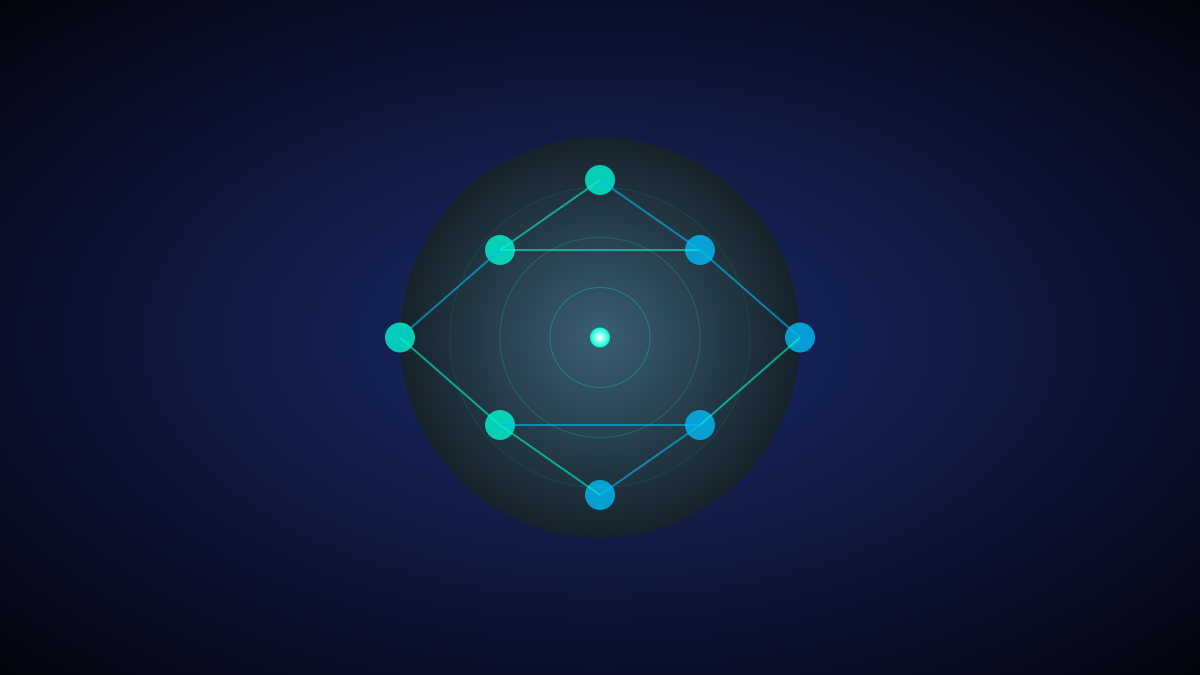
  1. Graph Structure Representation: Seismic phase observations are nodes, edges capture spatiotemporal relationships, and seismic phases from the same event form a specific connection pattern;
  2. Seismic Phase Association Mechanism: GNN learns the interaction of node features, combining P/S wave arrival times, station distribution, and velocity model constraints to achieve robust grouping and reduce reliance on manual rules;
  3. Spatiotemporal Location Capability: Incorporate location into the graph learning framework, infer the source's longitude, latitude, depth, and origin time through node feature aggregation and propagation, where association and location tasks mutually promote each other.
4

Section 04

GENIE's Implementation Workflow and Usage Steps

GENIE provides full-process code implementation:

  1. Environment Configuration: Install dependencies and initialize station, region, and velocity model files;
  2. Travel Time Calculation and Training: Support 1D/3D velocity models, calculate travel time grids, then train the GNN model to learn the mapping between seismic phase features and source parameters;
  3. Continuous Data Processing: Process continuous seismic phase picking data, automatically identify events and output parameters, and support integration with NonLinLoc/HypoDD (GENIE initial location + traditional method refinement).
5

Section 05

GraphDD Extension: Improving Location Accuracy of Dense Seismic Swarms

GENIE plans the Graph Double Difference (GraphDD) module, combining graph neural networks with double-difference location technology. Double-difference location uses relative arrival time differences between event pairs to eliminate common path model errors, which is a common method for studying the fine structure of seismic sequences. GraphDD is expected to further improve the location accuracy of dense seismic swarms.

6

Section 06

Application Prospects and Academic Value of GENIE

GENIE represents the cutting-edge application of AI in geophysics:

  • Addressing the efficiency and accuracy challenges of traditional methods brought by the densification of global monitoring networks, deep learning tools will become a standard part of future monitoring systems;
  • Its open-source release provides technical resources for the community, promoting the popularization of automatic monitoring technology. With the release of pre-trained models and sample data, it is expected to become one of the standard tools in the seismology community.

