Zing Forum

Reading

GenAI Video Summarizer: A YouTube Video Intelligent Summarization Tool Based on Local LLM

genai-video-summarizer is an open-source Python command-line tool that automatically extracts subtitles from YouTube videos and uses local large language models (LLMs) to generate concise summaries. It helps users efficiently capture the core content of long videos while protecting privacy without relying on cloud APIs.

视频摘要YouTube字幕提取本地LLMOllama内容自动化隐私保护开源工具
Published 2026-05-15 10:24Recent activity 2026-05-15 10:30Estimated read 5 min
GenAI Video Summarizer: A YouTube Video Intelligent Summarization Tool Based on Local LLM
1

Section 01

GenAI Video Summarizer Introduction: A YouTube Video Intelligent Summarization Tool Based on Local LLM

This article introduces the open-source Python command-line tool genai-video-summarizer, which automatically extracts subtitles from YouTube videos and uses local large language models to generate concise summaries. It helps users efficiently capture the core content of long videos without relying on cloud APIs, balancing privacy protection and cost control.


2

Section 02

The Dilemma of Video Content Overload and User Pain Points

Currently, videos have become the main information carrier, but long videos are time-consuming, requiring users to spend a lot of time to get core information. Traditional methods (linear viewing, speed-up, chapter markers) cannot solve the fundamental problems: how to quickly judge the value of a video and extract key points from multiple videos? Knowledge workers such as researchers and students have limited time, so there is an urgent need for automatic video summarization tools.

3

Section 03

Project Introduction: An Open-Source Tool with Localization Priority

genai-video-summarizer is developed and maintained by jayaramvs1243, an open-source Python CLI application. Core features: extract YouTube subtitles + generate summaries via local LLM, running entirely locally. It integrates with the Ollama framework and supports open-source models like Llama and Mistral, making it suitable for sensitive content or intranet environments.

4

Section 04

Technical Architecture and Workflow

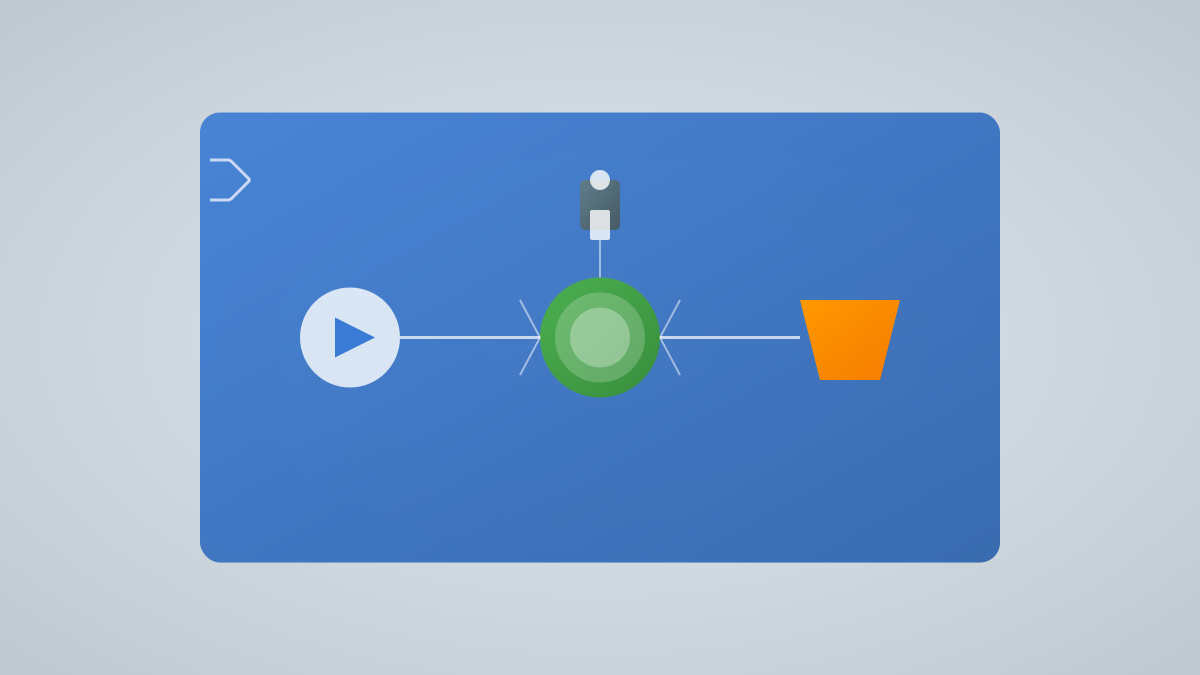
The tool has two stages: 1. Subtitle extraction: Obtain auto-generated subtitles via YouTube API and convert them to plain text; 2. Summary generation: Use local LLM for semantic understanding to generate coherent summaries (better than traditional extractive methods). Ollama supports model switching, balancing quality and speed (large models are accurate, lightweight models are fast).

5

Section 05

Dual Advantages of Privacy and Cost

Compared to cloud API services, the local solution eliminates the risk of data leakage (subtitles never leave the device) and has no API call fees (only hardware investment with low marginal cost). It is suitable for enterprise intranets, academic research, and privacy-sensitive users, proving that open-source local models can replace commercial APIs.

6

Section 06

Diverse Application Scenarios and Practical Value

It has a wide range of application scenarios: students quickly generate course outlines; content creators conduct competitor analysis/trend tracking; researchers process academic conference recordings; enterprise training departments generate content indexes. For cross-language scenarios, it can be combined with translation APIs for filtering.

7

Section 07

Limitations and Improvement Directions

Current limitations: High threshold for CLI use (requires Python/command line knowledge); relies on YouTube auto-generated subtitles (effect is affected when there are no subtitles or their quality is poor); fixed summary strategy (lack of customization); no use of visual information. Improvement directions: Develop a GUI; integrate speech recognition; support configuration of summary length/focus; integrate multimodal understanding.

8

Section 08

Conclusion: A Model of Open-Source AI Solving Practical Problems

genai-video-summarizer is a case of individual developers using open-source AI to solve practical problems, combining LLM capabilities with user needs. In the era of video explosion, such tools are becoming increasingly important and suitable for technical users who pursue efficiency and privacy to try.

