Zing Forum

Reading

Building an End-to-End Loan Approval Prediction System: A Complete Practice from Data Preprocessing to Flask Deployment

This article details how to build a complete loan approval prediction system using machine learning, covering the entire process from data preprocessing, random forest model training, to the deployment of a real-time prediction web application based on Flask.

机器学习随机森林Flask贷款审批金融AI数据预处理Web应用Python
Published 2026-06-14 16:46Recent activity 2026-06-14 16:48Estimated read 5 min
Building an End-to-End Loan Approval Prediction System: A Complete Practice from Data Preprocessing to Flask Deployment
1

Section 01

Introduction: Complete Practice of End-to-End Loan Approval Prediction System

The end-to-end loan approval prediction system introduced in this article covers the entire process of data preprocessing, random forest model training, and Flask deployment. The original author is hassan-ali786, and the source is the GitHub project loan-approval-system (link: https://github.com/hassan-ali786/loan-approval-system), published on 2026-06-14. This project provides full-process reference value for developers of financial AI applications.


2

Section 02

Project Background and Significance

Traditional manual loan approval processes are time-consuming and prone to subjective factors. Machine learning automation systems can improve efficiency and reduce risks. This project demonstrates a complete solution from data cleaning and processing to model training optimization and web application deployment, which has important reference value for developers who are new to financial AI applications.

3

Section 03

Core Functions and Technology Stack

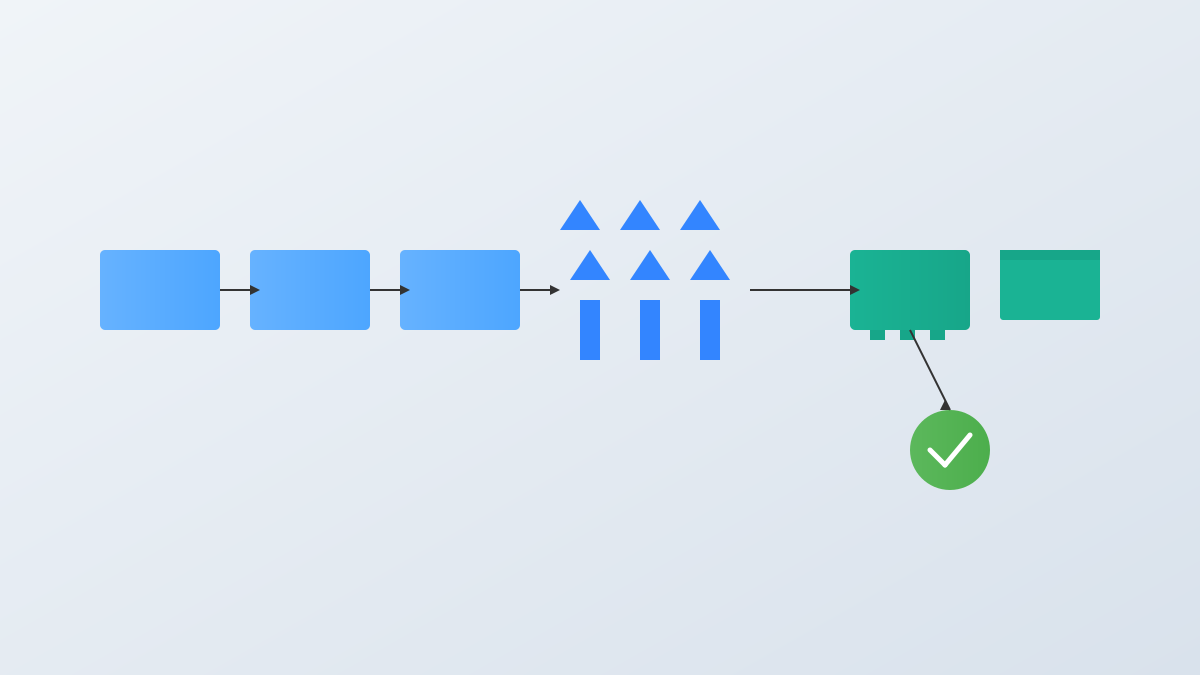
The system includes three core modules:

  1. Data Preprocessing Module: Processes features such as applicants' income, credit records, and educational background, including cleaning, missing value handling, and categorical feature encoding;
  2. Machine Learning Model: Uses the random forest algorithm, which has advantages like anti-overfitting and strong interpretability, making it suitable for financial risk control scenarios;
  3. Web Application Interface: Builds a responsive interface based on Flask, supports real-time prediction, and lowers the threshold for non-technical users to use.
4

Section 04

Technical Implementation Details

Data Preprocessing Phase: Perform logarithmic transformation on income to handle skewed distribution; credit records are binary features; educational background uses one-hot/labelling encoding; derive debt-to-income ratio features; Model Training: Optimize random forest hyperparameters (number of trees, maximum depth, etc.) through cross-validation and grid search; Flask Deployment: Follow the MVC pattern, front-end responsive design, the interface receives JSON input and returns prediction results.

5

Section 05

Application Scenarios and Expansion Directions

Application Scenarios: Assisting small and medium-sized financial institutions in application screening, fintech company API services, academic research and teaching cases; Expansion Directions: Introduce XGBoost/LightGBM comparison experiments, add SHAP value interpretation functions, integrate multiple data sources, and implement an A/B testing framework.

6

Section 06

Practical Key Points and Notes

Deployment Notes:

  1. Data Privacy Compliance: Comply with GDPR, CCPA, and financial regulatory requirements;
  2. Model Fairness: Avoid discriminatory biases against specific groups;
  3. Model Monitoring and Update: Regularly evaluate performance and retrain to adapt to environmental changes.
7

Section 07

Project Summary

This project provides a clear and complete example of machine learning application development. The implementation ideas for each link are clear, and the modular design is easy to expand and replace, making it a good starting point for developers of financial AI applications.

