Zing Forum

Reading

Flappy Bird Neural Network Demo: Training AI to Play the Game Using Genetic Algorithms

A Flappy Bird neural network demo project based on pure JavaScript and genetic algorithms, which visually demonstrates how AI learns game strategies from scratch, with all code integrated into a single HTML file.

神经网络遗传算法JavaScript神经进化AI教育可视化游戏AI
Published 2026-05-01 11:15Recent activity 2026-05-01 11:20Estimated read 4 min
Flappy Bird Neural Network Demo: Training AI to Play the Game Using Genetic Algorithms
1

Section 01

Flappy Bird Neural Network Demo: Core Overview

This open-source educational demo uses native JavaScript, neural networks, and genetic algorithms to train AI to play Flappy Bird. Packaged in a single HTML file (no external dependencies), it visualizes the AI's learning process to help beginners understand abstract AI concepts intuitively.


2

Section 02

Background: The Need for Intuitive AI Learning

Neural networks and genetic algorithms are core AI concepts but often hard for beginners to grasp due to abstract math and pseudocode. This project addresses this by visualizing the AI's evolution from random behavior to game mastery, lowering the understanding barrier.

3

Section 03

Neural Network Architecture for Game Control

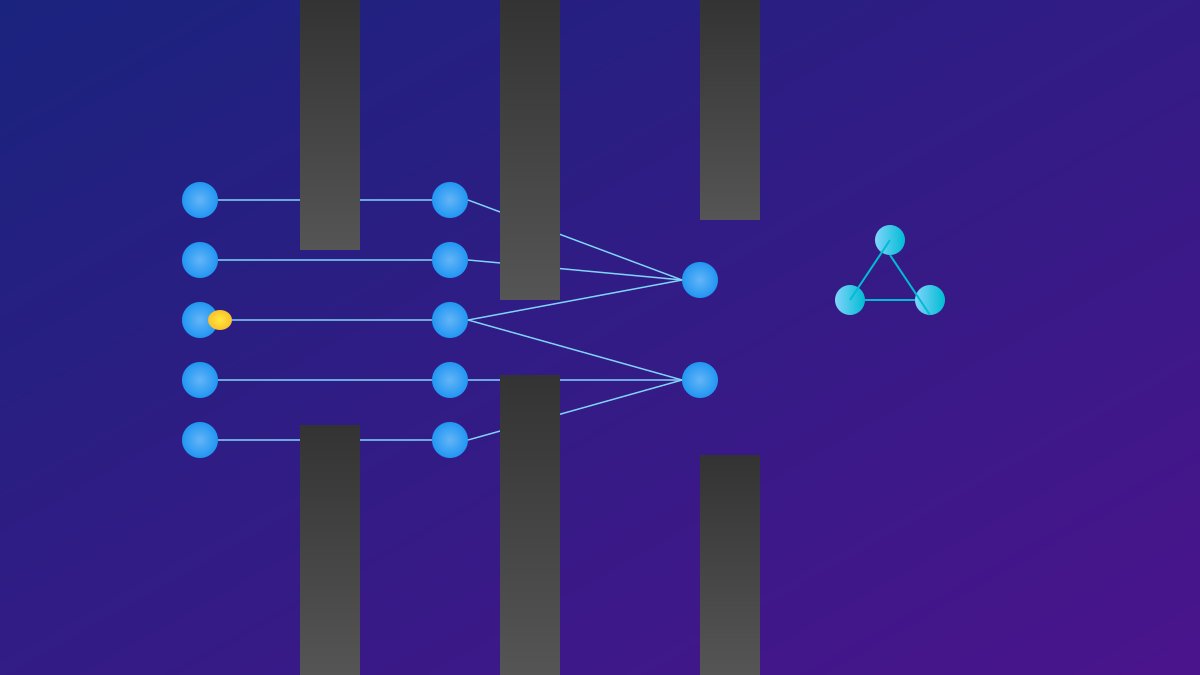
The AI is controlled by a simple neural network. It takes game state inputs (bird position, pipe distance, pipe heights) and outputs a jump decision. This end-to-end learning mimics biological reflexes without explicit game rule programming.

4

Section 04

Genetic Algorithm Optimization Process

Instead of backpropagation, the network's weights are evolved via genetic algorithms: 1. Initialize random weight populations; 2. Evaluate fitness (survival time/score);3. Select top performers as parents;4. Cross weights and add random mutations to generate new generations;5. Iterate to improve performance—mimicking natural selection.

5

Section 05

Visualization: Observing AI Evolution in Real-Time

Key visualizations include: population performance (best vs worst per generation), evolution trajectory (performance over generations), decision visualization (how inputs lead to jump decisions), and gene diversity (mutation's role in new behaviors). These help understand concepts like convergence and diversity maintenance.

6

Section 06

Educational Value & Technical Implementation Highlights

Educational Advantages: Zero threshold (single HTML file, no setup), readable native JS code (transparent implementation), instant feedback (game success/failure). Technical Highlights: Canvas rendering for smooth gameplay, vector operations for neural network forward propagation, requestAnimationFrame for async loops, and state management for game/AI lifecycle.

7

Section 07

Expansion Possibilities for Further Experiments

This project can be extended: modify network topology to test effects; adjust GA parameters to study selection pressure; replace game environments to test generalization; add multi-agent competition for co-evolution.

8

Section 08

Conclusion: A Valuable AI Education Tool

This demo turns complex NN and GA concepts into intuitive visual experiences. Observing AI learn Flappy Bird from scratch builds learners' intuitive understanding, making it an ideal starting point for studying neuroevolution. Its concise implementation also aids in grasping core algorithms.

