Zing Forum

Reading

Exo: Building a Home AI Cluster with Daily Devices, Democratizing AI Computing

This article introduces how the Exo project enables users to build a distributed AI computing cluster using idle phones, tablets, and computers at home, achieving low-cost, scalable local large model inference.

distributed computingAI clusteredge computinglocal LLMmodel parallelismprivacydemocratization
Published 2026-04-27 18:44Recent activity 2026-04-27 18:53Estimated read 5 min
Exo: Building a Home AI Cluster with Daily Devices, Democratizing AI Computing
1

Section 01

Exo Project Introduction: Building a Home AI Cluster with Daily Devices, Democratizing AI Computing

The Exo project aims to enable users to build a distributed AI computing cluster using idle devices at home such as phones, tablets, and computers, achieving low-cost, scalable local large model inference and promoting the democratization of AI computing. This article will discuss aspects including background, core concepts, technical architecture, application value, limitations and challenges, and future outlook.


2

Section 02

Background: Pain Points of Large Model Centralization and Challenges of Local Deployment

The rise of large language models (such as GPT-4, Claude) has brought intelligent experiences, but centralized computing resources lead to privacy risks, network dependency, and high cost barriers. Local deployment of open-source models (like Llama, Mistral) is an alternative, but high-end graphics cards are expensive and memory limits model size. The Exo project proposes a solution of building a cluster by combining existing devices.

3

Section 03

Core Concepts of the Exo Project: Building a Distributed Computing Pool with Existing Devices

The design philosophy of Exo is 'Use the devices you already have to do things you didn't expect'. It integrates heterogeneous idle devices like phones, tablets, and laptops into a unified computing pool, drawing on the idea of multi-machine distributed training in data centers and simplifying it for home network environments, making large model inference that a single device cannot handle possible.

4

Section 04

Technical Architecture: Heterogeneous Device Networking and Model Parallelism Optimization

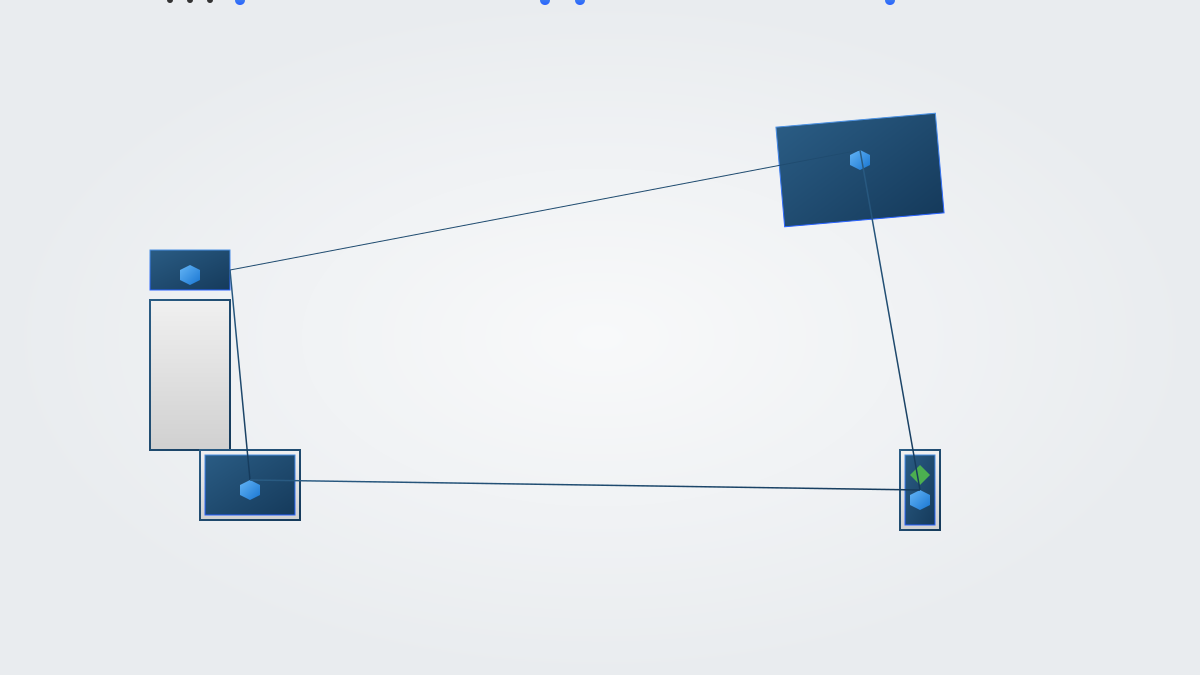
  1. Device Discovery and Networking: Automatically discover compatible devices in the local area network, establish peer-to-peer connections, and shield hardware differences through a unified abstraction layer;
  2. Model Parallelism Strategy: Adopt model layer distribution (e.g., the front and rear parts of a Transformer belong to different devices) or tensor parallelism (weight matrix splitting and aggregation;
  3. Pipeline and Communication Optimization: Pipeline parallelism hides communication delays, and quantization technologies (INT8/INT4) reduce transmission volume.
5

Section 05

Application Scenarios and Value: Privacy, Offline Availability, Cost, and Scalability

  • Privacy First: Local computing does not require uploading sensitive data;
  • Offline Availability: Does not rely on the Internet, suitable for scenarios with unstable networks;
  • Cost-Effective: Uses existing devices without the need to purchase high-end graphics cards;
  • Scalability: Computing power grows linearly with the number of devices, extending the lifespan of old devices.
6

Section 06

Limitations and Challenges: Optimization Problems of Home Networks and Heterogeneous Devices

  • Network Bandwidth Limitation: Home network bandwidth is far lower than that of data centers, affecting parallel efficiency;
  • Load Imbalance: Differences in the capabilities of heterogeneous devices lead to resource waste, requiring dynamic scheduling;
  • Mobile Device Limitations: Battery and heat dissipation affect the feasibility of continuous high-load operation.
7

Section 07

Future Outlook: A Feasible Path to Democratizing AI Computing

With the growth of edge device computing power (such as Apple Silicon, Qualcomm Snapdragon NPU) and model efficiency optimization (distillation, pruning, quantization), the feasibility of home clusters will improve. In the long run, it can be combined with federated learning to achieve cross-home collaborative training, or integrated with decentralized networks to form a P2P computing market, lowering the threshold for ordinary users to access large models.

