Zing Forum

Reading

End-to-End Customer Churn Analysis: A Complete Data Science Practice with Excel, SQL, Python, and Power BI

This article introduces an end-to-end customer retention and churn analysis project, demonstrating how to integrate Excel, SQL, Python machine learning, and Power BI to build a complete data analysis workflow

客户流失数据科学机器学习Power BISQLPython客户留存预测模型商业智能数据分析
Published 2026-06-11 15:16Recent activity 2026-06-11 15:24Estimated read 5 min
End-to-End Customer Churn Analysis: A Complete Data Science Practice with Excel, SQL, Python, and Power BI
1

Section 01

Introduction: Core Overview of the End-to-End Customer Churn Analysis Project

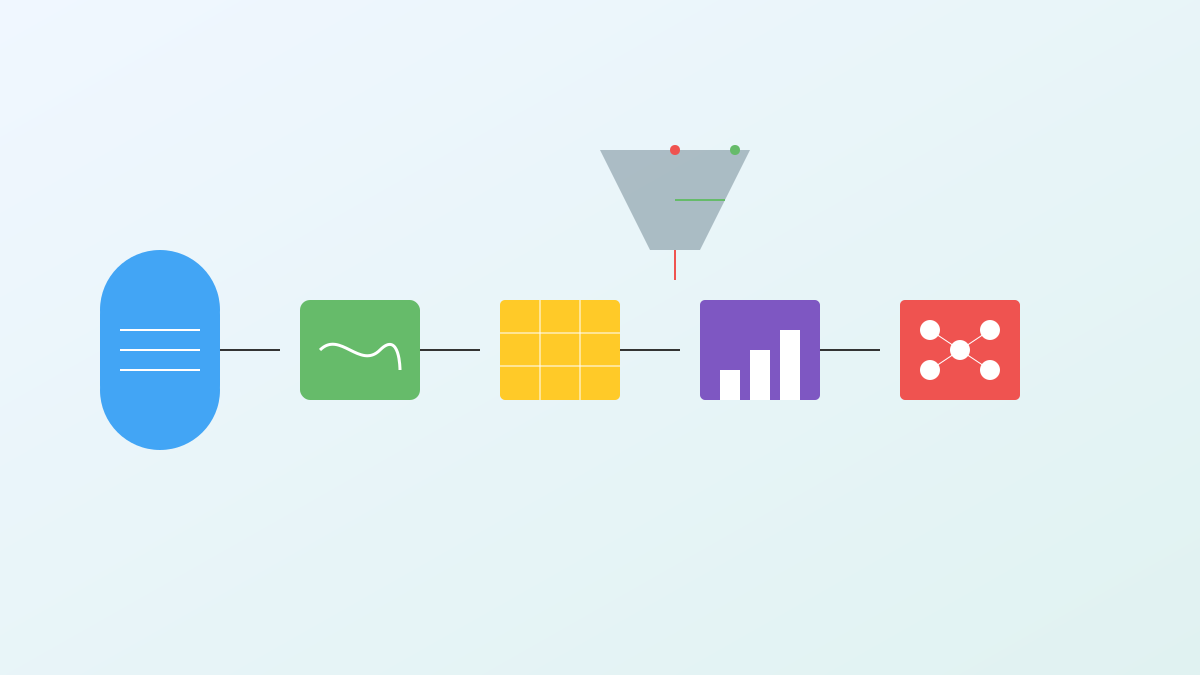
The end-to-end customer churn analysis project introduced in this article integrates Excel, SQL, Python machine learning, and Power BI tools, covering the complete workflow from data processing to visualization. The project aims to predict customer churn risk and provide a basis for business interventions, which is of reference value for data science learners to understand real-world work scenarios.


2

Section 02

Business Background: The Importance of Customer Churn Issues

Customer churn is a core business issue across industries; the cost of acquiring new customers is 5-10 times that of retaining existing ones. Predicting churn and intervening in advance is a key task for enterprise data science teams. This project demonstrates a typical workflow of multi-tool collaboration, reflecting data science practices in real enterprise environments.

3

Section 03

Data Processing and SQL Application

Customer churn data comes from multiple data sources such as CRM and transaction records, which need to be cleaned and integrated. Excel is used for preliminary exploration and data quality checks; SQL is used for data extraction, table joining, calculating aggregate metrics (e.g., average consumption amount, recent transaction time), and creating feature views for modeling.

4

Section 04

Python Machine Learning Modeling Practice

Customer churn prediction is a binary classification problem; common algorithms include logistic regression, random forests, gradient boosting trees, etc. The modeling process includes data splitting, feature scaling, training, tuning, and cross-validation. Evaluation metrics focus on accuracy, precision, recall, F1 score, and ROC-AUC, among which recall is particularly important for identifying potential churn customers.

5

Section 05

Power BI Visualization Report

Power BI is used to create interactive dashboards to help decision-makers quickly understand insights. Common modules include churn rate trends, high-risk customer lists, key driver analysis, etc., which support connecting multiple data sources and facilitate collaboration and sharing.

6

Section 06

Churn Analysis Dimensions and Business Actions

Churn analysis needs to focus on behavioral (login frequency, usage duration, etc.), transactional (average order amount, payment delay, etc.), demographic, and service (age, package type, etc.) dimensions. The model needs to be interpretable (feature importance, SHAP values, etc.), and enterprises can formulate layered retention strategies based on this: exclusive resources for high-value customers, discounts for price-sensitive customers, and feature upgrades for customers dissatisfied with products.

7

Section 07

Project Limitations and Improvement Directions

Currently, this project mainly demonstrates the structure and technology stack planning, and specific implementation details need to be improved. In the future, we can supplement the Jupyter Notebook analysis workflow, complete SQL scripts, Python model code, Power BI design files, as well as project documentation and result interpretation.

