Zing Forum

Reading

EduGaze: A Privacy-First AI Classroom Attention Monitoring System

EduGaze is an open-source online education attention monitoring tool that uses WebGazer.js for browser-local eye-tracking, analyzes students' focus in real time, provides teachers with insights into classroom engagement, and ensures students' privacy data never leaves their local devices.

在线教育注意力监测眼动追踪隐私保护WebGazer教育技术边缘计算Chrome扩展
Published 2026-05-26 01:15Recent activity 2026-05-26 01:24Estimated read 7 min
EduGaze: A Privacy-First AI Classroom Attention Monitoring System
1

Section 01

EduGaze: A Privacy-First AI Classroom Attention Monitoring System (Introduction)

EduGaze is an open-source online education attention monitoring tool developed by snehadenny (released on GitHub on May 25, 2026). Its core features include browser-local eye-tracking using WebGazer.js, real-time analysis of students' focus, and providing teachers with insights into classroom engagement—all while ensuring students' privacy data never leaves their local devices throughout the process. The system is available as a Chrome extension and supports online meeting platforms like Google Meet, balancing functional practicality with users' data rights.


2

Section 02

Background: Attention Challenges and Privacy Needs in Online Education

After the pandemic accelerated the digital transformation of education, teachers in remote teaching find it difficult to intuitively perceive students' engagement status (e.g., when cameras/microphones are turned off). Studies show that due to factors like lack of physical constraints and home distractions, attention dispersion in online learning is more severe than in face-to-face classes. How to help teachers understand classroom engagement without violating privacy has become a key issue in educational technology—EduGaze is an open-source solution tailored to this need.

3

Section 03

Core Design and System Architecture

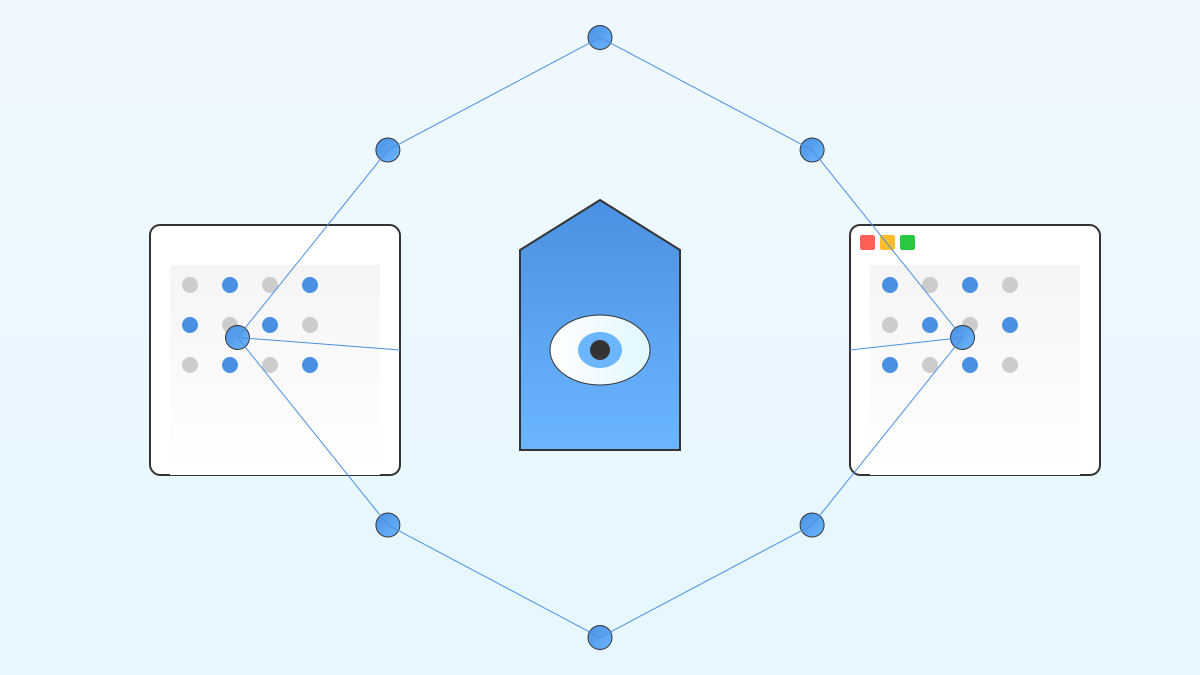
EduGaze follows the design philosophy of 'Edge Computing + Privacy Protection' and its system architecture consists of three core components:

  1. Student-side Chrome Extension: Captures local camera streams, performs eye-tracking via the WebGazer model (requires a 9-point calibration game to build a personalized model), and only sends 'focused/distracted' status events to the server;
  2. Node.js Server: Handles identity authentication, real-time status aggregation (WebSocket communication), calculation of the whole class's attention score, and historical data query;
  3. React Teacher Dashboard: Provides real-time attention trend charts, student status grids, and historical course analysis functions.
4

Section 04

In-depth Technical Analysis

  • WebGaze.js Eye-tracking Principle: Achieves screen gaze point estimation through facial feature detection (clmtrackr), pupil tracking, gaze mapping (calibration model), and continuous learning (optimization using user interaction data);
  • Attention Judgment Algorithm: Generates a weighted attention score by integrating gaze stability, duration, and state transition frequency, rather than a simple binary judgment;
  • Edge Computing Advantages: Privacy protection (sensitive data processed locally), real-time performance (low latency), cost-effectiveness (reduces server resources), and scalability (supports large-scale concurrency).
5

Section 05

Application Scenarios and Value

  • Teachers: Real-time intervention (adjust teaching strategies), post-class reflection (optimize course design), personalized support (identify students with weak attention);
  • Students: Self-awareness (view attention reports), fair evaluation (objective reference for engagement), privacy protection (data processed locally);
  • Educational Institutions: Teaching quality assessment (compare course/teacher effectiveness), resource optimization (identify inefficient periods), compliance (meet data protection requirements).
6

Section 06

Limitations and Ethical Considerations

EduGaze has the following limitations and ethical issues:

  • Informed Consent: Do students truly participate in monitoring voluntarily, or is there pressure to install it against their will?
  • Data Usage: Is attention data only used for teaching improvement, or could it be used for grading or punishment?
  • Technical Limitations: Factors like lighting, camera quality, and facial occlusion may lead to misjudgment;
  • Psychological Impact: Does continuous monitoring increase students' anxiety, which in turn affects learning outcomes? These issues require joint consideration and standardization by institutions, developers, and users.
7

Section 07

Deployment and Future Outlook

Deployment Steps:

  1. Build all packages: pnpm -r build
  2. Clear the port and start the server: lsof -ti :3000 | xargs kill -9 || true; pnpm --filter @webgazer/server start System Requirements: Node.js environment, Chrome browser, available camera, Google Meet (optional).

Outlook: EduGaze proves that technology-assisted teaching can balance privacy protection. In the future, we need to balance innovation and ethical responsibility. Its open-source nature provides a reference implementation for the integration of educational technology and privacy, which deserves attention from educators and developers.

