Zing Forum

Reading

ECG-XPLAIM: An Interpretable Deep Learning Tool for Arrhythmia Detection

A research team from institutions including the Medical School of the University of Athens (Greece) has open-sourced the ECG-XPLAIM project. This is a deep learning model specifically designed for multi-label classification of 12-lead ECG signals, integrating interpretable AI technology to allow doctors to intuitively understand the basis of AI's diagnoses.

ECG心电图深度学习可解释AI心律失常CNNGrad-CAM医疗AI多标签分类心血管医学
Published 2026-05-10 10:49Recent activity 2026-05-10 10:58Estimated read 5 min
ECG-XPLAIM: An Interpretable Deep Learning Tool for Arrhythmia Detection
1

Section 01

ECG-XPLAIM: An Interpretable Deep Learning Tool for Arrhythmia Detection (Introduction)

A research team from institutions including the Medical School of the University of Athens (Greece) has open-sourced the ECG-XPLAIM project. This is an interpretable deep learning model designed for 12-lead ECG signals, focusing on multi-label classification of arrhythmias. The tool integrates interpretable AI technologies (such as Grad-CAM) to address the "black box" problem of traditional deep learning models, enabling doctors to intuitively understand the basis of AI's diagnoses. It balances high performance and interpretability, providing support for cardiovascular disease diagnosis.


2

Section 02

Project Background and Clinical Significance

Cardiovascular disease is the leading cause of death globally, and early identification of arrhythmias is crucial. Traditional ECG detection relies on doctors' experience and is inefficient; while deep learning models have excellent performance, their "black box" nature raises concerns among doctors. ECG-XPLAIM bridges the gap between high performance and interpretability. It has been published in Frontiers in Cardiovascular Medicine, and the team includes medical and machine learning experts to ensure rigor.

3

Section 03

Technical Architecture: Inception-style 1D CNN

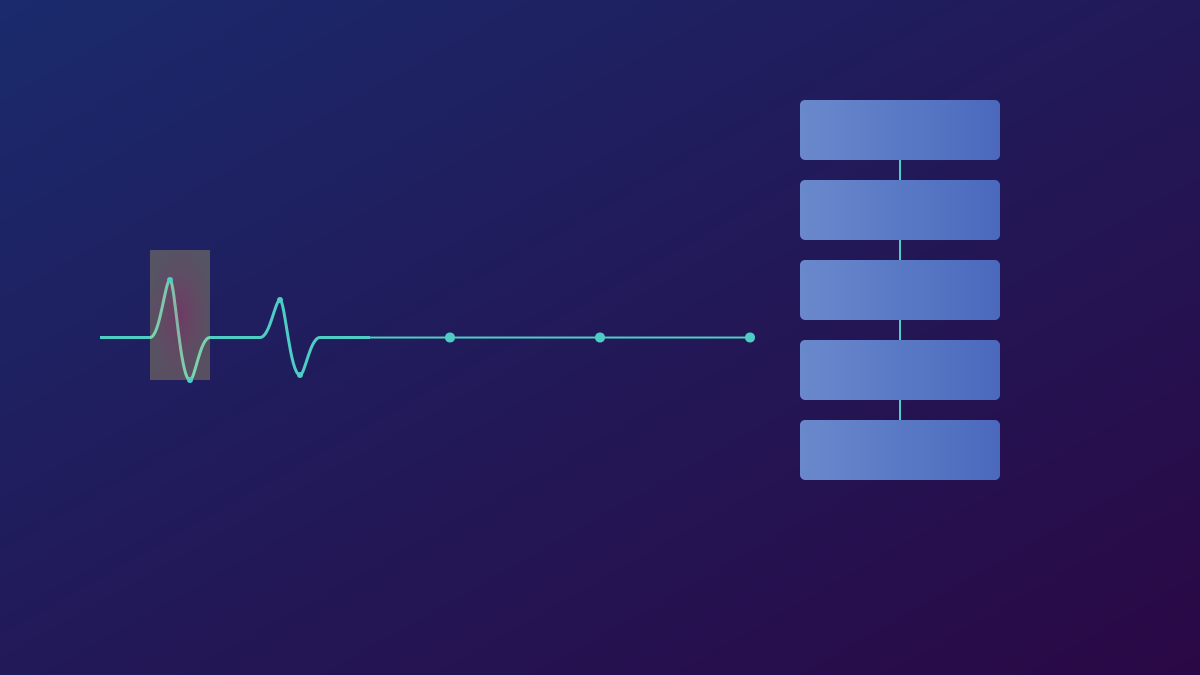
ECG-XPLAIM uses a customized Inception-style 1D CNN, optimized for time series analysis, which captures both local waveform features (such as P waves, QRS complexes) and global rhythm patterns (such as RR interval variability). The input is a standardized 12-lead signal (5000×12), and the output layer uses multi-label classification (Sigmoid activation), which aligns with clinical scenarios where multiple diseases coexist.

4

Section 04

Interpretability: Grad-CAM Visualization Mechanism

ECG-XPLAIM integrates Grad-CAM technology to generate heatmaps overlaid on ECG waveforms, showing the regions the model focuses on. It provides multiple visualization modes: quick_plot (simplified view), fine_plot (abnormalities marked with red boxes), gradcam_plot (12-lead heatmap), and gradcam_plot_single (single-lead focus), helping doctors verify the rationality of AI judgments and enabling human-machine collaboration.

5

Section 05

Dataset Support and Training Process

It supports two major public datasets: PTB-XL (over 20,000 records) and MIMIC-IV ECG. The training process is flexible, supporting batch training via Jupyter and CLI. It is based on the TensorFlow framework and depends on libraries like numpy. During training, checkpoints are automatically saved and logs are generated, and the test set is evaluated separately to ensure reproducibility.

6

Section 06

Pretrained Models and Evaluation Tools

Pretrained models are released on the Zenodo platform, which users can directly use. The evaluate.ipynb notebook is provided, covering model inference, performance comparison, visualization generation, and custom dataset adaptation, lowering the barrier to use.

7

Section 07

Application Prospects and Open-Source Value

The open-sourcing of ECG-XPLAIM provides a foundation for cardiovascular AI research, and its modular design allows for fine-tuning and adaptation. Its interpretability is suitable for medical regulatory scenarios, facilitating clinical implementation. It is valuable to medical AI practitioners, doctors, and researchers, and will play a greater role as telemedicine becomes more widespread.

