Zing Forum

Reading

EasyGAD: A One-stop Implementation Solution for Black-box Distillation of Large Language Models

EasyGAD is a large language model (LLM) distillation framework based on the GAD (Generative Adversarial Distillation) algorithm. Through adversarial training, it enables student models to learn the style and capabilities of teacher models using only the black-box outputs of the teacher models, without requiring access to internal parameters or logits.

大语言模型知识蒸馏黑盒蒸馏对抗训练GADEasyGAD模型压缩PPOLLM
Published 2026-06-11 14:13Recent activity 2026-06-11 14:20Estimated read 7 min
EasyGAD: A One-stop Implementation Solution for Black-box Distillation of Large Language Models
1

Section 01

EasyGAD: One-stop Black-box Distillation Framework for Large Language Models

Basic Information

  • Author/Maintainer: Dr-Corgi
  • Source: GitHub (https://github.com/Dr-Corgi/EasyGAD)
  • Release Time: 2026-06-11
  • Paper: Black-Box On-Policy Distillation of Large Language Models (arXiv:2511.10643)

Core Overview

EasyGAD is a GAD (Generative Adversarial Distillation)-based framework for LLM black-box distillation. It enables student models to learn the teacher's style and capabilities via only the teacher's text outputs (no internal parameters/logits access). Its key value lies in one-stop implementation—integrating all dependencies into a single repo for out-of-the-box use.


2

Section 02

Background: What is Black-box Distillation & Its Importance

Traditional knowledge distillation requires access to the teacher model's internal parameters or logits, which is impossible for closed commercial models like GPT-4 or Claude.

Black-box distillation solves this by training students using only the teacher's text outputs. This allows enterprises and researchers to leverage top commercial models' capabilities to train lightweight, cost-effective local models.

3

Section 03

Method: GAD Algorithm & EasyGAD Architecture

GAD Core Idea

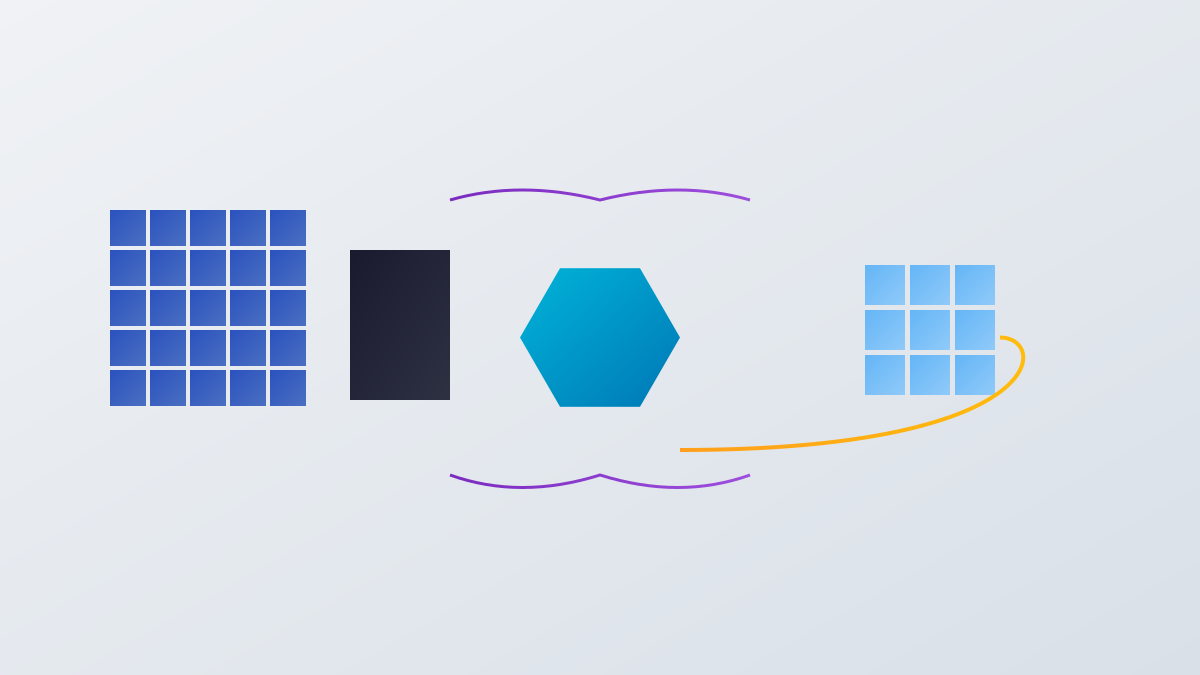
GAD (Generative Adversarial Distillation) introduces adversarial training into distillation:

  • Student model as Generator: generates responses.
  • Discriminator: distinguishes student vs teacher outputs.
  • Minimax game: student aims to mimic teacher, discriminator improves distinction.
  • Advantage: Discriminator acts as an on-policy reward model, providing stable adaptive feedback (better than SeqKD).

EasyGAD Architecture

  • VeRL Core Library: Includes unified trainer (ray_trainer.py) and algorithms (core_algos.py: PPO, SFT, GRPO).
  • Actor & Critic: Actor generates responses; Critic/Discriminator evaluates quality (co-optimized via adversarial training).
  • DeepScaler Tools: Global config, evaluation prompts, reward functions.

Training Stages

  1. SeqKD: Optional baseline (supervised fine-tuning on teacher data).
  2. Warmup: Required (init discriminator, SFT student on teacher data).
  3. GAD: Core stage (PPO + advantage estimation, discriminator provides rewards).
  4. Eval: No parameter updates (model assessment).
4

Section 04

Practical Usage of EasyGAD

Environment Preparation

  • Docker Support: Recommended image czwin32768/verl2:v0.2.0-vllm085 (pre-installed Python3.10.12, PyTorch2.6.0, vLLM0.8.5).
  • Data: LMSYS-Chat dataset, converted to Parquet via provided scripts (for efficient large-scale processing).

Training Options

  • One-click: run_gad_full.sh (Warmup + GAD core stages) or run_gad_direct.sh (start from pre-trained Actor/Critic).
  • Staged: run_seqkd.sh (baseline), run_warmup.sh (preheat), run_gad.sh (adversarial training).
5

Section 05

Experimental Results & Evaluation Notes

Key Results

GAD-trained Qwen2.5-14B-Instruct student model performs comparably to teacher model GPT-5-Chat (per LMSYS-Chat auto evaluation).

Evaluation Note

ROUGE-L score of GAD may be lower than SeqKD, but ROUGE-L measures n-gram overlap (not deep semantic quality). It should only be used as a training diagnostic indicator, not a final quality metric.

6

Section 06

Technical Significance & Application Prospects

Technical Value

  • Lowers black-box distillation threshold for resource-limited researchers/enterprises.
  • Proves adversarial training's effectiveness in text generation/distillation (extending from image domain).

Application Scenarios

  • Enterprises can use public APIs of top models to get high-quality data, then train cost-effective private models via GAD.
7

Section 07

Summary of EasyGAD's Value

EasyGAD is a well-designed, engineering-perfect LLM black-box distillation framework. It encapsulates complex adversarial distillation into easy-to-use tools (Docker support, one-click scripts) to reduce usage barriers.

For AI practitioners focused on model compression, knowledge distillation, or efficient deployment, EasyGAD is a valuable tool and an important engineering contribution to the adversarial distillation field.

