Zing Forum

Reading

DLEF: A Dual-Layer Embodied Intelligence Architecture Separating Cognition and Motor Control Inspired by Cerebellar Mechanisms

This article introduces DLEF (Dual-Layer Embodied Framework), a novel neuromorphic architecture that separates high-level cognition from predictive motor control. Inspired by the biological mechanisms of the cerebellum, it is implemented using Intel's Hala Point neuromorphic chip.

具身智能神经形态计算小脑运动控制认知架构Intel Hala Point机器人预测控制
Published 2026-06-08 04:12Recent activity 2026-06-08 04:19Estimated read 6 min
DLEF: A Dual-Layer Embodied Intelligence Architecture Separating Cognition and Motor Control Inspired by Cerebellar Mechanisms
1

Section 01

[Introduction] DLEF: A Dual-Layer Embodied Intelligence Architecture Separating Cognition and Motor Control via Cerebellar Mechanisms

This article presents DLEF (Dual-Layer Embodied Framework), a novel neuromorphic architecture whose core lies in separating high-level cognition from predictive motor control. Inspired by the biological mechanisms of the cerebellum, it is implemented using Intel's Hala Point neuromorphic chip. This architecture is expected to provide more efficient and robust solutions for fields such as robotics and autonomous driving.


2

Section 02

Background: Limitations of Traditional AI and Inspiration from Biological Neural Systems

Traditional AI systems often handle perception, cognition, and motor control in a unified manner, while biological neural systems (especially the human cerebellum) have evolved modular structures that separate high-level cognition from low-level predictive motor control, enhancing efficiency and motor coordination. DLEF is a dual-layer architecture proposed based on this biological insight.

3

Section 03

Core of DLEF Architecture: Dual-Layer Separation Design

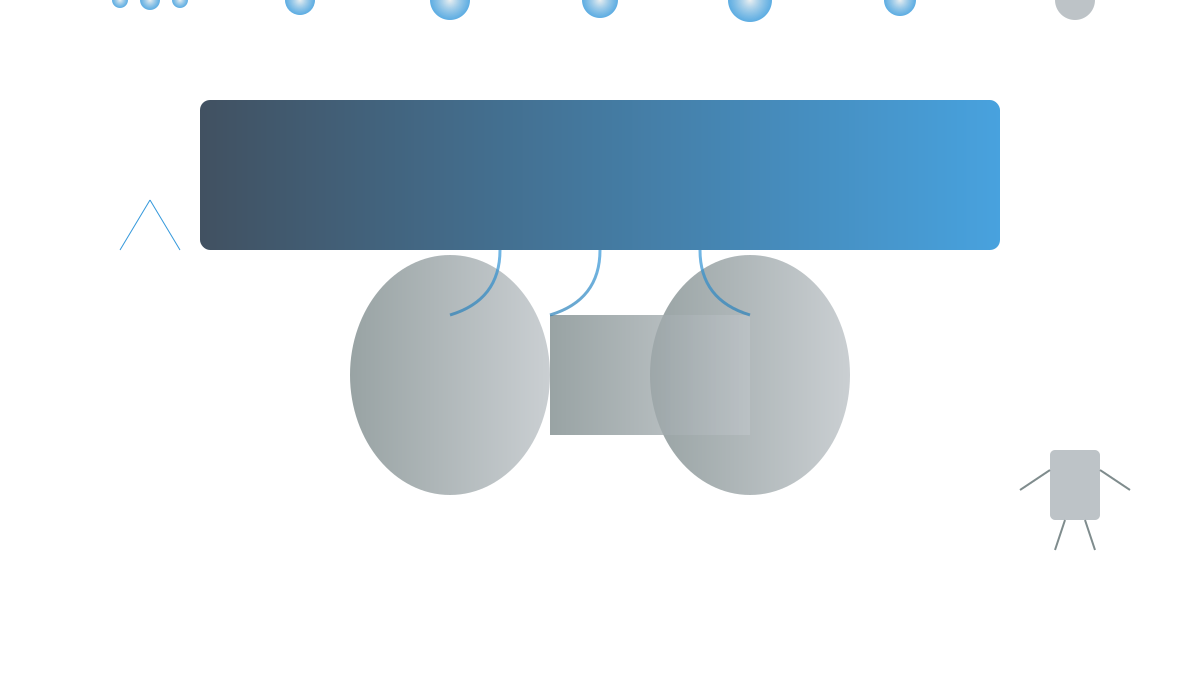
The core innovation of DLEF is its dual-layer separation design:

  • High-level Cognition Layer: Handles complex perceptual inputs, reasoning and decision-making, and long-term goal planning, similar to the function of the cerebral cortex. It can use deep learning models for scene understanding, etc.
  • Predictive Motor Control Layer: Responsible for real-time motor control and coordination. It receives instructions from the cognition layer and fine-tunes parameters through an independent prediction mechanism to achieve millisecond-level responses. The two layers communicate via an interface to ensure intent conversion and state feedback.
4

Section 04

Biological Inspiration: The Cerebellum's "Prediction-Correction" Mechanism

The design of DLEF is inspired by the cerebellum: accounting for about 10% of the brain's volume but containing more than half of its neurons, the cerebellum's main functions are coordinating movement, maintaining balance, and learning fine motor sequences. Its parallel structure receives cortical intent signals and real-time feedback, optimizing motor execution through a "prediction-correction" mechanism—this is exactly the core capability replicated by DLEF's second layer.

5

Section 05

Hardware Implementation: Intel Hala Point Neuromorphic Chip

DLEF is deeply integrated with Intel's Hala Point neuromorphic chip (the successor to Loihi), which has over 1 billion neurons and 12 billion synapses and simulates large-scale neural networks with extremely low power consumption. Its event-driven processing method (only consuming energy when neurons receive signals) is suitable for real-time applications. DLEF leverages the chip's parallel processing and sparse computing features to achieve efficient edge operation.

6

Section 06

Application Prospects: Advantages in Multiple Scenarios

The dual-layer architecture brings multiple benefits:

  1. Balance Between Response Speed and Precision: Separating fast motor control from slow cognitive processing balances response speed and decision complexity, making it suitable for robots that perform fine operations.
  2. Modularity and Scalability: The two layers can be optimized independently—the cognition layer uses multimodal large models, while the motor layer is optimized for hardware.
  3. Robustness and Safety: When the cognition layer fails, the motor layer can maintain basic safe behaviors through prediction models, which is crucial for key scenarios like autonomous driving.
7

Section 07

Summary and Outlook: Significance and Future Directions of DLEF

DLEF represents an important direction for embodied intelligence architectures: drawing inspiration from biological neural systems to achieve functional module separation and collaboration. As neuromorphic hardware matures and algorithms are optimized, intelligent systems based on such architectures are expected to be deployed. This research reminds us that the neural mechanisms evolved in nature are among the best blueprints for building the next generation of intelligent systems.

