Zing Forum

Reading

Building DDPM from Scratch: PyTorch Implementation of Diffusion Model for High-Resolution Face Image Generation

This article deeply analyzes a Denoising Diffusion Probabilistic Model (DDPM) project implemented from scratch, covering key technologies such as core principles of diffusion models, U-Net architecture design, time-step embedding, self-attention mechanism, and mixed-precision training, demonstrating how to build a complete image generation pipeline using PyTorch.

DDPM扩散模型PyTorch图像生成U-Net深度学习生成式AICelebA-HQ去噪机器学习
Published 2026-05-04 02:16Recent activity 2026-05-04 02:17Estimated read 5 min
Building DDPM from Scratch: PyTorch Implementation of Diffusion Model for High-Resolution Face Image Generation
1

Section 01

【Introduction】Building DDPM from Scratch: PyTorch Implementation for High-Resolution Face Generation

This project implements the Denoising Diffusion Probabilistic Model (DDPM) from scratch using PyTorch, covering key technologies such as core principles of diffusion models, U-Net architecture design, time-step embedding, self-attention mechanism, and mixed-precision training. It is trained on the CelebA-HQ dataset to generate high-quality face images, helping to fully understand the internal working mechanism of diffusion models and the application of modern deep learning technologies in the field of image generation.


2

Section 02

Background: Diffusion Models—A New Paradigm for Generative AI

In recent years, the field of generative AI has evolved rapidly, from GANs to diffusion models. DDPM has become a focus due to its stable training and excellent generation quality. Unlike GANs which rely on adversarial games, diffusion models restore original images through forward step-by-step noise addition and reverse denoising learning, with a solid mathematical foundation and outstanding generation capabilities. This project is based on the PyTorch framework and trained on the CelebA-HQ dataset to generate high-quality face images.

3

Section 03

Methodology: Core Principles of Diffusion Models and U-Net Architecture Design

Core Principles

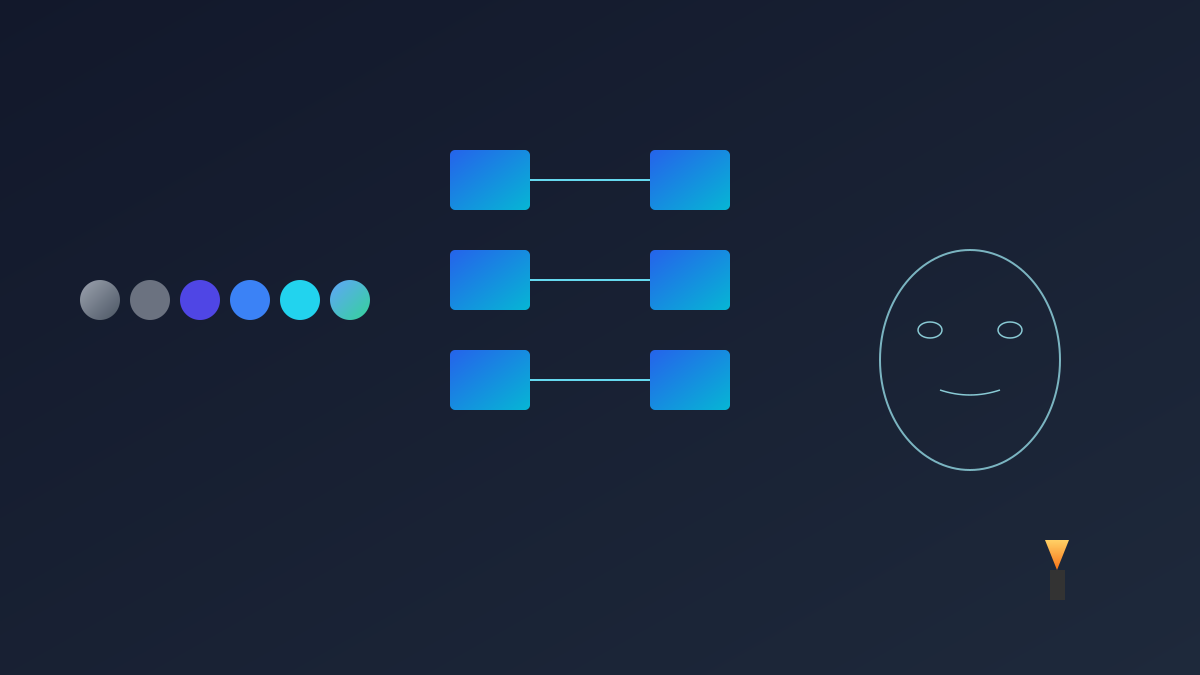
Diffusion models consist of forward diffusion (gradually adding Gaussian noise until reaching a standard Gaussian distribution, formula: q(xₜ|x₀)=N(xₜ;√ᾱₜx₀,(1-ᾱₜ)I)) and reverse denoising (learning εθ(xₜ,t) to predict noise and minimize MSE).

U-Net Architecture

It adopts an encoder-decoder structure, including residual blocks (to alleviate gradient vanishing), sinusoidal time-step embedding (to perceive time steps), and bottleneck layer self-attention (to model global pixel relationships), adapting to the needs of image generation.

4

Section 04

Training Strategy: Optimization Techniques and Efficiency Improvement

Training uses mixed precision (FP16) to reduce memory usage and accelerate computation; data preprocessing includes center cropping and normalization; the loss function is MSE (mean squared error between predicted noise and real noise), avoiding the mode collapse problem of GANs; reasonable selection of batch size and learning rate scheduling improves performance.

5

Section 05

Applications: Image Generation and Interactive Demonstration

After training, faces can be generated from pure noise through iterative denoising; a Gradio interactive web application is provided, allowing users to experience the generation process without code, supporting image upload or random generation, which is convenient for demonstration teaching and application expansion (such as image editing, super-resolution, etc.).

6

Section 06

Conclusion and Outlook: Technical Insights and Future Opportunities of Diffusion Models

This project proves the feasibility of implementing DDPM from scratch and has unique educational value (deeply understanding algorithm principles and implementation details). In the future, diffusion models will develop towards sampling acceleration (DDIM), text guidance (Stable Diffusion), video/3D generation, etc. Mastering the basics of DDPM is the key to cutting-edge technology applications.

7

Section 07

Suggestions: Learning Path for Generative AI Developers

It is recommended that developers start with this project and gradually explore more complex variants and extensions; combine diffusion model theory with practice to unlock infinite possibilities for AI creative applications.

