Zing Forum

Reading

End-to-End Revenue Intelligence Platform: SaaS Architecture Practice Integrating Databricks, Snowflake, and Machine Learning

This article introduces an open-source revenue intelligence platform project, demonstrating how to integrate Databricks, Snowflake, dbt, machine learning, and Power BI to build a complete revenue forecasting and customer analysis system, covering the full-link implementation of data engineering, ML model deployment, and delivery of executive-ready business insights.

revenue intelligenceSaaSDatabricksSnowflakedbtmachine learningPower BIcustomer churnCLVdata engineering
Published 2026-06-07 07:44Recent activity 2026-06-07 07:54Estimated read 7 min
End-to-End Revenue Intelligence Platform: SaaS Architecture Practice Integrating Databricks, Snowflake, and Machine Learning
1

Section 01

[Introduction] End-to-End Revenue Intelligence Platform: SaaS Architecture Practice Integrating Databricks, Snowflake, and Machine Learning

This article introduces the open-source project Strategic Revenue Intelligence Platform, which aims to build an end-to-end revenue intelligence solution integrating Databricks, Snowflake, dbt, machine learning, and Power BI, covering the full link from data engineering and ML model deployment to business insight delivery. The project is maintained by Achayo-Emmanuel, with source code available on GitHub (link: https://github.com/Achayo-Emmanuel/Strategic-Revenue-Intelligence-Platform-SaaS), released on June 6, 2026. Its core value lies in providing SaaS enterprises with intelligent capabilities such as revenue forecasting, customer churn identification, and customer lifetime value (CLV) quantification, helping them shift from historical analysis to future prediction.


2

Section 02

Project Background and Positioning

In modern SaaS enterprises, revenue forecasting and customer retention are core competencies, but traditional BI tools can only review historical data and lack the ability to predict future trends. This project emerged to build a full-stack revenue intelligence system: it is not just a visual dashboard, but also can proactively predict revenue fluctuations, identify churn risks, and quantify CLV. Target users include data engineers, ML engineers, and business analysts, providing a production-grade architecture template.

3

Section 03

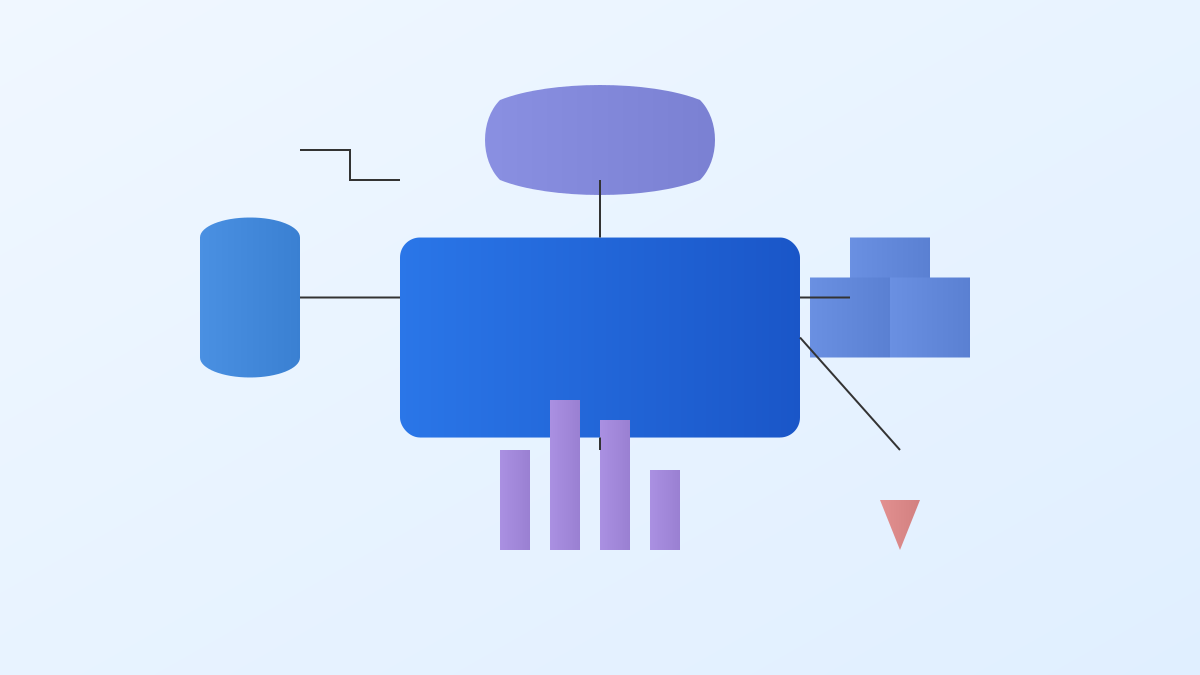
Technical Architecture and Core Functions

Technical Architecture:

  • Data Storage and Computing: Databricks (unified analytics/ML platform, Delta Lake ensures consistency), Snowflake (cloud-native data warehouse with elastic computing and storage separation);
  • Data Transformation: dbt (write testable transformation logic with SQL, incremental models reduce costs);
  • ML Layer: Revenue forecasting (time series such as ARIMA/Prophet/LSTM), churn prediction (classification algorithms like XGBoost), CLV estimation (survival analysis);
  • Visualization: Power BI (real-time/near-real-time display, enterprise-level permission management).

Core Functions:

  • Revenue forecasting and anomaly detection: Output prediction intervals + anomaly alerts;
  • Customer health score and churn warning: Build scores based on multi-dimensional data, trigger risk list push;
  • Customer segmentation: Automated segmentation based on CLV and behavioral characteristics, matching personalized strategies.
4

Section 04

Implementation Key Points and Challenges

  1. Data Quality Governance: dbt data tests block dirty data, Snowflake builds quality monitoring dashboards;
  2. Model Interpretability: Use SHAP/LIME to explain prediction drivers (e.g., decreased logins of churned customers, P0 bug submissions);
  3. Trade-off Between Latency and Real-time: T+1 latency is acceptable for daily decisions; stream processing (Spark Streaming/Flink) is needed for high real-time scenarios;
  4. Security and Compliance: Column-level encryption, dynamic desensitization, fine-grained access control, compliance with GDPR/CCPA, and establishment of data lineage tracking.
5

Section 05

Expansion and Customization Directions

Expansion directions for this project:

  • Multi-data source access: In addition to CRM and billing systems, add Amplitude/Mixpanel (product analysis), Zendesk/Intercom (customer feedback);
  • A/B testing integration: Connect to experiment platforms to quantify the impact of strategies on revenue;
  • Automated workflows: Orchestrate the entire pipeline with Airflow/Databricks Workflows;
  • Natural language interface: Build query interfaces with LLM for non-technical users to self-obtain insights.
6

Section 06

Summary and Insights

This project demonstrates the typical architecture of a modern data intelligence platform: cloud-native data warehouse as the foundation, dbt as the transformation hub, Databricks as the ML platform, and Power BI as the display window. Implementation suggestions: Adopt a progressive path (basic pipeline → core dashboard → ML → automation), oriented towards business value. Its open-source nature supports community contributions, making it a production-grade case worth referencing for data practitioners.

