Zing Forum

Reading

CosmicML-Biodetect: Searching for Signs of Life on Exoplanets Using Physics-Informed Neural Networks

A machine learning framework combining Physics-Informed Neural Networks (PINN) and Bayesian inference, which detects biosignature gases like oxygen, methane, and ozone by analyzing atmospheric spectral data of exoplanets, providing a new tool for searching for extraterrestrial life.

物理信息神经网络PINN系外行星天体生物学透射光谱生物特征气体机器学习JWST贝叶斯推断
Published 2026-06-07 05:13Recent activity 2026-06-07 05:19Estimated read 7 min
CosmicML-Biodetect: Searching for Signs of Life on Exoplanets Using Physics-Informed Neural Networks
1

Section 01

CosmicML-Biodetect: An Extraterrestrial Life Detection Tool Combining Physics-Informed Neural Networks and Bayesian Inference

CosmicML-Biodetect is an open-source project. Through a machine learning framework combining Physics-Informed Neural Networks (PINN) and Bayesian inference, it analyzes atmospheric spectral data of exoplanets to detect biosignature gases such as oxygen, methane, and ozone, providing a new tool for searching for extraterrestrial life. This project integrates knowledge of atmospheric physics and chemical dynamics to enhance the reliability and interpretability of results, supports data processing from telescopes like JWST, and is currently in the active development phase.


2

Section 02

Traditional Methods for Extraterrestrial Life Search and the Background of This Project

Human exploration of extraterrestrial life has never stopped. Traditional methods include listening for signals with radio telescopes, searching for microorganisms with Mars rovers, etc. The innovation of CosmicML-Biodetect lies in the use of Physics-Informed Neural Networks (PINN), which enforces atmospheric physics constraints during training, avoiding the statistical correlation issues of purely data-driven models and enabling a better understanding of real physical processes.

3

Section 03

Core Principles: Transmission Spectroscopy and Application of PINN

Principles of Transmission Spectroscopy

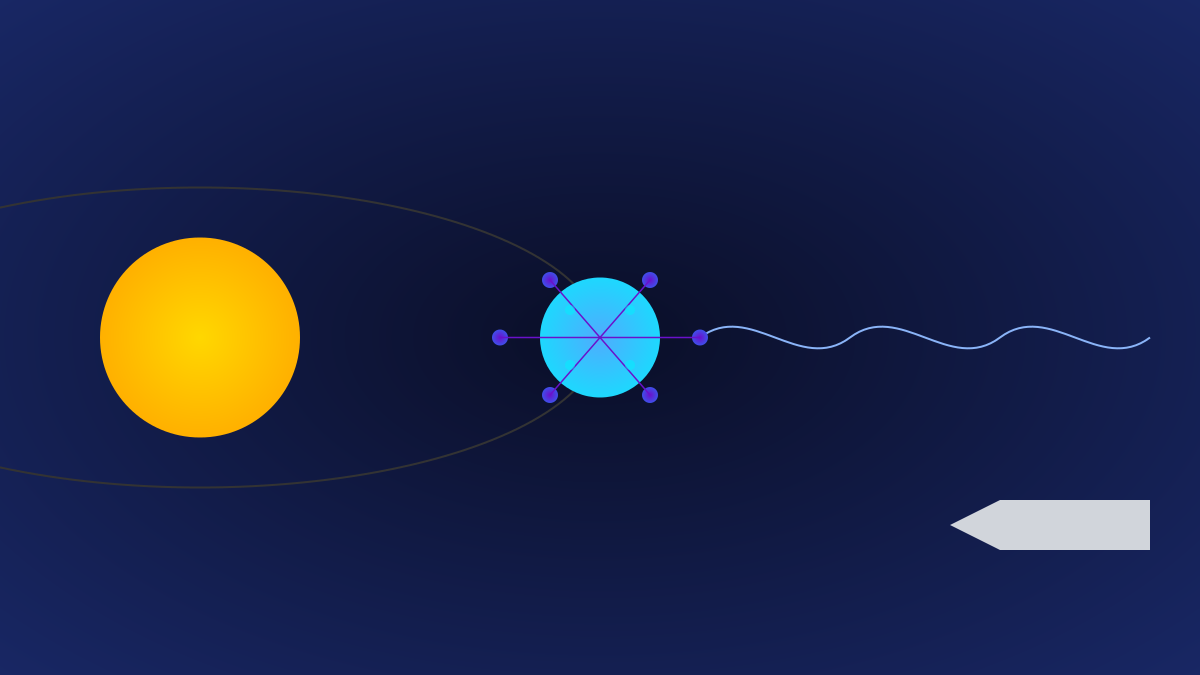
When an exoplanet transits, starlight passes through its atmosphere. Different gases absorb specific wavelengths to form absorption features. By analyzing the spectrum, the atmospheric composition can be inferred. The project focuses on detecting biosignature gases such as oxygen (O₂), methane (CH₄), and ozone (O₃).

Advantages of PINN

Traditional neural networks rely on data-driven approaches. PINN adds physical equation constraints to the loss function to ensure predictions comply with atmospheric chemistry and radiative transfer laws:

  • Strong generalization ability (reasonable inference with limited data)
  • Physically interpretable (non-black-box results)
  • Uncertainty quantification (provides confidence intervals through Bayesian inference)
4

Section 04

Technical Architecture: Module Design for Simulation and Practical Use

CosmicML-Biodetect contains core modules:

Atmospheric Simulation Engine

Generates synthetic training data: scenarios of different star types/habitable zone planets, chemical dynamics models (simulating atmospheric reactions), and radiative transfer calculations (generating realistic spectra).

PINN Model Architecture

Encoder-decoder structure, with constraint layers to enforce chemical equations, and physical loss terms to ensure learning aligns with real atmospheric physical processes.

Data Processing and Inference Pipeline

Supports observation data formats from JWST, Keck, HST, etc. The preprocessing module handles normalization/feature engineering, and the Bayesian inference pipeline estimates posterior distributions via MCMC sampling to quantify result uncertainty.

5

Section 05

Application Scenarios: From Tutorials to Real Observation Practice

The project provides complete Jupyter Notebook tutorials:

  1. Introduction to exoplanet atmospheres and biosignatures
  2. Spectral data visualization
  3. PINN model training
  4. Biosignature detection (Bayesian inference)
  5. JWST real data analysis

Hardware requirements: NVIDIA GPU is recommended for training (10,000 samples take 8-12 hours on A100), and a single spectral inference takes only 0.1 seconds, meeting real-time analysis needs.

6

Section 06

Scientific Significance and Open-Source Development Prospects

CosmicML-Biodetect is an important advancement in the interdisciplinary field of astrophysics and machine learning, demonstrating the value of integrating domain knowledge into ML models. As telescopes like JWST produce massive amounts of data, automated intelligent analysis tools are becoming increasingly critical. The project is open-source, and contributions from the astronomy and ML communities are welcome, especially in areas such as expanding atmospheric chemistry modules, optimizing PINN architecture, and improving Keck/HST data pipelines.

7

Section 07

Conclusion: Combining Physics and AI to Step Up Extraterrestrial Life Exploration

Searching for extraterrestrial life is one of humanity's grand scientific explorations. CosmicML-Biodetect shows how machine learning can enhance the ability to analyze complex data, rather than replacing physicists' intuition. The combination of physical laws and neural networks may bring us one step closer to answering the ultimate question: 'Are we alone in the universe?'

