Zing Forum

Reading

Deep Reinforcement Learning Combined with CNN: A New Paradigm for Intelligent Diagnosis of Lesion Detection in CT Images

This article introduces a CT image lesion detection system that integrates deep reinforcement learning and convolutional neural networks, and discusses its application value and technical innovations in medical image diagnosis.

医学影像CT扫描病灶检测深度强化学习卷积神经网络人工智能诊断计算机视觉医疗AI深度学习智能诊断
Published 2026-04-30 02:43Recent activity 2026-04-30 02:51Estimated read 6 min
Deep Reinforcement Learning Combined with CNN: A New Paradigm for Intelligent Diagnosis of Lesion Detection in CT Images
1

Section 01

Introduction: Deep Reinforcement Learning + CNN Build an Intelligent System for CT Image Lesion Detection

This article introduces LesionDetector, a CT image lesion detection system that integrates deep reinforcement learning and convolutional neural networks. It aims to solve the problem of limited generalization ability of traditional lesion detection methods, improve the accuracy and efficiency of medical image diagnosis, and provide a new paradigm for intelligent diagnosis.


2

Section 02

Project Background and Research Motivation

The LesionDetector project stems from the demand for automation in medical image diagnosis. Traditional lesion detection relies on manual feature extraction and has limited generalization ability. This project innovatively combines deep reinforcement learning (DRL) and convolutional neural networks (CNN) to build an end-to-end system, using the feature extraction capability of CNN and the decision optimization capability of DRL to achieve accurate localization and recognition of lesions.

3

Section 03

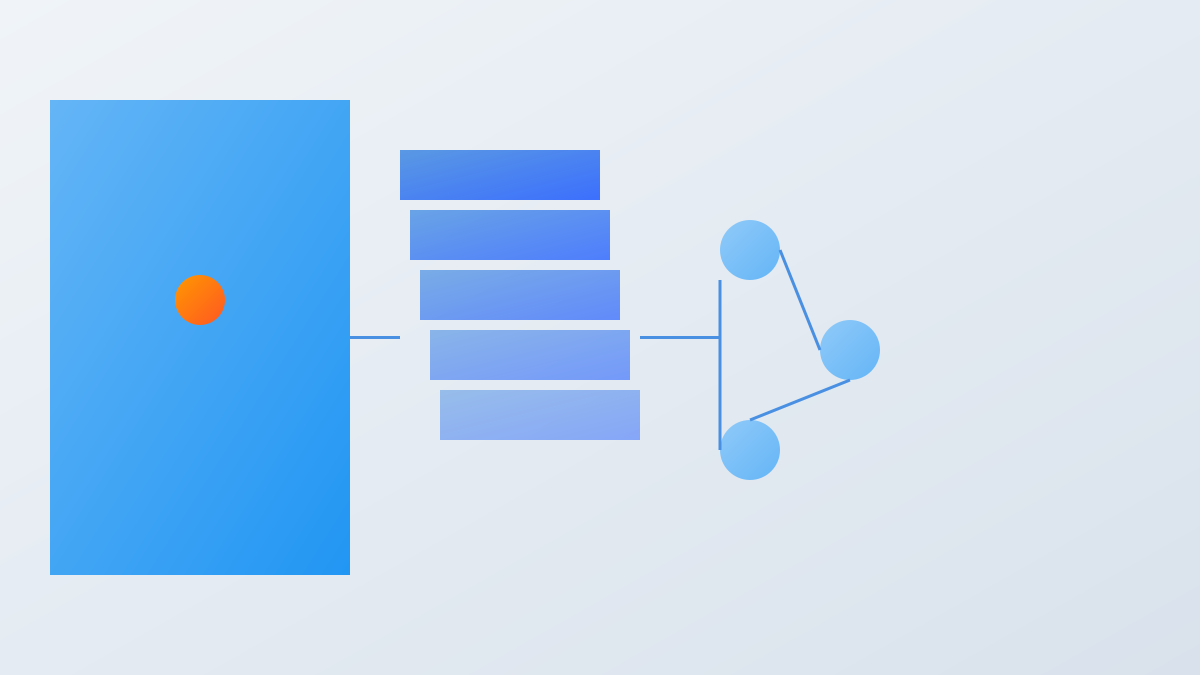
Technical Architecture: An Intelligent Detection System Driven by Dual Engines

Convolutional Neural Network: The Cornerstone of Feature Extraction

An improved U-Net architecture (encoder-decoder) is adopted. Hierarchical features are extracted through multi-layer convolution and pooling; the decoder uses upsampling + skip connections to restore resolution; 3D convolution is introduced to capture 3D spatial information.

Deep Reinforcement Learning: Intelligent Decision Optimizer

A "virtual radiologist" agent is designed, which uses the DQN algorithm to autonomously navigate images. It learns efficient strategies through a reward function (positive reward for locating lesions, penalty for invalid observations) to balance accuracy and efficiency.

4

Section 04

Key Technical Innovations

Multi-scale Attention Mechanism

Convolutional kernels with different receptive fields are used in parallel to generate multi-scale feature maps. The attention module automatically adjusts weights to adapt to lesions of different sizes.

Context Information Fusion

LSTM is used to model the context of CT sequences, and adjacent slice information is combined to identify three-dimensional structures.

Uncertainty Quantification

Bayesian deep learning + Monte Carlo dropout are used to evaluate prediction uncertainty, and uncertain regions are marked for doctors to review.

5

Section 05

Experimental Verification and Performance Evaluation

Verified on datasets such as LUNA16 (lung nodules) and LiTS (liver tumors):

  • Detection sensitivity exceeds 95%;
  • False positive rate per case <1;
  • Processing time per case <30 seconds. In comparative experiments, some indicators reached the level of human experts, demonstrating the potential of AI assistance.
6

Section 06

Clinical Application Value and Challenges

Application Value

Improve diagnostic efficiency (rapid screening), reduce missed diagnoses (no fatigue effect), promote resource balance (grassroots assistance), and support medical education (teaching tool).

Challenges

Data privacy and ethics (need for privacy protection technology), cross-domain generalization (device differences), regulatory certification (clinical trials), and doctor acceptance (positioned as an auxiliary tool).

7

Section 07

Future Development Directions

Multi-modal fusion (CT+MRI+PET+multi-omics), personalized diagnosis (individual differences), predictive analysis (disease trends/treatment responses), and enhanced interpretability (visualization of decision-making basis).

8

Section 08

Conclusion

LesionDetector demonstrates the potential of DRL+CNN in medical image diagnosis and provides new ideas for AI development. AI will become a standard configuration in healthcare, but it needs to be combined with doctors' professional knowledge and humanistic care to realize the vision of smart healthcare.

