Zing Forum

Reading

CNN-based Natural Scene Image Classification Hands-On: A Complete Deep Learning Project from Training to Deployment

An end-to-end deep learning image classification project that uses a custom convolutional neural network to classify six categories of natural scenes (buildings, forests, glaciers, mountains, oceans, and streets), achieving an 85% validation accuracy and deployed as an interactive web application via Streamlit.

深度学习卷积神经网络图像分类CNNStreamlit计算机视觉场景识别自然场景分类
Published 2026-05-20 17:44Recent activity 2026-05-20 17:48Estimated read 7 min
CNN-based Natural Scene Image Classification Hands-On: A Complete Deep Learning Project from Training to Deployment
1

Section 01

Introduction to the CNN-based Natural Scene Image Classification Project

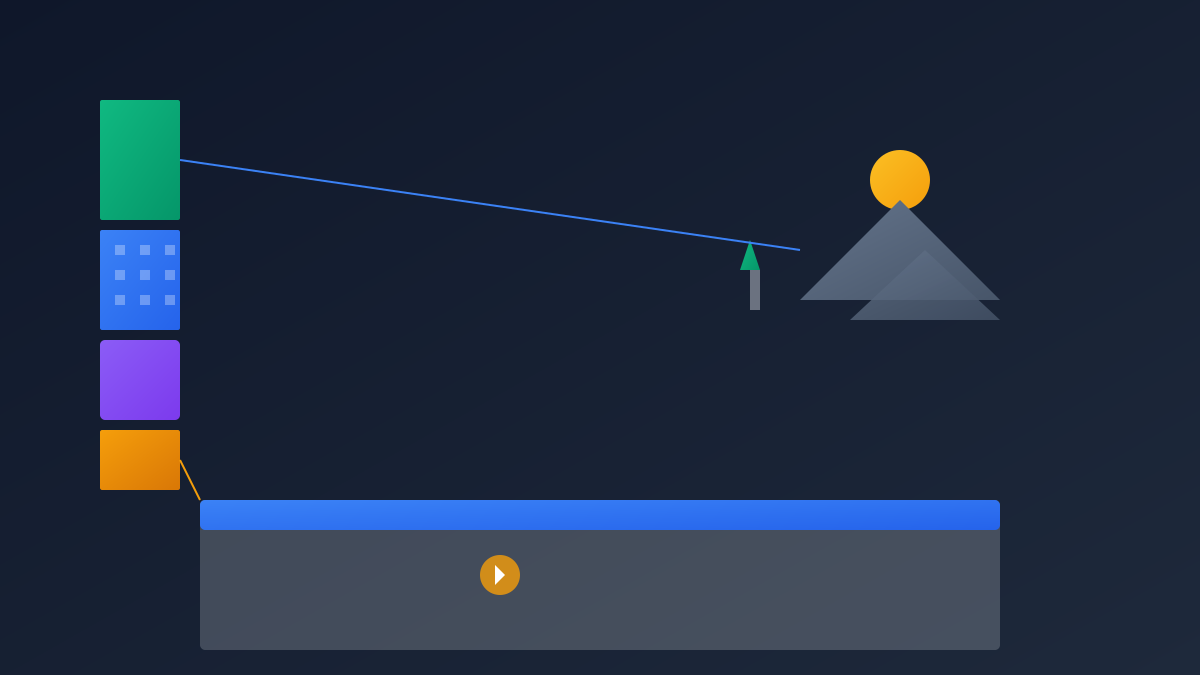
This project is an end-to-end deep learning image classification system that uses a custom convolutional neural network to classify six categories of natural scenes (buildings, forests, glaciers, mountains, oceans, and streets). It achieves an 85% validation accuracy and is deployed as an interactive web application via Streamlit, covering the complete workflow from training to deployment.


2

Section 02

Project Background and Overview

In the field of computer vision, scene image classification is an important application of deep learning, which requires understanding the semantic information of images and is of great significance for autonomous driving, intelligent photo album management, etc. This open-source project was developed by shahedbatayha, trained on the Intel Image Dataset, can classify six categories of natural scenes, and includes model training evaluation and Streamlit deployment solutions.

3

Section 03

Dataset Introduction and Features

The project uses the Intel Image Dataset, which contains six non-overlapping categories: Buildings (urban architectural structures), Forests (dense vegetation), Glaciers (ice and snow-covered landscapes), Mountains (bare mountain terrain), Oceans (large water areas), and Streets (urban road scenes). The diversity of the dataset requires the model to learn features under different lighting conditions and angles, and to capture local textures and global layouts.

4

Section 04

Model Architecture Design Ideas

The project adopts a custom CNN architecture, considering task characteristics and computational efficiency, without using pre-trained transfer learning. CNN performs hierarchical feature learning: shallow layers detect low-level features, while deep layers combine them into global structures. Key design factors: reasonable configuration of receptive fields (to cover global structures), balancing feature channel dimensions and computational costs, and selecting regularization strategies (Dropout, batch normalization) to prevent overfitting.

5

Section 05

Training Process and Optimization Strategies

The model uses a supervised learning process, with optimizers possibly being Adam or SGD. Data augmentation (random rotation, flipping, scaling, color jitter) expands sample diversity to prevent overfitting. Learning rate scheduling (decay, cosine annealing, etc.) helps with late-stage fine-tuning. After training, the validation set accuracy reaches 85%, indicating that the model can effectively distinguish between the six categories of scenes.

6

Section 06

Streamlit Interactive Deployment

The project deploys the model as a Streamlit web application, allowing users to upload images for real-time inference and return category labels and confidence levels. Advantages of Streamlit: declarative Python API, no need for complex front-end development, encapsulates model loading, preprocessing, and inference processes, lowers deployment barriers, facilitates sharing and dissemination, and users can use it without configuring a deep learning environment.

7

Section 07

Practical Applications and Expansion Directions

This project provides complete learning resources for deep learning beginners, covering the entire life cycle of project development. Practical applications: automatic tagging for smart photo albums, environmental perception for autonomous driving. Expansion directions: introducing architectures like ResNet/EfficientNet, trying transfer learning, supporting more categories, and combining with object detection to locate key objects.

8

Section 08

Project Summary and Insights

This project demonstrates the potential of deep learning in scene understanding. Through a carefully designed CNN and engineering implementation, it builds a high-accuracy and easy-to-deploy system. The 85% validation accuracy proves the effectiveness of the custom network, and the Streamlit deployment reflects practicality in real-world applications. It provides learners with an example from theory to practice, showing the method of transforming AI technology into application products, which is of reference value.

