Zing Forum

Reading

Industrial Conveyor Belt Material Recognition System: A CNN-based Classification Project for Foam, Asphalt, Aluminum, and Polystyrene Using Dual Cameras

A convolutional neural network (CNN) system developed during a university project period that uses two 384x384 RGB cameras for real-time classification of materials (foam, asphalt, aluminum, polystyrene) on conveyor belts. It adopts an 80/10/10 dataset split strategy and p-hash deduplication technology to prevent data leakage.

卷积神经网络图像识别工业视觉材料分类CNN数据泄漏感知哈希Python机器学习传送带检测
Published 2026-05-28 19:45Recent activity 2026-05-28 19:53Estimated read 8 min
Industrial Conveyor Belt Material Recognition System: A CNN-based Classification Project for Foam, Asphalt, Aluminum, and Polystyrene Using Dual Cameras
1

Section 01

[Introduction] Industrial Conveyor Belt Material Recognition System: Core Overview of the Dual-Camera CNN Classification Project

This convolutional neural network (CNN) system, developed during a university project period, uses two 384x384 RGB cameras for real-time classification of four materials (foam, asphalt, aluminum, polystyrene) on conveyor belts. The project adopts an 80/10/10 dataset split strategy and uses perceptual hash (p-hash) deduplication technology to prevent data leakage. The system aims to solve the problems of low efficiency and high error rate in manual classification in industrial production, and improve the intelligence level of production lines.


2

Section 02

Project Background and Objectives: Addressing Pain Points in Industrial Conveyor Belt Material Classification

In industrial production environments, material classification on conveyor belts is a key but challenging task. Traditional manual detection is inefficient and error-prone, while automated visual recognition systems can significantly improve the intelligence level of production lines. This project is a CNN system developed during a university project period, with the goal of realizing automatic classification of four common industrial materials (foam, asphalt, aluminum, polystyrene) through computer vision technology.

3

Section 03

System Architecture Design and Dataset Construction Strategy

Dual-Camera Acquisition Scheme

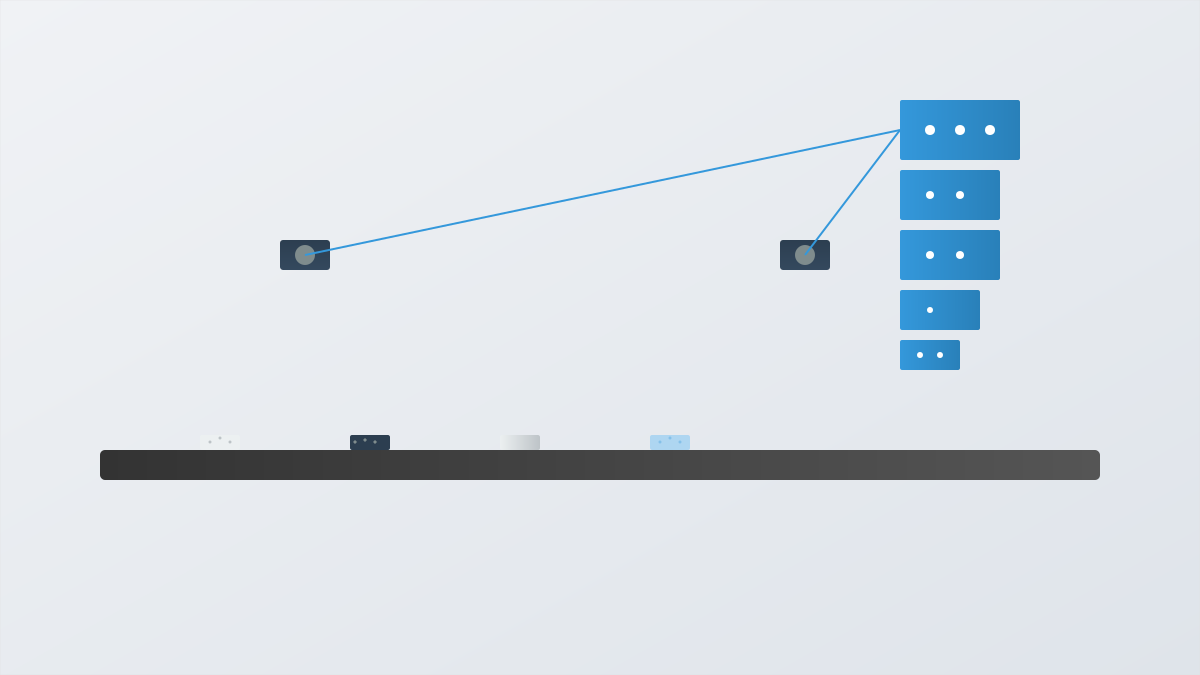
Two cameras (installed on the left and right sides) are used to capture images of materials from different perspectives. Each camera captures 384x384 RGB images to improve classification accuracy and provide redundancy.

Image Naming and Annotation

Video naming format: CameraId_VideoId_{CLASSIFICATION}_... (classification labels are HIGH/MEDIUM/LOW/NONE); image names include source, frame number, and classification levels of the four materials. Labels are manually annotated to ensure reliability.

Dataset Split

A stratified split strategy of 80% training set, 10% validation set, and 10% test set is adopted to ensure the model's generalization ability and fair evaluation.

Data Leakage Prevention

Data leakage is prevented through time window separation (frames from the same video segment are not in both training and test sets) and perceptual hash deduplication (excluding near-duplicate images).

4

Section 04

Convolutional Neural Network Model and Software Architecture Implementation

Model Architecture Selection

CNN is used as the core recognition algorithm. It uses local connection and weight sharing mechanisms to extract hierarchical features of images, processes 384x384 input images, and finally maps to the probability distribution of the four materials.

Multi-Class Classification Strategy

For the multi-label multi-class problem of four materials (each with four levels), possible strategies include independent classifiers, multi-task learning, or label combination (details not specified).

Software Modular Design

  • Input script: Handles user queries, loads datasets, and performs preprocessing;
  • CNN script: Implements model definition, training, inference, and evaluation, encapsulating core logic.

Technology Stack Speculation

Possible technologies include Python (main language), TensorFlow/PyTorch (deep learning frameworks), OpenCV (image processing), NumPy/Pandas (data processing), etc.

5

Section 05

Application Scenarios and Project Value Analysis

Application Scenarios

  1. Industrial Quality Inspection Automation: Real-time detection of material types and contamination levels, triggering processing flows (such as stopping the production line or cleaning);
  2. Waste Classification and Recycling: Identify waste components, guide sorting equipment to improve recycling efficiency and purity;
  3. Production Process Monitoring: Generate statistical data to help optimize production parameters and identify quality issues.

Academic and Engineering Value

As a university project, it demonstrates the complete machine learning process from problem definition to system implementation, combining deep learning technology with practical engineering issues (such as data leakage prevention and modular design). It has reference value for students learning computer vision and industrial AI.

6

Section 06

Project Limitations and Future Improvement Directions

Current Limitations

  1. Limited dataset size, which restricts the model's generalization ability;
  2. Reliance on manual annotation, leading to high costs for large-scale deployment;
  3. Fixed dual-camera positions may not adapt to all material forms and lighting conditions.

Improvement Directions

  1. Data augmentation (rotation, flipping, brightness adjustment, etc., to expand training data);
  2. Transfer learning (using pre-trained models like ResNet/EfficientNet to improve performance);
  3. Active learning (prioritize annotating samples that the model is uncertain about to improve annotation efficiency);
  4. Multi-modal fusion (combining data from weight sensors, metal detectors, etc., to enhance accuracy).
