Zing Forum

Reading

CNN-Based Sign Language Recognition System: Deep Learning Drives Innovation in Accessible Communication Technology

A sign language recognition project implemented using Convolutional Neural Networks (CNN), leveraging computer vision and deep learning technologies to build a technical bridge for communication between the hearing-impaired and hearing populations.

手语识别CNN卷积神经网络计算机视觉深度学习无障碍技术图像分类实时识别
Published 2026-05-16 05:26Recent activity 2026-05-16 05:41Estimated read 8 min
CNN-Based Sign Language Recognition System: Deep Learning Drives Innovation in Accessible Communication Technology
1

Section 01

Introduction: CNN-Based Sign Language Recognition System—Deep Learning Empowers Accessible Communication

CNN-Based Sign Language Recognition System: Deep Learning Drives Innovation in Accessible Communication Technology

This project uses Convolutional Neural Networks (CNN) combined with computer vision technology to achieve real-time sign language recognition, aiming to build a communication bridge between the hearing-impaired and hearing populations. The project demonstrates the application of CNN in image classification tasks and reflects the positive value of AI technology in promoting social inclusion.


2

Section 02

Project Background and Social Value

Project Background and Social Value

Communication Dilemmas of the Hearing-Impaired Group

Approximately 466 million hearing-impaired people worldwide rely on sign language for communication, but they face language isolation (large differences in sign language systems across regions, low penetration among hearing people), communication barriers (difficulties in medical/educational/employment scenarios), and the need for technical assistance (lack of real-time and accurate tools).

AI Technology Solutions

Computer vision and deep learning offer new possibilities: real-time recognition, high accuracy, low cost, and portability (can be deployed on mobile devices).

3

Section 03

Technical Architecture and Implementation Methods

Technical Architecture and Implementation

System Architecture

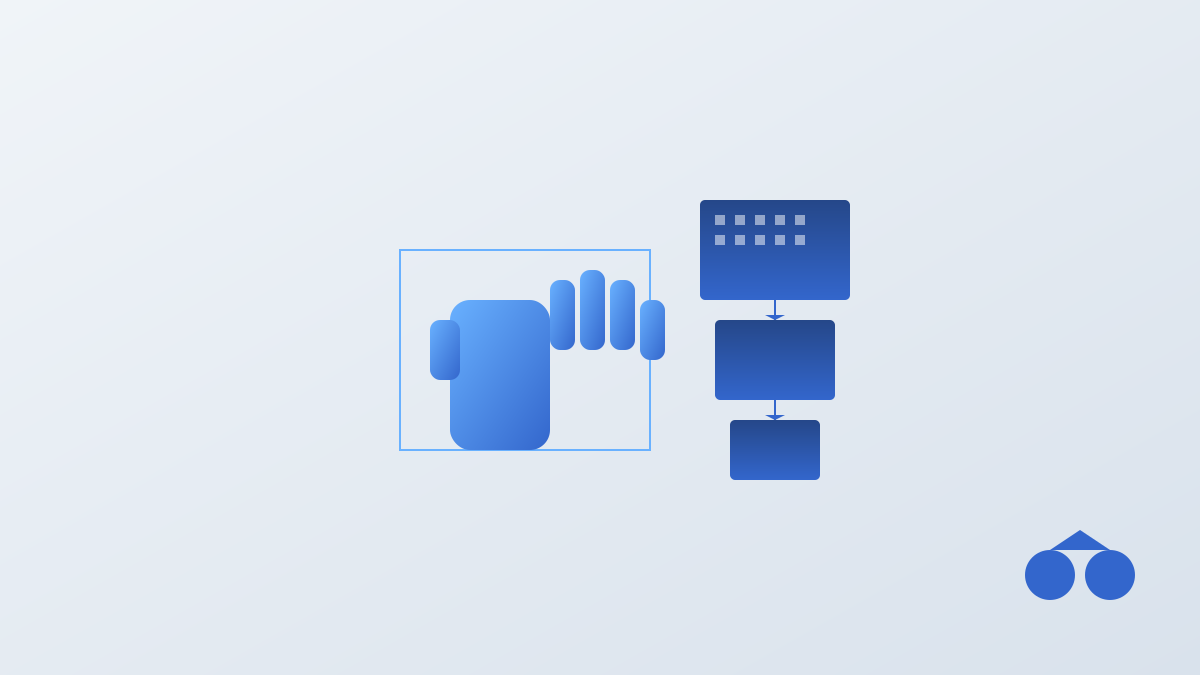
Includes modules for data collection (camera capture + preprocessing + enhancement), feature extraction (CNN automatically learns spatial features), classification and recognition (fully connected layer integration + Softmax output), and output display (text/voice + confidence visualization).

CNN Model Design

Classic architecture: Input layer → Convolutional layer → Activation function → Pooling layer → Convolutional layer → Activation function → Pooling layer → Fully connected layer → Dropout → Output layer. Key components: Convolutional layer (extracts local features), activation function (ReLU/Leaky ReLU), pooling layer (Max/Average), fully connected layer (feature integration), regularization (Dropout/Batch Normalization).

Possible Model Choices

Lightweight models (suitable for real-time/mobile), pre-trained transfer learning (fine-tuning on ImageNet), classic architectures (LeNet-5/VGG/ResNet/MobileNet).

4

Section 04

Dataset and Training Strategy

Dataset and Training

Sign Language Datasets

Common datasets: MNIST for Sign Language, ASL Alphabet, Sign Language MNIST, custom datasets. Characteristics: Static gestures are simple; dynamic gestures require temporal modeling and are affected by lighting/background/hand shape.

Data Preprocessing

Image preprocessing: Grayscale conversion, normalization, size unification, background removal; Data augmentation: Random rotation/translation/scaling/brightness adjustment/horizontal flip.

Training Strategy

Loss function (cross-entropy), optimizer (Adam/SGD/RMSprop), learning rate scheduling (Step Decay/Cosine Annealing), early stopping strategy (monitoring validation set loss).

5

Section 05

System Deployment and Application Scenarios

System Deployment and Application

Real-Time Recognition Process

Steps: Image capture → Preprocessing → Model inference → Result output (text/voice + confidence).

Deployment Platforms

Desktop applications (Python+OpenCV+Tkinter), Web applications (Flask+HTML5), mobile applications (TensorFlow Lite+Android/iOS).

Application Scenarios

Education (sign language learning), healthcare (doctor-patient communication), public services (government affairs/transportation), social interaction (real-time translation), smart home (gesture control).

6

Section 06

Technical Challenges and Solutions

Technical Challenges and Solutions

  1. Background Interference: Skin color detection/background subtraction/deep learning segmentation/solid color background requirement;
  2. Lighting Changes: Data augmentation/histogram equalization/adaptive thresholding;
  3. Hand Shape Differences: Diverse data/augmentation simulation/normalization/personalized fine-tuning;
  4. Static vs. Dynamic: CNN for static gestures; CNN+LSTM/3D CNN/keypoint detection for dynamic gestures;
  5. Real-Time Performance: Model lightweighting (MobileNet)/quantization/hardware acceleration (GPU/TPU)/inference optimization (TensorRT).
7

Section 07

Conclusion and Future Outlook

Conclusion

This project demonstrates the potential of deep learning in the accessible field, improving the communication efficiency of the hearing-impaired and reflecting the inclusive value of technology. For learners, it covers CV/DL/engineering skills; for developers, continuous innovation (dynamic recognition/practical applications) is needed. Future systems will be more accurate and real-time, creating an equal communication environment for the hearing-impaired and becoming a model of warm AI applications.

