Zing Forum

Reading

CGAN Implementation for Conditional Probability Distribution Generation: Predicting Future Distributions Based on Historical Trajectories

This article introduces a project based on Conditional Generative Adversarial Networks (CGAN) that can generate future probability distribution predictions from historical trajectory data, with significant application value in time-series data modeling and uncertainty quantification.

CGAN生成对抗网络概率分布生成时序预测不确定性量化深度学习机器学习
Published 2026-05-11 04:25Recent activity 2026-05-11 04:28Estimated read 13 min
CGAN Implementation for Conditional Probability Distribution Generation: Predicting Future Distributions Based on Historical Trajectories
1

Section 01

Introduction: CGAN Implementation for Future Probability Distribution Prediction Based on Historical Trajectories

This article introduces a project based on Conditional Generative Adversarial Networks (CGAN) that can generate future probability distribution predictions from historical trajectory data. It addresses the problem that traditional point predictions cannot express uncertainty, and has significant application value in time-series data modeling and uncertainty quantification, suitable for multiple fields such as finance, autonomous driving, and meteorology.

2

Section 02

Project Background and Motivation

Project Background and Motivation

In many practical application scenarios, we not only need to predict a single future value but also need to understand the probability distribution of possible future values. Traditional point prediction methods can only give the most likely value and cannot express the uncertainty of the prediction. Conditional Generative Adversarial Networks (CGAN) provide an elegant solution to this problem—it can learn the complex mapping relationship between historical trajectories and future distributions, thereby generating probability distribution samples that meet specific conditions.

This project is based on this idea and builds a generative neural network system that can generate future probability distribution predictions conditioned on historical trajectories.

3

Section 03

Core Technical Principles

Core Technical Principles

Conditional Generative Adversarial Network Architecture

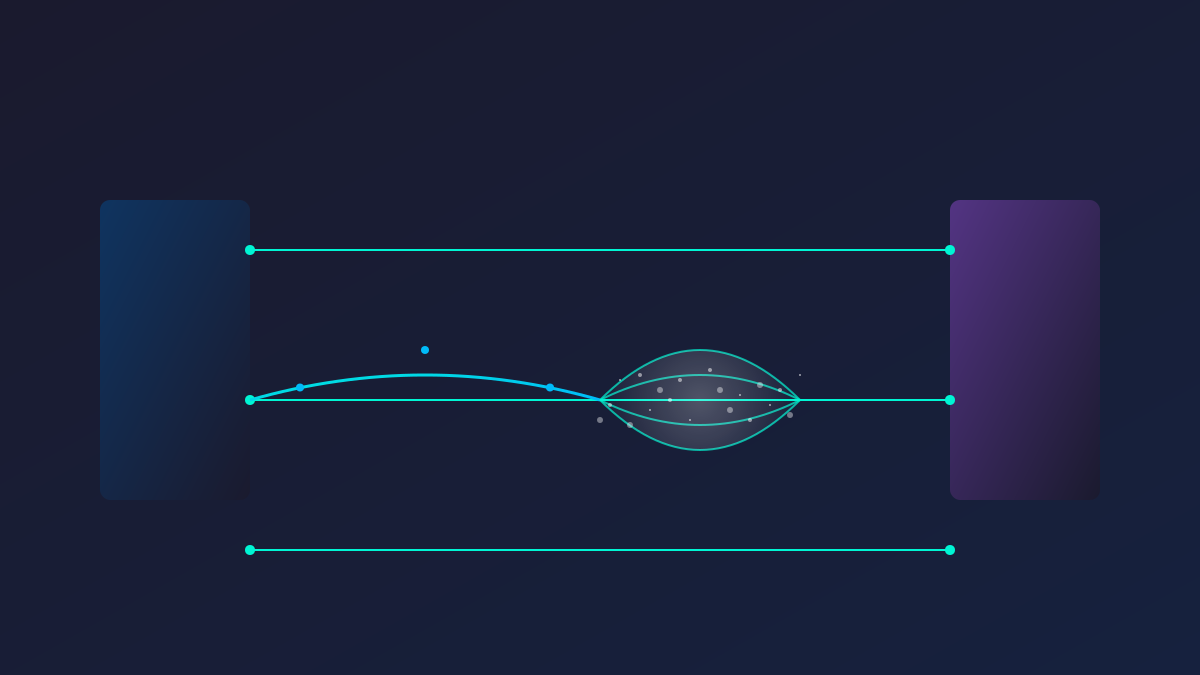
CGAN is an extension of the standard GAN, with its core innovation being the introduction of conditional information. In a standard GAN, the generator G learns to generate samples from random noise z; in CGAN, the generator receives two inputs: random noise z and conditional information c, generating data G(z|c) that meets the condition. The discriminator D also receives the condition and the sample, judging whether the sample truly meets the condition.

The conditional information in this project is the "previous trajectory", and the generation target is the "future probability distribution".

Unique Challenges in Probability Distribution Generation

Unlike generating images or text, generating probability distributions faces several unique challenges:

  1. Continuity of distribution space: Probability distributions exist in a continuous space, requiring the network to learn distribution parameters or directly sample from the distribution
  2. Normalization constraints: The generated distribution must satisfy the basic properties of probability (non-negativity, integral of 1)
  3. Conditional dependence: The generated distribution must reasonably depend on the given historical trajectory
  4. Multimodality: The future distribution may be multimodal, requiring the network to capture this complexity
4

Section 04

Project Architecture and Technical Implementation

Project Architecture and Technical Implementation

Network Design

The project uses a network architecture suitable for time-series data processing:

  • Generator: Usually adopts an encoder-decoder structure, where the encoder processes the historical trajectory sequence, and the decoder generates parameters of the future distribution or directly outputs distribution samples
  • Discriminator: Needs to simultaneously evaluate the authenticity of the generated distribution and its consistency with the conditional trajectory
  • Conditional encoding: Historical trajectories are encoded into conditional vectors via recurrent neural networks (such as LSTM or GRU) or Transformers

Loss Function Design

In addition to the standard adversarial loss, the project may also introduce:

  • Distribution matching loss: Such as Maximum Mean Discrepancy (MMD) or Wasserstein distance, to ensure the generated distribution is close to the real distribution
  • Conditional consistency loss: To ensure the generated distribution truly reflects the trends and patterns implied by the historical trajectory
  • Regularization terms: To prevent mode collapse and encourage the generation of diverse distribution samples
5

Section 05

Application Scenarios and Value

Application Scenarios and Value

Financial Risk Management

In the financial field, this project can be used to predict the future distribution of asset prices, not just point predictions. This is crucial for Value at Risk (VaR) calculation, option pricing, and portfolio optimization. With historical price trajectories as input, the generated probability distribution can reveal the possibility of extreme events.

Autonomous Driving and Robot Planning

In autonomous driving scenarios, it is necessary to predict the future position distribution of surrounding vehicles or pedestrians. A single trajectory prediction is often not safe enough, while probability distribution prediction can better support robust decision-making. With historical movement trajectories as conditions, the generated position distribution can be used for collision risk assessment.

Meteorological and Environmental Prediction

Weather forecasting is essentially a probabilistic problem. Generating the probability distribution of future weather variables based on past meteorological observation sequences can provide richer decision-making information, such as precipitation probability and temperature ranges.

Healthcare Monitoring

In patient monitoring, predicting the probability distribution of future physiological indicators based on historical indicator trajectories can detect abnormal trends early and realize early warning. Compared to a single prediction value, distribution prediction can quantify uncertainty and reduce false alarms.

6

Section 06

Technical Highlights and Innovations

Technical Highlights and Innovations

  1. End-to-end learning: Directly learn distribution generation from raw trajectory data without manual feature design or distribution form assumptions
  2. Flexibility: Can generate arbitrarily complex distributions without being limited by parameterized distribution families (such as Gaussian distribution)
  3. Scalability: The framework can adapt to historical trajectories of different lengths and output distributions of different dimensions
  4. Uncertainty quantification: Naturally provides uncertainty estimates for predictions, which is particularly important for high-risk decision-making scenarios
7

Section 07

Usage and Extension Recommendations

Usage and Extension Recommendations

For developers who want to use or extend this project:

  • Data preprocessing: Historical trajectories need appropriate normalization and window segmentation
  • Hyperparameter tuning: GAN training is notoriously unstable, requiring careful adjustment of hyperparameters such as learning rate and batch size
  • Evaluation metrics: In addition to qualitative visualization, it is recommended to use distribution distance metrics (such as KL divergence, Wasserstein distance) for quantitative evaluation
  • Combining other technologies: Consider combining Variational Autoencoders (VAE) or Normalizing Flows to enhance the controllability of generated distributions
8

Section 08

Summary and Outlook

Summary and Outlook

This project demonstrates the powerful capabilities of conditional generative adversarial networks in probability distribution prediction tasks. By using historical trajectories as conditional information, the network can learn to generate reasonable future distributions, which has important value in application scenarios requiring uncertainty quantification.

Future development directions may include: introducing attention mechanisms to handle long sequence dependencies, combining diffusion models to improve generation quality, and exploring application effects on more real-world datasets. With the continuous progress of generative AI technology, conditional generation-based probability distribution prediction will play an increasingly important role in intelligent decision-making systems.


