Zing Forum

Reading

CareerPilot: Technical Practice of an End-to-End AI Career Guidance System

A full-stack career guidance platform integrating machine learning, natural language processing, and generative AI, enabling resume analysis, career path prediction, and personalized skill improvement recommendations.

AI职业指导机器学习自然语言处理生成式AI简历分析职业规划全栈应用
Published 2026-06-14 22:15Recent activity 2026-06-14 22:19Estimated read 8 min
CareerPilot: Technical Practice of an End-to-End AI Career Guidance System
1

Section 01

CareerPilot: Introduction to the End-to-End AI Career Guidance System

Introduction to the CareerPilot Project

CareerPilot is an end-to-end AI career guidance system developed by Lalita0008 (released on GitHub on June 14, 2026). It integrates machine learning, natural language processing (NLP), and generative AI technologies. Its core functions include intelligent resume analysis, career path prediction, skill gap identification, and personalized improvement recommendations, aiming to address the pain points of traditional career consulting such as high cost, difficulty in scaling, and lack of personalization in existing tools.

Keywords: AI career guidance, machine learning, natural language processing, generative AI, resume analysis, career planning, full-stack application


2

Section 02

Project Background and Motivation

Project Background and Motivation

The current job market is changing rapidly. Traditional career consulting services are costly and difficult to scale, while existing online tools lack personalization and in-depth analysis capabilities. The CareerPilot project aims to build a fully automated AI-driven career guidance system, breaking down complex career planning processes into computable, predictable, and optimizable technical problems. It achieves end-to-end automation of resume parsing, skill assessment, career matching, and continuous learning recommendations by integrating multiple AI technologies.

3

Section 03

Technical Architecture Overview

Technical Architecture Overview

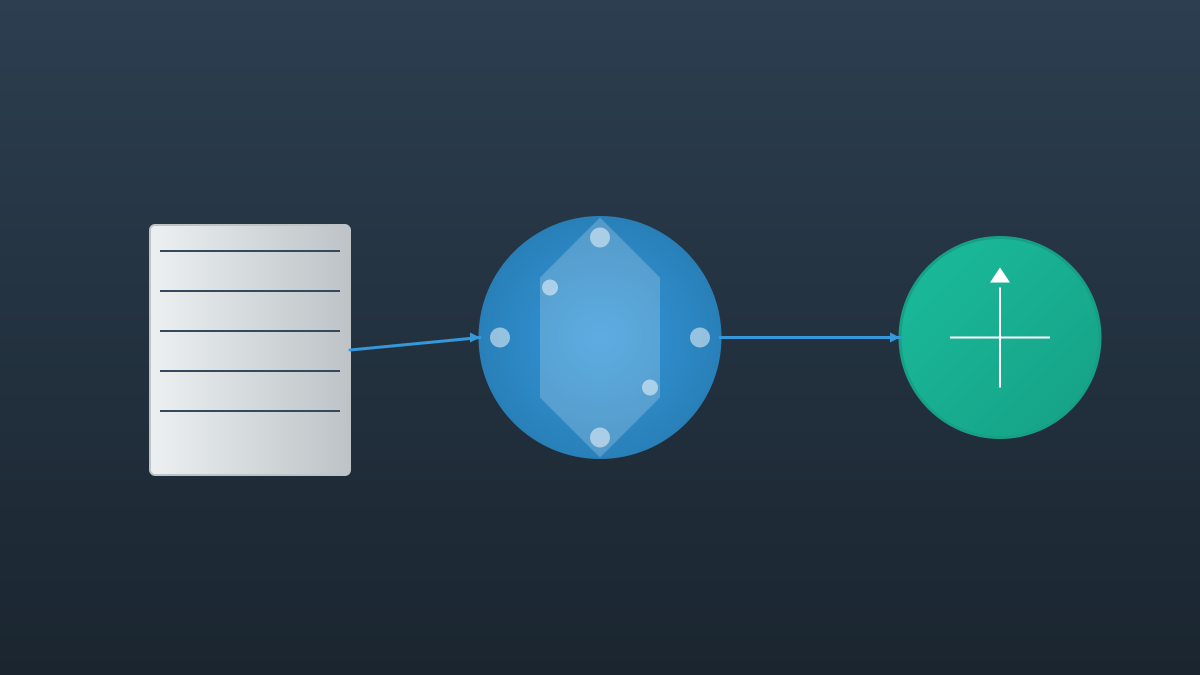
CareerPilot adopts an end-to-end design and integrates a three-layer AI technology stack:

  1. Machine Learning Layer: Handles structured data analysis and prediction, such as career path prediction models trained on historical data, which identify career trajectory patterns and predict development outcomes;
  2. Natural Language Processing Layer: Focuses on unstructured text understanding and generation, with the core being resume parsing (extracting information such as education/work experience and skills, involving named entity recognition, text classification, and semantic similarity calculation);
  3. Generative AI Layer: Generates personalized career recommendations, learning path planning, and skill improvement plans based on user profiles, leveraging the context understanding and generation capabilities of large language models.
4

Section 04

Core Function Analysis

Core Function Analysis

  1. Intelligent Resume Analysis: Automatically extracts key information from resumes and builds structured user profiles, including in-depth semantic understanding (such as skill correlation and in-depth evaluation of work experience);
  2. Career Path Prediction: Combines industry trends and personal ability assessment to predict possible career development paths, quantifying the success probability and potential of each path;
  3. Skill Gap Identification: Based on semantic analysis of skill graphs, compares users' existing skills with target job requirements to accurately identify gaps;
  4. Personalized Improvement Recommendations: Generates specific learning resource recommendations, path planning, and time arrangements to form a complete action plan.
5

Section 05

Highlights and Challenges of Technical Implementation

Highlights and Challenges of Technical Implementation

As a full-stack application, CareerPilot needs to coordinate multiple heterogeneous AI models (document understanding models, structured data ML models, large language models). Key challenges include designing data flows, managing model dependencies, and ensuring system response speed.

6

Section 06

Application Value and Significance

Application Value and Significance

  • Reduces the threshold for career consulting, promotes educational equity, and allows more people to access professional guidance;
  • Helps job seekers objectively recognize their strengths and weaknesses and make rational career decisions;
  • Provides educational institutions with auxiliary means for vocational education, helping students plan their learning paths.
7

Section 07

Limitations and Future Outlook

Limitations and Future Outlook

Limitations: As a learning/experimental project, it faces challenges such as data quality, model generalization ability, and privacy protection. It is difficult to fully capture the complexity of the job market, as well as the randomness and subjective preferences in personal development; Outlook: It represents the application direction of AI in the human resources field. With technological progress and data accumulation, it is expected to improve accuracy, personalization, and practicality, becoming an intelligent assistant for career development.

