Zing Forum

Reading

CacheGen: Analysis of KV Cache Compression and Streaming Transmission Technology for Large Language Model Inference Acceleration

An in-depth analysis of CacheGen, an innovative method that significantly reduces inference latency of large language models through quantized compression and streaming transmission of KV cache, covering technical principles, implementation details, and performance analysis.

CacheGenKV缓存压缩大语言模型推理优化量化技术流式传输Transformer分布式推理显存优化长上下文
Published 2026-04-30 08:37Recent activity 2026-04-30 10:13Estimated read 6 min
CacheGen: Analysis of KV Cache Compression and Streaming Transmission Technology for Large Language Model Inference Acceleration
1

Section 01

[Introduction] Core Analysis of CacheGen Technology: KV Cache Compression and Streaming Transmission Boost Large Model Inference Acceleration

CacheGen is an innovative technology addressing the memory and communication bottlenecks of KV cache in large language model (LLM) inference. Its core lies in quantized compression (channel-aware quantization + dynamic bit allocation) and streaming transmission architecture. While ensuring generation quality, it significantly reduces inference latency, cuts down GPU memory usage, and supports longer context processing. This technology can be seamlessly integrated into mainstream inference frameworks like vLLM and TensorRT-LLM, providing efficient solutions for scenarios such as long-context dialogue and document analysis.


2

Section 02

[Background] KV Cache Bottlenecks and Challenges in Large Model Inference

As LLM scales grow, inference efficiency and cost control become key to deployment. In autoregressive generation, KV cache avoids redundant computations but brings enormous memory bandwidth pressure and storage overhead. In long-context scenarios, KV cache grows linearly with sequence length, becoming the main consumer of GPU memory, limiting context length and causing inference latency (frequent memory swaps slow down speed when cache cannot reside in high-speed memory).

3

Section 03

[Technical Approach] Core Principles and Implementation Details of CacheGen

Core Principles

  1. KV Cache Quantized Compression: Channel-aware quantization—independently calculate scaling factors and zero points for each channel to retain key information;
  2. Dynamic Bit Allocation: Adjust quantization bit count based on the time distance between the cache and current generation position (recent cache uses high precision, early cache uses high compression ratio);
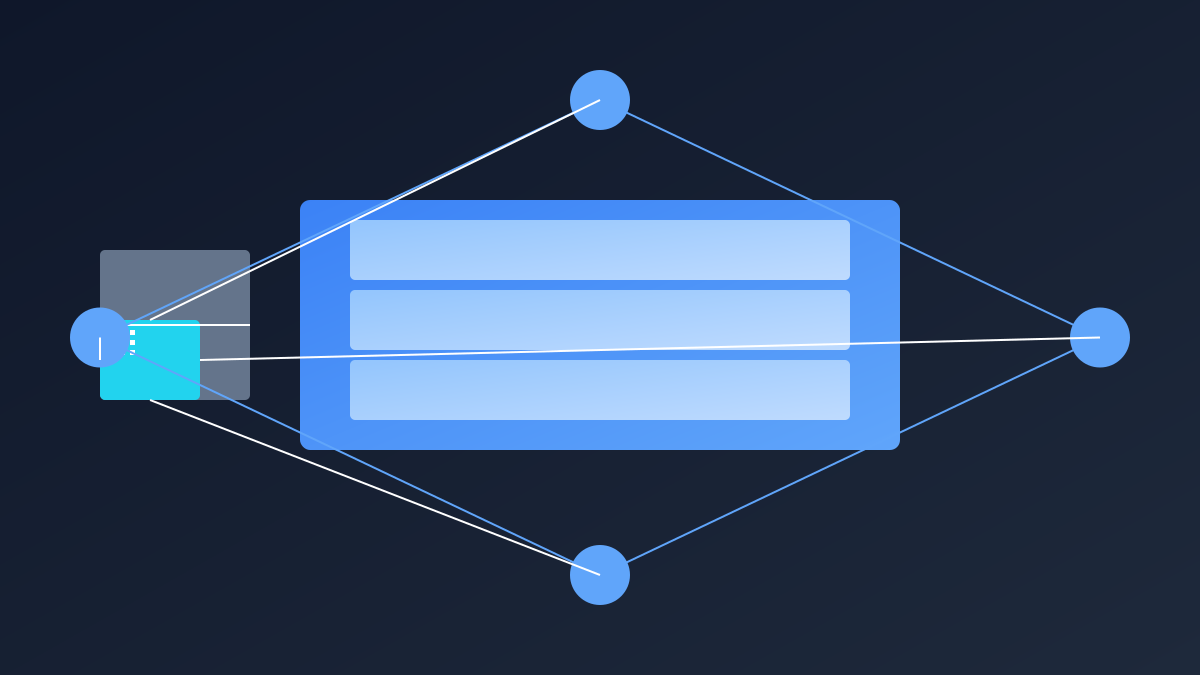
  3. Streaming Transmission Architecture: Split compressed cache into small blocks and incrementally transmit cache corresponding to new tokens, reducing communication overhead in distributed inference.

Implementation Details

  • Quantization Encoder: Non-uniform quantization + entropy coding, optimized reconstruction accuracy based on channel distribution characteristics;
  • Cache Reconstruction: Residual-aware strategy to control cumulative quantization errors;
  • Framework Integration: Standardized interfaces compatible with mainstream inference engines, no need to modify models or retrain.
4

Section 04

[Experimental Evidence] Performance Evaluation Results of CacheGen

  1. Compression Ratio and Quality: In dialogue tasks, compressed to 10%-25% of original size; generation quality (perplexity, human evaluation) under 4-bit quantization is close to uncompressed;
  2. Inference Latency: In distributed scenarios, end-to-end latency reduced by 30%-50% when sequence length >8K;
  3. Memory Optimization: On A100 GPU, context length increased by 2-4 times, supporting longer text processing.
5

Section 05

[Application Scenarios] Practical Value and Applicable Fields of CacheGen

  • Long-context dialogue: Save longer dialogue history under limited memory, improve user experience coherence;
  • Document analysis and generation: Process long documents like entire contracts or medical records, avoiding fragmented information from segmentation;
  • Edge device deployment: Reduce memory usage, making it possible to run LLMs of a certain scale on mobile devices.
6

Section 06

[Conclusion and Outlook] Limitations and Future Directions of CacheGen

Limitations

  • Quantized compression is lossy; conservative strategies are needed for high-precision scenarios (mathematical reasoning, code generation);
  • Streaming transmission has requirements for network topology and protocols; performance in heterogeneous/high-latency environments needs optimization.

Future Directions

Explore learning-based compression coding, adaptive bit allocation, and cache compression for multimodal models.

Summary

CacheGen effectively solves the KV cache bottleneck, provides tools for efficient and scalable LLM services, and is an important progress in the field of inference optimization.

