Zing Forum

Reading

Azure Cloud-Based RAG Framework: Practice of Enterprise-Level Intelligent Proposal Generation System

This article introduces an enterprise-level automatic proposal generation framework based on Retrieval-Augmented Generation (RAG) technology. The system integrates Azure cloud services, multi-source data warehouses, and large language models to achieve intelligent conversion from fragmented information to structured proposals, significantly improving the work efficiency of pre-sales teams.

检索增强生成RAGAzure云提案生成企业AI大语言模型知识管理售前自动化智能文档
Published 2026-03-31 08:00Recent activity 2026-04-03 00:52Estimated read 8 min
Azure Cloud-Based RAG Framework: Practice of Enterprise-Level Intelligent Proposal Generation System
1

Section 01

[Introduction] Azure Cloud-Based RAG Framework: Practice of Enterprise-Level Intelligent Proposal Generation System

This article introduces an enterprise-level automatic proposal generation framework based on Retrieval-Augmented Generation (RAG) technology. The system integrates Azure cloud services, multi-source data warehouses, and large language models to realize intelligent conversion from fragmented information to structured proposals. It primarily addresses the pain points in traditional pre-sales document writing, such as heavy reliance on manual work, time-consuming and labor-intensive processes, and information omissions, significantly improving the work efficiency and proposal quality of pre-sales teams, and providing a feasible path for the implementation of LLMs in enterprise scenarios.


2

Section 02

Pain Points and Opportunities in Pre-Sales Document Writing

In the enterprise sales process, proposal quality directly affects the success or failure of business opportunities, but the traditional writing mode is highly dependent on manual work: sales personnel need to retrieve information from scattered document warehouses, emails, and historical cases and integrate them manually, which is time-consuming and prone to omissions or version inconsistencies. Industry research shows that pre-sales personnel spend more than 40% of their working time on document preparation, most of which are repetitive tasks. With the accumulation of enterprise knowledge assets, efficiently utilizing scattered heterogeneous information has become a key breakthrough to improve sales efficiency.

3

Section 03

RAG Architecture and Azure Cloud-Native System Design

Large Language Models (LLMs) face issues of knowledge timeliness and hallucination risks in enterprise scenarios. The Retrieval-Augmented Generation (RAG) architecture solves these problems by retrieving external knowledge bases in real time. This system is designed based on Azure cloud-native:

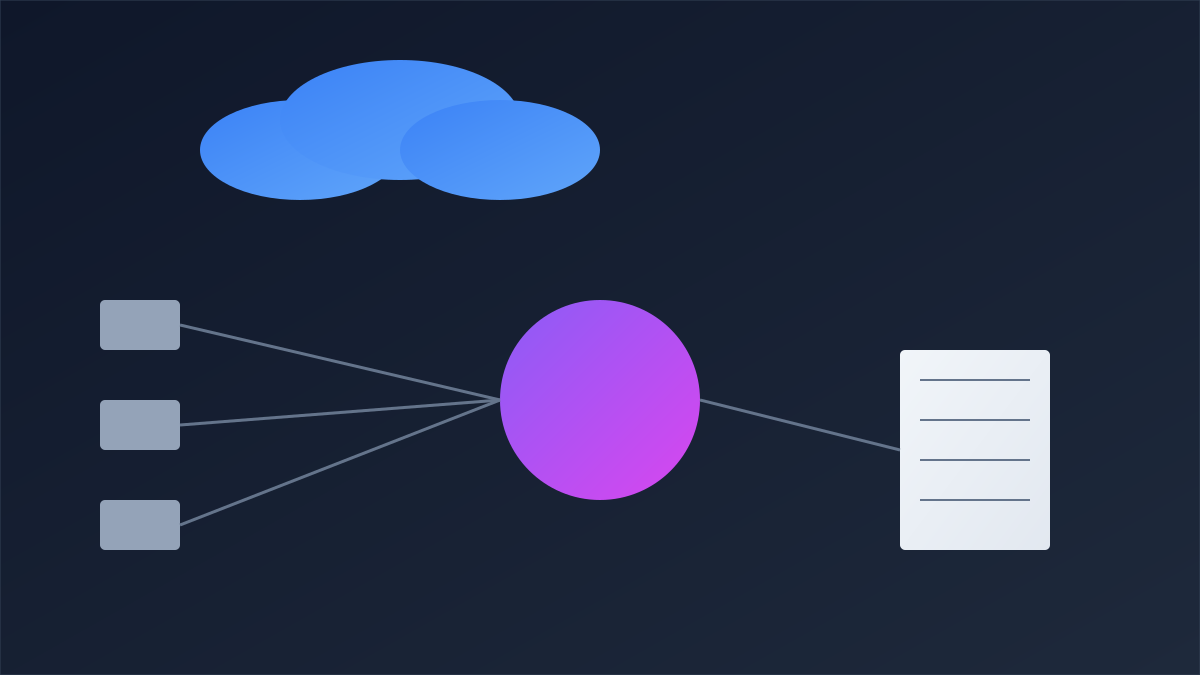
  1. Multi-source Data Integration Layer: Connects to heterogeneous data sources such as SharePoint, OneDrive, and Blob Storage, automatically parses formats like PDF, Word, and Excel, and builds indexes;
  2. Retrieval Engine: Adopts the hybrid vector retrieval + keyword search mode of Azure Cognitive Search, combined with query intent recognition and entity extraction;
  3. Generation Engine: Uses Azure OpenAI service, organizes retrieval fragments through a dynamic prompt construction mechanism to ensure content traceability.
4

Section 04

Experimental Evaluation: Dual Improvement in Efficiency and Quality

A three-month enterprise experimental evaluation shows:

  • Efficiency Improvement: The average time for proposal preparation was reduced from 4.2 hours to 102 milliseconds for retrieval and generation plus manual review and adjustment, reducing manual input in document drafting by about 70%;
  • Quality Evaluation: 85% of participants believed that the generated proposals could be used directly or only needed minor modifications, performing well in terms of relevance, completeness, and consistency;
  • Comparison Experiment: The RAG solution outperforms pure LLM generation (with factual errors) and traditional keyword retrieval + template filling (lack of flexibility) in accuracy, flexibility, and generation quality.
5

Section 05

Implementation Challenges and Countermeasures

Practical deployment faces three major challenges and corresponding countermeasures:

  1. Data Governance and Privacy: Ensure security through mechanisms such as TLS transmission encryption, Azure managed key storage encryption, fine-grained permission control, and data desensitization;
  2. Knowledge Base Maintenance: Automatically monitor document changes to incrementally update indexes, establish quality scoring mechanisms, and ensure timeliness and accuracy through human-machine collaborative review;
  3. User Acceptance: Alleviate resistance through hierarchical training, gradual promotion, and clear positioning of AI as an "assistant".
6

Section 06

Future Outlook: From Proposal Generation to Intelligent Sales Assistant

The system can be expanded in the following directions in the future:

  1. Multi-modal Expansion: Integrate Azure AI Vision/Speech services to support retrieval and generation of rich media content such as videos, charts, and 3D models;
  2. Personalized Optimization: Generate personalized proposals based on customer profiles and historical data, and continuously optimize strategies through A/B testing;
  3. End-to-End Sales Automation: Integrate with CRM, email automation, and contract management tools to build a full-process intelligent sales workflow.
7

Section 07

Conclusion: RAG Reshapes the Form of Enterprise Knowledge Work

The Azure cloud-based RAG proposal generation framework effectively solves the efficiency bottlenecks and information fragmentation problems in traditional pre-sales document writing. It combines retrieval accuracy and generation flexibility, providing a path for the enterprise implementation of LLMs. With the evolution of technology and the deepening of digital transformation, intelligent document generation will evolve from an auxiliary tool to a core competitiveness, reshaping the future form of enterprise knowledge work.

