Zing Forum

Reading

AWS IoT Greengrass Edge Face Recognition System: A Machine Learning Practice for Low Latency and Privacy Protection

An edge computing face recognition solution built on AWS IoT Greengrass and Lambda, implementing a hybrid architecture of local detection and cloud recognition, balancing real-time performance and data privacy protection.

边缘计算人脸识别AWS IoT GreengrassLambdaPyTorch隐私保护机器学习物联网
Published 2026-05-21 08:45Recent activity 2026-05-21 08:53Estimated read 6 min
AWS IoT Greengrass Edge Face Recognition System: A Machine Learning Practice for Low Latency and Privacy Protection
1

Section 01

Introduction: Core Solution of AWS Edge Face Recognition System

This project builds a face recognition system with a hybrid edge-cloud architecture based on AWS IoT Greengrass and Lambda. Through the collaboration of local detection and cloud recognition, it addresses the network latency and sensitive data privacy risks of traditional cloud-based solutions, balancing real-time performance and data security protection.


2

Section 02

Project Background and Core Challenges

Face recognition technology is widely used in scenarios such as security, access control, and retail. However, traditional cloud-based solutions face two major pain points: network latency leading to slow responses, and privacy risks from uploading sensitive image data. The edge computing architecture performs initial processing on the device side, ensuring real-time performance while reducing the transmission of sensitive data. This project is built based on this idea.

3

Section 03

System Architecture Design and Tech Stack Analysis

System Architecture

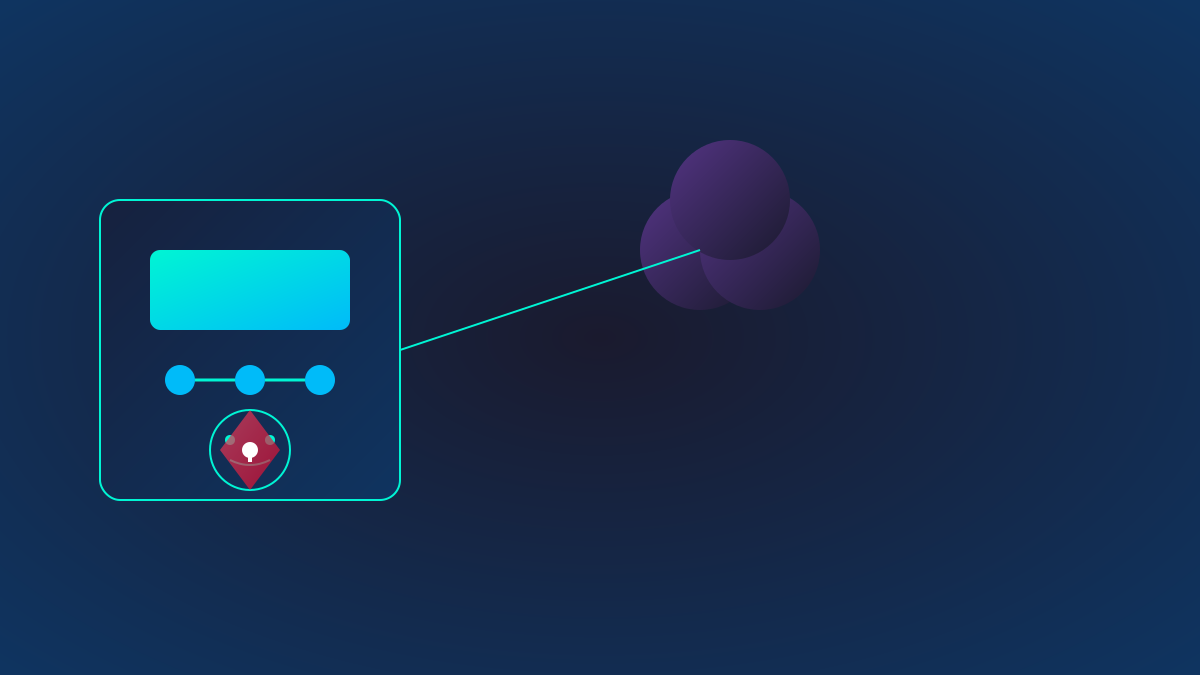
Adopts a layered architecture:

  • Edge Layer: Real-time face detection on the device side, only uploading frames containing faces or feature data to reduce bandwidth and cloud pressure;
  • Cloud Layer: AWS Lambda handles core recognition tasks, combined with Amazon SQS for asynchronous processing, and PyTorch provides deep learning inference;
  • Communication Layer: AWS IoT Core and MQTT protocol enable secure bidirectional communication.

Tech Stack

Involves services such as AWS IoT Greengrass, Lambda, SQS, PyTorch, EC2, etc., embodying the cloud-native design philosophy.

4

Section 04

Application Scenarios and Value Proposition

This architecture is suitable for:

  • Smart Access Control: Local detection of face presence, cloud identity verification, millisecond-level response, and avoiding unauthorized image uploads;
  • Retail Foot Traffic Analysis: Edge-side statistics of number of people and stay duration, only transmitting aggregated data to protect privacy while providing business insights;
  • Industrial Safety Monitoring: Local detection of safety equipment wearing status, real-time alerts, and cloud-based record tracing.
5

Section 05

Privacy Protection Mechanisms

The edge computing architecture inherently protects privacy: raw video is processed locally, only filtered data is transmitted. Enhanced with AWS security services:

  • TLS encryption for device-cloud communication;
  • Local key management and secure storage via AWS IoT Greengrass;
  • Isolation of Lambda execution environments;
  • Configurable data retention policies to automatically clean up expired records.
6

Section 06

Deployment and Scaling Recommendations

Recommendations for developers:

  1. Device Selection: Ensure edge devices have sufficient computing power and consider power consumption and heat dissipation;
  2. Model Optimization: Quantize and prune PyTorch models to reduce inference latency;
  3. Network Disaster Recovery: Design offline mode so that edge devices can run basic functions independently when the network is interrupted;
  4. Monitoring and Operation: Use AWS CloudWatch to uniformly monitor the health status of edge and cloud components.
7

Section 07

Project Summary

This project demonstrates a practical edge AI implementation solution. Instead of pursuing running complete complex models on the edge, it reasonably distributes tasks—edge is responsible for "seeing", cloud is responsible for "recognizing". This layered strategy balances latency, cost, and privacy, providing a reference architecture paradigm for similar applications.

