Zing Forum

Reading

AURONIS: An LLM-Powered Intelligent Code Review and Vulnerability Detection System

This article provides an in-depth analysis of the AURONIS project, exploring how it leverages large language models (LLMs) to enable real-time code scanning, multi-dimensional defect detection, and automated repair suggestions, offering new insights for improving code quality and development efficiency.

代码审查大语言模型LLM代码质量漏洞检测静态分析AI编程安全漏洞代码异味自动化修复
Published 2026-08-11 23:21Recent activity 2026-08-11 23:26Estimated read 9 min
AURONIS: An LLM-Powered Intelligent Code Review and Vulnerability Detection System
1

Section 01

[Introduction] AURONIS: Core Introduction to the LLM-Driven Intelligent Code Review System

AURONIS: An LLM-Powered Intelligent Code Review and Vulnerability Detection System

Project Core: Leverage large language models to implement real-time code scanning, multi-dimensional defect detection, and automated repair suggestions, improving code quality and development efficiency. Original Author/Maintainer: MUKILAN729 Source: GitHub Project (https://github.com/MUKILAN729/AURONIS) Release Time: August 11, 2026

This article will analyze the system from dimensions such as background, architecture, advantages, and challenges.

2

Section 02

Background: Code Quality Challenges and the Rise of AI Solutions

Code Quality Challenges and AI-Era Solutions

With the increasing complexity of software development, traditional manual reviews face issues like fatigue-induced omissions, long cycles, and high costs (the cost of fixing defects during coding is only 1% of that in the production environment). Static analysis tools (e.g., SonarQube) are limited by rule bases and struggle to handle complex logic and security vulnerabilities.

The semantic understanding capability of large language models (LLMs) brings new possibilities to code analysis. AURONIS is a practice of this trend: moving from syntax checking to semantic understanding, and from passive discovery to active repair suggestions.

3

Section 03

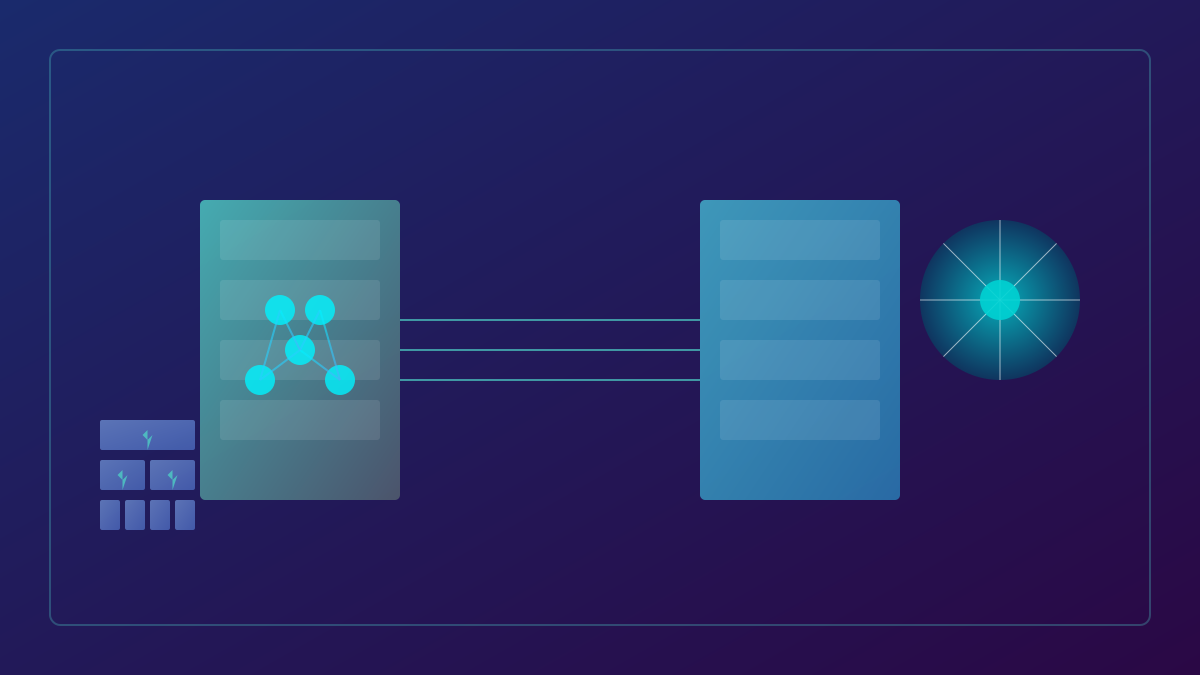
System Architecture: LLM-Driven Multi-Dimensional Detection Capabilities

System Architecture: LLM-Driven Multi-Dimensional Detection

Core Capabilities

  1. Real-Time Code Scanning: Analyze code instantly during development, aligning with the "shift-left" concept to reduce repair costs.
  2. Multi-Dimensional Defect Detection:
    • Syntax errors: Friendly explanations and repair suggestions
    • Code smells: Identify long functions, duplicate code, etc.
    • Logical defects: Null pointers, array out-of-bounds, etc.
    • Security vulnerabilities: SQL injection, XSS, etc.
  3. Line-Level Feedback and Repair Suggestions: Provide specific repair code to lower the threshold for problem-solving.
4

Section 04

Four Key Advantages of LLMs in Code Analysis

Advantages of LLMs in Code Analysis

Compared to traditional tools, LLMs have:

  1. Semantic Understanding: Grasp code intent and detect complex logical vulnerabilities
  2. Context Awareness: Provide contextually relevant suggestions (e.g., variable naming)
  3. Cross-Language Compatibility: Handle multiple languages with a unified model, adapting to multi-tech-stack teams
  4. Natural Language Interaction: Describe inspection requirements in natural language, lowering the usage barrier

These advantages stem from the pre-training of LLMs on massive code repositories.

5

Section 05

Key Challenges in Technical Implementation and Countermeasures

Key Challenges in Technical Implementation

  1. Prompt Engineering: Design prompts that include sufficient context and standardize output, balancing information and window limits
  2. Result Parsing and Validation: Filter incorrect suggestions, provide confidence scores, and validate repair code
  3. Performance Optimization: Use code chunking, parallel analysis, and caching to balance accuracy and response speed
  4. Cost Control: Analyze changed code, deploy open-source models locally, and use caching to avoid repeated calls

These challenges directly affect the system's reliability and practicality.

6

Section 06

Application Scenarios: Value from Individual Development to Team Collaboration

Application Scenarios and Value Proposition

  1. Individual Developers: Get real-time feedback to learn coding practices, helping beginners get started and veterans catch omissions
  2. Code Review Phase: AI pre-reviews basic issues, allowing humans to focus on architecture and business logic
  3. Legacy Code Maintenance: Quickly scan potential problem areas and provide maintenance entry points
  4. Security Audits: Assist in identifying common vulnerabilities, letting experts focus on complex attack surfaces

Integrating the tool into IDEs and CI/CD pipelines improves adoption rates.

7

Section 07

Limitations and Usage Recommendations

Limitations and Usage Recommendations

Limitations

  • Hallucination Issue: May provide incorrect or non-compilable suggestions
  • Context Limits: Chunked analysis of ultra-large projects loses the global perspective
  • Domain Knowledge Gap: General LLMs lack understanding of specific business constraints
  • Privacy and Security: Cloud APIs may leak sensitive code

Usage Recommendations

  • Verify AI suggestions and do not adopt them blindly
  • Choose local/private deployment for sensitive code
  • Optimize the model with domain knowledge bases

Maintaining critical thinking is key.

8

Section 08

Summary and Future Outlook

Summary and Future Outlook

AURONIS demonstrates the application value of LLMs in the code review field, enhancing development experience through real-time scanning and intelligent suggestions. However, technology is just a tool—code quality requires a combination of developer awareness and team culture. The ideal state is human-AI collaboration: AI handles repetitive tasks, while humans focus on creative decision-making.

Future Directions:

  • Proactive code generation and refactoring
  • Cross-file global analysis
  • Personalized learning to adapt to developer habits
  • Multi-modal interaction (voice/visualization)

AI-assisted development tools will become a standard for developers.

