Zing Forum

Reading

ANN Customer Churn Prediction Project: Production-Grade Application Based on Artificial Neural Networks

This project is a production-ready application for customer churn prediction using Artificial Neural Networks (ANN), equipped with a Streamlit interactive interface, which can be used to formulate customer retention strategies in real business scenarios.

人工神经网络客户流失预测Streamlit深度学习生产就绪分类模型客户保留业务应用
Published 2026-06-07 16:44Recent activity 2026-06-07 16:54Estimated read 10 min
ANN Customer Churn Prediction Project: Production-Grade Application Based on Artificial Neural Networks
1

Section 01

ANN Customer Churn Prediction Project: Guide to Production-Grade Deep Learning Application

ANN Customer Churn Prediction Project: Guide to Production-Grade Deep Learning Application

Original Author/Maintainer: pavankuma38767-bit Source Platform: GitHub Original Link: https://github.com/pavankuma38767-bit/ANN-PROJECT Release Date: June 7, 2026

Customer churn is a core challenge for enterprises; the cost of acquiring new customers is 5-25 times that of retaining existing ones. This project provides a production-ready customer churn prediction solution, with Artificial Neural Network (ANN) as the core model, paired with a Streamlit interactive web interface, which can be directly deployed to formulate customer retention strategies.


2

Section 02

Business Background and Commercial Value of Churn Prediction

Business Background and Commercial Value of Churn Prediction

What is Customer Churn

A phenomenon where customers terminate their business relationship with an enterprise, such as canceling subscriptions or switching to competitors.

Commercial Value of Churn Prediction

  1. Reduce marketing costs: Focus resources on high-risk customers
  2. Increase customer lifetime value: Timely intervention to extend the lifecycle
  3. Optimize product strategy: Identify reasons for churn
  4. Improve customer experience: Proactively solve pain points
  5. Enhance competitive advantage: Take early action to prevent customer churn

Challenges in Predictive Modeling

  • Data imbalance (churned customers are a minority)
  • Multiple factors affecting churn reasons
  • Dynamic changes in customer behavior
  • Feature engineering needs to extract effective features
  • Business needs to understand the basis of predictions
3

Section 03

Technical Architecture: ANN Model and Streamlit Interactive Interface

Technical Architecture: ANN Model and Streamlit Interactive Interface

Artificial Neural Network (ANN) Design

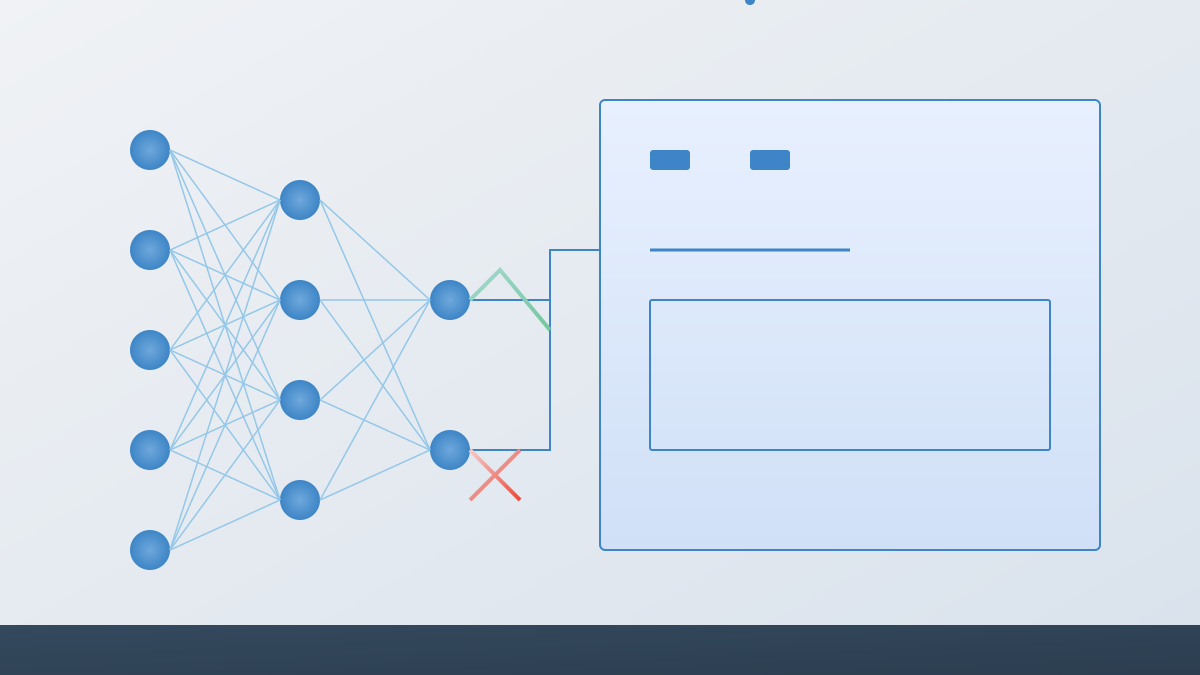
Network Architecture

  • Input Layer: Receives customer features (demographics, account, usage behavior, billing, service history)
  • Hidden Layers: 2-3 layers, ReLU activation, Dropout for overfitting prevention, Batch Normalization to accelerate training
  • Output Layer: Single neuron, Sigmoid output for 0-1 churn probability

Training Strategy

  • Loss function: Binary cross-entropy
  • Optimizer: Adam
  • Class balance: Class weights, SMOTE oversampling, undersampling
  • Early stopping and K-fold cross-validation

Streamlit Interface Features

  1. Data upload: Supports CSV/Excel, preview and validation
  2. Single customer prediction: Form input, real-time display of churn probability and risk level
  3. Batch prediction: Upload list, export report
  4. Visualization: Risk distribution, feature importance, model performance
  5. Model interpretation: SHAP values, key influencing factors

Tech Stack

Python, TensorFlow/Keras, scikit-learn, pandas, numpy, Streamlit, plotly/matplotlib, SHAP

4

Section 04

Data Processing and Model Training Workflow

Data Processing and Model Training Workflow

Data Preprocessing

  1. Data cleaning: Handle missing values, outliers, type conversion
  2. Feature engineering: Category encoding, numerical standardization, feature combination, time extraction
  3. Feature selection: Correlation analysis, recursive elimination, model importance

Training Workflow

  1. Data splitting: Training set (70%), validation set (15%), test set (15%)
  2. Model training: Batch training, learning rate scheduling, validation monitoring
  3. Evaluation metrics: Accuracy, precision, recall, F1 score, AUC-ROC, confusion matrix
5

Section 05

Key Considerations for Production Deployment

Key Considerations for Production Deployment

Model Persistence

  • Save as HDF5/SavedModel format
  • Preprocessing pipeline serialization
  • Version control and model management

Performance Optimization

  • Model quantization to reduce inference time
  • Batch processing to improve throughput
  • Cache frequently used queries

Monitoring and Maintenance

  • Model drift detection
  • Performance monitoring dashboard
  • Regular retraining mechanism
  • A/B testing framework

Security

  • Input validation
  • Data privacy protection
  • Access control
  • Audit logs
6

Section 06

Practical Application Scenarios and Cases

Practical Application Scenarios and Cases

Telecommunications Industry

  • Prediction target: Customer service cancellation
  • Key features: Contract type, monthly consumption, number of customer service calls
  • Intervention measures: Preferential packages, dedicated customer service

Subscription Services (SaaS/Streaming)

  • Prediction target: Subscription cancellation
  • Key features: Usage frequency, feature usage, support tickets
  • Intervention measures: Personalized recommendations, discounted renewal

Financial Services

  • Prediction target: Account closure/credit card cancellation
  • Key features: Transaction patterns, balance changes, complaint records
  • Intervention measures: Dedicated advisor, rate adjustment
7

Section 07

Project Highlights and Improvement/Expansion Directions

Project Highlights and Improvement/Expansion Directions

Project Highlights

  1. End-to-end solution: Covers data processing → model training → web deployment → production considerations
  2. Practicality: Streamlit interface lowers the threshold for use, supports real-time feedback and visualization
  3. Best practices: Code modularization, configuration management, error handling, logging

Improvement Directions

Model Enhancement

Ensemble learning, time-series modeling (RNN/LSTM), transfer learning, AutoML

Feature Expansion

Real-time monitoring, automated intervention, customer segmentation, lifecycle prediction

Technical Upgrade

RESTful API, Docker containerization, cloud hosting, mobile support

8

Section 08

Project Summary and Value

Project Summary and Value

This project is a practical customer churn prediction solution, combining the predictive power of ANN with the convenient Streamlit interface to provide a production-grade application.

For developers: A complete reference implementation covering the entire workflow of data processing, model training, web development, and deployment. For business users: An intuitive tool to convert data into actionable customer retention strategies.

Customer churn prediction is a successful case of machine learning business applications, and this project demonstrates the transformation from academic concepts to practical value, which is worthy of attention from data scientists and engineers.

