Zing Forum

Reading

Amor Distributed Artificial Intelligence System: Building a Connected Cluster of Independent AIs

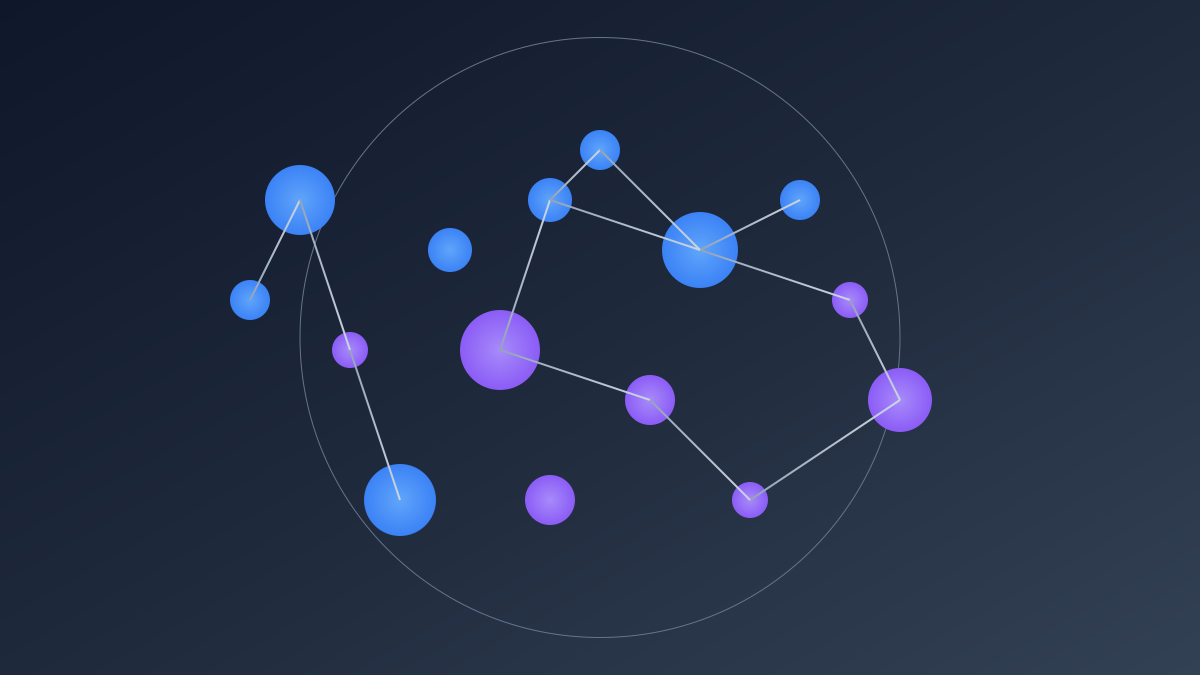
Exploring how the Amor project builds a distributed AI connection system cluster to enable collaboration and communication between independent AI models.

分布式AI多智能体系统AI集群模型路由群体智能异构模型任务调度去中心化
Published 2026-04-28 08:34Recent activity 2026-04-28 09:01Estimated read 8 min
Amor Distributed Artificial Intelligence System: Building a Connected Cluster of Independent AIs
1

Section 01

Amor Distributed AI System: Core Vision for Building a Connected Cluster of Independent AIs

The Amor Distributed Artificial Intelligence System project aims to build a connection network for independent AI systems, enabling multiple specialized AI models to work collaboratively to form collective intelligence, thereby addressing the limitations of single models (such as exponential growth in training costs, low efficiency in specific tasks, and single point of failure risks). This project explores distributed AI architecture paths, drawing inspiration from swarm intelligence phenomena in nature, as an alternative to the development direction of traditional monolithic supermodels.


2

Section 02

Background: Limitations of Monolithic AI Models and Exploration of Distributed Paths

The current mainstream AI paradigm focuses on building large monolithic models (e.g., GPT-4, Claude, Gemini), but faces constraints such as exponential growth in training costs, low efficiency in specific tasks due to generalized capabilities, and single point of failure risks. The Amor project explores distributed AI architecture, with the core idea of building an ecosystem composed of multiple specialized AIs to enable autonomous discovery, negotiated task allocation, information sharing, and collaborative resolution of complex problems, drawing inspiration from swarm intelligence phenomena like ant colonies and bee colonies.

3

Section 03

Methodology: Core Architecture Design of the Amor Distributed System

The Amor system is built around connected clusters, with its technical architecture including: 1. Node Discovery and Registration: A decentralized mechanism where nodes broadcast capability descriptions (model type, performance characteristics, load status); 2. Communication Protocols and Message Formats: Standardized protocols support messages such as task requests and result returns, based on JSON or Protocol Buffers, handling network unreliability and supporting end-to-end encryption; 3. Task Scheduling and Load Balancing: Scheduling based on factors like task matching degree, node load, and network latency, with strategies ranging from round-robin to reinforcement learning optimization; 4. Result Aggregation and Consistency: Comparing or merging results from multiple nodes to resolve conflicts and redundancy.

4

Section 04

Technical Challenges and Solutions

Challenges and solutions for building the Amor system: 1. Heterogeneous Model Integration: Encapsulating different models into a unified node type via an abstract interface layer (adapter pattern); 2. Latency and Synchronization: Using an asynchronous architecture for parallel work, with synchronization when necessary, and workflow engines to manage the state of complex tasks; 3. Fault Tolerance and Recovery: Heartbeat mechanisms to monitor node health, task replication strategies to ensure critical computations are not lost, and rerouting tasks when nodes fail; 4. Security and Trust: Identity authentication, permission management, result verification, and cross-validation by multiple nodes for critical tasks.

5

Section 05

Application Scenarios and Value Advantages

Advantageous scenarios for the Amor architecture include: 1. Complex multi-step tasks (e.g., research report writing): Decomposed into subtasks handled by specialized nodes; 2. Cross-modal tasks (e.g., video content understanding): Coordinating collaboration between image, voice, and natural language nodes; 3. High availability requirements: Redundant nodes ensure service continuity; 4. Cost optimization: Simple tasks routed to lightweight local models, complex tasks using cloud APIs to balance cost-effectiveness.

6

Section 06

Relationship and Differences with Existing Technologies

Relationship between Amor and related technologies: 1. Shares goals with model routing projects (LiteLLM, LangRouter), but Amor is a distributed peer-to-peer architecture, which is more ambitious than centralized routing; 2. Overlaps with multi-agent system research concepts, but emphasizes heterogeneous AI model integration rather than homogeneous agent collaboration; 3. Both Amor and federated learning involve distributed computing, but Amor focuses on collaboration during inference rather than parameter sharing during training.

7

Section 07

Current Status and Future Development Roadmap

Amor is in an active development phase, with a general framework for the web interface established, and proof of concept and core architecture design completed. Future development directions include: smarter node discovery algorithms, richer task decomposition strategies, more robust security mechanisms, and a broader development ecosystem, with the goal of becoming the infrastructure for next-generation distributed AI applications.

8

Section 08

Conclusion: Exploration Value of the Amor Project

The Amor Distributed AI System represents a bold exploration of the future form of AI architecture, questioning the inevitability of monolithic supermodels and proposing an alternative path of swarm intelligence. Regardless of success or failure, its exploration enriches the understanding of the AI system design space and is a project worth attention for researchers and developers concerned with the evolution of AI infrastructure.

