Zing Forum

Reading

In-depth Analysis of AIoT Technology Integration: Application Architecture and Practice in Smart Manufacturing, Healthcare, and Smart Cities

This article deeply explores the technical integration of Artificial Intelligence and the Internet of Things (AIoT), analyzing its system architecture design, core application scenarios, implementation challenges, and future development trends in three major fields: smart manufacturing, healthcare, and smart cities, providing a comprehensive reference framework for technical decision-makers.

AIoT人工智能物联网智能制造智慧医疗智慧城市边缘计算预测性维护数字孪生TinyML
Published 2026-05-21 05:35Recent activity 2026-05-21 05:49Estimated read 6 min
In-depth Analysis of AIoT Technology Integration: Application Architecture and Practice in Smart Manufacturing, Healthcare, and Smart Cities
1

Section 01

In-depth Analysis of AIoT Technology Integration: Application Architecture and Practice in Smart Manufacturing, Healthcare, and Smart Cities

This article deeply explores the technical integration of Artificial Intelligence and the Internet of Things (AIoT), analyzing its system architecture design, core application scenarios, implementation challenges, and future development trends in three major fields: smart manufacturing, healthcare, and smart cities, providing a comprehensive reference framework for technical decision-makers. Below, we will conduct a detailed analysis from dimensions such as technical architecture, industry applications, implementation challenges, and future trends.


2

Section 02

AIoT Technical Architecture and Core Principles

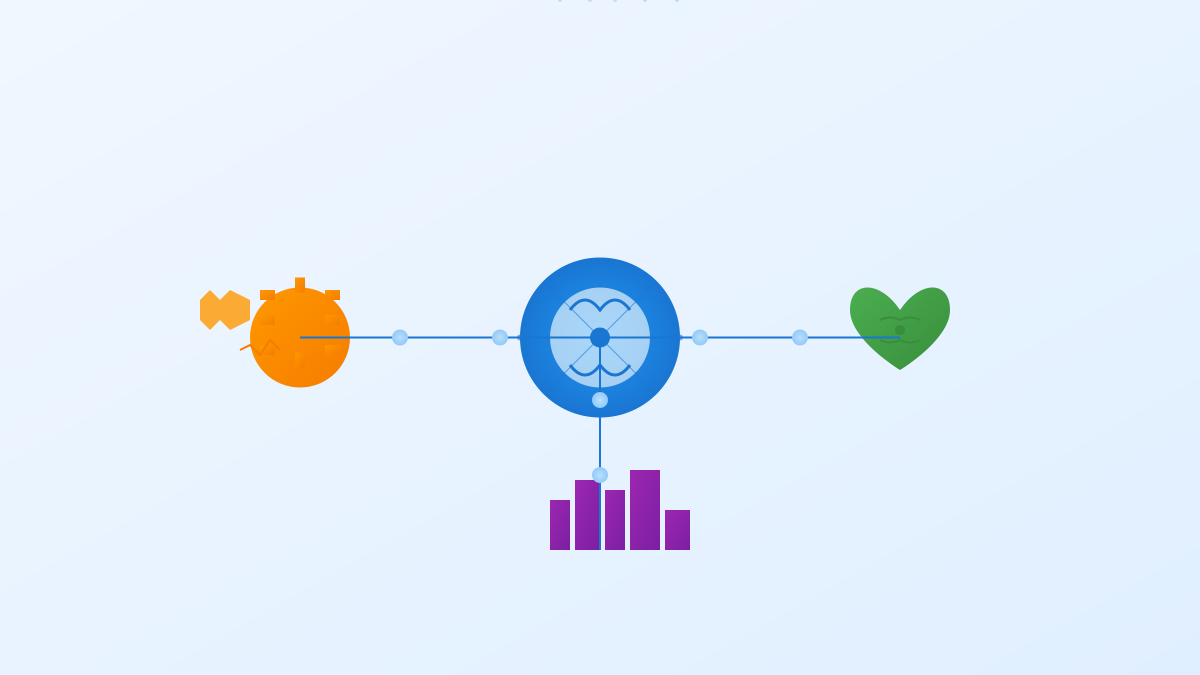
AIoT is a systematic project involving edge computing, cloud computing, communication protocols, and data pipelines. Its core architecture consists of four layers: the perception layer (sensors/actuators collect data), the network layer (transmits data via 5G/Wi-Fi6/LoRa, etc.), the platform layer (the "brain" for data storage/processing/model training), and the application layer (converts to business value such as predictive maintenance). Key technical components include edge AI chips (e.g., NVIDIA Jetson), time-series databases (e.g., InfluxDB), and MLOps pipelines.

3

Section 03

AIoT Application Practices in Key Industries

Smart Manufacturing: Promotes factories from automation to autonomy, such as predictive maintenance (reducing unplanned downtime by 30-50%), computer vision quality inspection (accuracy over 99%), and digital twins (lowering trial-and-error costs). Smart Healthcare: Shifts from treatment to prevention, such as remote patient monitoring (reducing heart failure readmission rates by 25%), intelligent diagnostic assistance (improving early cancer detection rates), and smart medication management (enhancing compliance). Smart Cities: Builds the city's nervous system, such as intelligent transportation (reducing congestion index by 15-20%), smart energy (reducing energy consumption by 20-30%), and environmental monitoring (supporting pollution control).

4

Section 04

AIoT Implementation Challenges and Countermeasures

Large-scale deployment faces four major challenges: 1. Data Security and Privacy: Requires end-to-end encryption, device authentication, and federated learning to balance intelligence and privacy; 2. System Interoperability: Promote open standards like MQTT/CoAP/OPC UA and establish a unified data model; 3. Edge Resource Constraints: Reduce complexity through model compression, quantization, and NAS (Neural Architecture Search) technologies; 4. Operational Complexity: Adopt MLOps for IoT to achieve automated device management and fault diagnosis.

5

Section 05

Future Development Trends of AIoT

Key trends include: 1. TinyML: Enable deep learning models to run on microcontrollers, unlocking edge intelligence; 2. 5G and AIoT Synergy: Reduce latency and increase bandwidth to support real-time applications; 3. Autonomous Systems: Devices have goal-driven autonomous decision-making capabilities; 4. Edge Intelligence and Digital Sovereignty: Data processing shifts to distributed edges to meet local compliance requirements.

6

Section 06

Conclusions and Key Insights for Practitioners

AIoT is the ultimate form of deep integration between information technology and the physical world. It is not just a superposition of technologies but a systematic transformation of production and lifestyle. Technical practitioners need to understand architecture design, master interdisciplinary knowledge (embedded systems/ML/networks), and focus on business value creation. As technology matures and costs decrease, AIoT will move from pilot projects to large-scale deployment and become an infrastructure for the digital economy.

