Zing Forum

Reading

Building Neural Networks from Scratch: The Educational Value and Practical Significance of the Aiga Project

Aiga is an open-source project focused on implementing machine learning models from scratch. Through modular design, it helps learners deeply understand the mathematical principles behind neural networks, rather than just calling pre-built frameworks.

machine learningneural networkseducationpythonfrom scratchbackpropagationfeedforwardopen source
Published 2026-05-14 14:54Recent activity 2026-05-14 15:02Estimated read 8 min
Building Neural Networks from Scratch: The Educational Value and Practical Significance of the Aiga Project
1

Section 01

[Introduction] The Aiga Project: Educational Practice of Building Neural Networks from Scratch

Aiga is an open-source project focused on implementing machine learning models from scratch. It aims to help learners deeply understand the mathematical principles behind neural networks, rather than just calling pre-built frameworks. Through modular design, the project allows users to write code by hand and experience the implementation process of core concepts, which has important educational value and practical significance.


2

Section 02

Project Background and Core Philosophy

The Aiga project was created to demystify machine learning and turn it into an understandable and masterable engineering technology. Its core philosophy is not to pursue efficiency or production-level performance, but to focus on educational value—allowing users to write every line of code by hand and experience the implementation process of core concepts such as forward propagation, backpropagation, and gradient descent. This "from scratch" methodology is similar to learning to write a simple kernel for an operating system or implementing a mini-compiler for compiler theory. It provides learners with the opportunity to "build the wheel" themselves, turning abstract mathematical formulas into debuggable and modifiable code, thus solidifying their theoretical knowledge.

3

Section 03

Technical Architecture and Modular Design

Aiga adopts a highly modular architecture. Each component (activation function, loss function, optimizer, etc.) can be understood, tested, and modified independently. In contrast to the complex encapsulation of mainstream frameworks, this allows learners to clearly see the flow of data through each layer of the network. The project is mainly implemented in Python, leveraging its concise syntax and scientific computing ecosystem such as NumPy to ensure code readability and portability. Deviations from Python are only considered when necessary.

4

Section 04

Implementation of Feedforward Networks: From Theory to Code

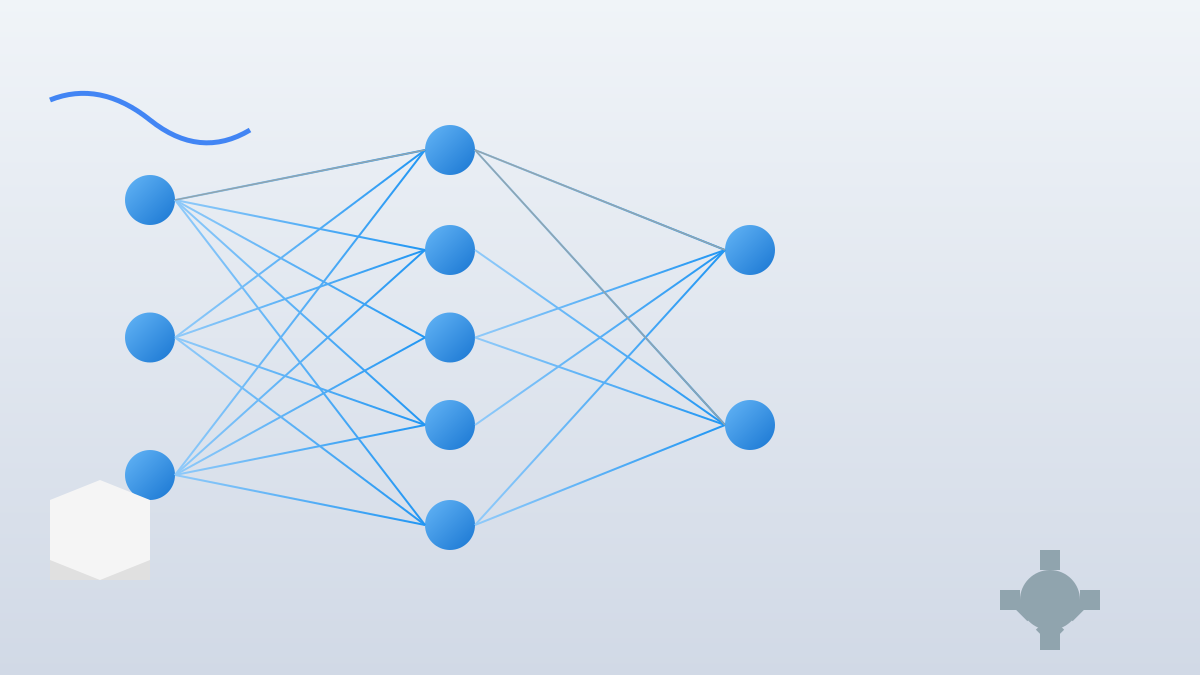
Aiga first implements basic feedforward neural networks, covering core deep learning concepts: inter-layer weight matrices, nonlinear activation functions, loss function calculation, and gradient-based parameter updates. In the implementation, the process of data flowing from the input layer to the hidden layer and then to the output layer—including the linear transformation (matrix multiplication) and nonlinear activation (e.g., ReLU, Sigmoid) of each layer—is explicitly written, rather than being hidden in underlying framework calls. This transparency simplifies debugging and experimentation; for example, testing the impact of different activation functions only requires modifying a few lines of code.

5

Section 05

Transparent Implementation of the Backpropagation Algorithm

Backpropagation is the cornerstone of neural network training and a difficult point for beginners. Aiga demonstrates each step of the algorithm through a clear code structure: calculation of output layer errors, reverse flow of gradients through layers, and weight parameter updates. The entire process is visible and traceable. This transparency is crucial for understanding classic problems such as gradient vanishing/exploding. Learners can observe gradient changes at the code level and intuitively understand the causes of these problems.

6

Section 06

Educational Value and Significance of Community Contributions

The greatest value of Aiga lies in lowering the threshold for understanding deep learning. It is a valuable resource for students, career-changers, and others who wish to deeply understand AI principles. Implementing algorithms by hand brings a deeper understanding and memory than reading textbooks or watching videos. As an open-source project, Aiga provides an entry point for community contributions. Participants deepen their understanding of machine learning while fixing bugs, adding new models, or improving documentation. "Learning by doing" is a valuable inheritance method in the technical community.

7

Section 07

Future Outlook and Practical Recommendations

Aiga is expected to develop into a complete educational tool library, covering various models from linear regression to convolutional and recurrent neural networks. For beginners, it can serve as an ideal starting point to build a theoretical foundation before engaging with production-level frameworks. For experienced developers, it provides an experimental platform to verify new ideas or for teaching demonstrations; its concise code structure facilitates rapid prototype validation. Aiga reminds us that the essence of technology is more important than tool usage. Building neural networks from scratch not only helps master implementation skills but also cultivates core competencies such as deeply understanding problems and disassembling complex systems.

