Zing Forum

Reading

AI Financial Dashboard: A Comprehensive Solution for Intelligent Financial Management

This article introduces an intelligent financial management system integrated with artificial intelligence technology. The system analyzes financial data, predicts consumption patterns via AI, and provides real-time insights through interactive charts to assist individuals and families in making financial decisions.

智能财务个人理财消费预测数据可视化人工智能预算管理投资跟踪
Published 2026-05-09 00:25Recent activity 2026-05-09 00:32Estimated read 7 min
AI Financial Dashboard: A Comprehensive Solution for Intelligent Financial Management
1

Section 01

AI Financial Dashboard: A Comprehensive Solution for Intelligent Financial Management (Introduction)

This article introduces the AI Financial Dashboard system integrated with artificial intelligence technology, which aims to solve the problem of traditional bookkeeping tools lacking in-depth analysis. The system provides one-stop financial decision support for individuals and families by intelligently analyzing financial data, predicting consumption patterns, and offering real-time insights through interactive charts. Its core functions include income and expenditure tracking, savings management, investment monitoring, and AI-driven analytical insights.


2

Section 02

Project Background and Limitations of Traditional Tools

Personal financial management is an important issue in modern life, but traditional bookkeeping tools can only record income and expenditure, lacking in-depth data analysis and intelligent insights. The AI Finance Dashboard project emerged to try to introduce AI technology into this field to provide more comprehensive financial decision support.

3

Section 03

Core Methods and Technology Applications

AI Technology Applications

  1. Pattern recognition: Analyze historical transaction data, automatically classify consumption habits and periodic expenses, and reduce manual bookkeeping workload;
  2. Consumption prediction: Based on time series analysis and machine learning models, predict future expenditure trends to assist budget planning;
  3. Anomaly detection: Identify abnormal transactions (e.g., large expenditures, repeated deductions) and alert users to prevent fraud and impulsive consumption.

Technical Implementation Considerations

  • Data security: Encrypted transmission and storage, strict access control;
  • AI models: Need to be trained/fine-tuned on user data, balancing personalization and interpretability;
  • Third-party integration: Connect to bank/investment accounts, handle data format conversion and standardization.

Data Visualization and Interaction

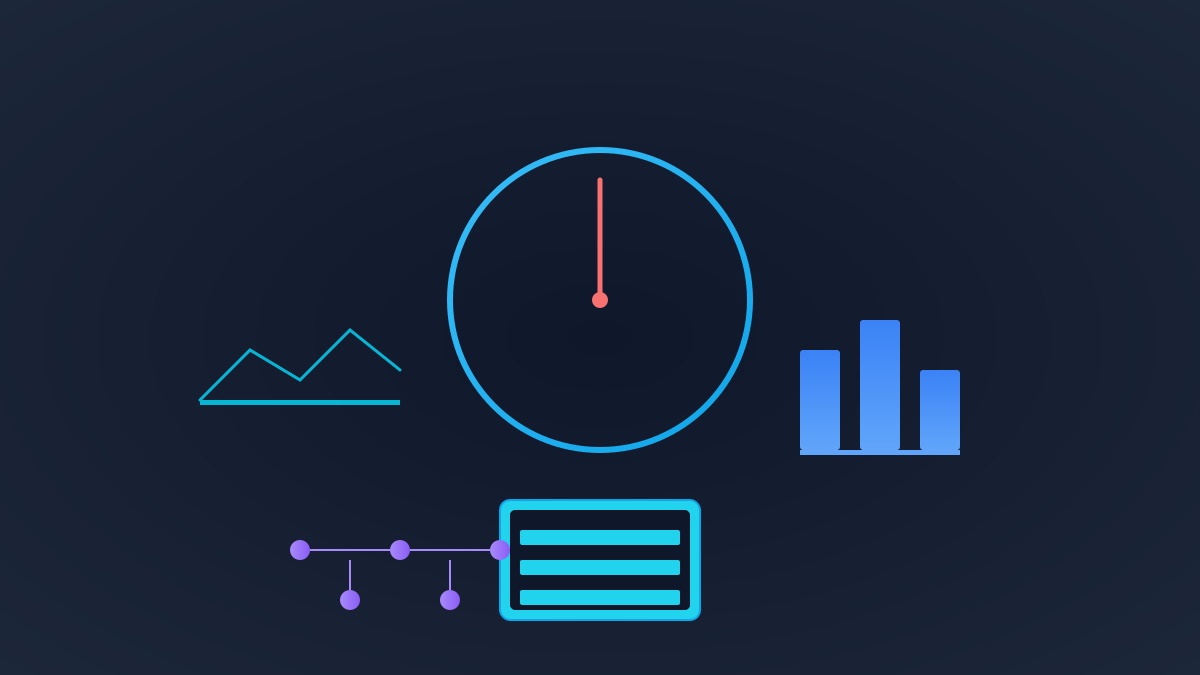
Use interactive charts (trend charts, pie charts, progress bars, etc.) to intuitively present financial information, support hierarchical drilling (from annual to monthly to specific transactions), and update data feedback in real time.

4

Section 04

Application Scenarios and Target Users

The tool is suitable for multiple user groups:

  • Young people: Automatic classification and consumption reminders to cultivate bookkeeping habits;
  • Family managers: Panoramic asset view to optimize resource allocation;
  • Investors: Monitor investment portfolios and get rebalancing suggestions;
  • Freelancers/small and medium business owners: Cash flow prediction to assist business planning and tax preparation.
5

Section 05

Project Value and Conclusion

AI Finance Dashboard reduces the cognitive burden of financial management through data integration, intelligent analysis, and visualization, helping users understand their financial status and make informed decisions. Compared with existing products, its differentiation lies in the depth of AI analysis and the flexibility of open-source customization (the open-source solution can be deployed locally to ensure data privacy and customization).

6

Section 06

Limitations, Usage Suggestions, and Future Directions

Limitations

  • Prediction accuracy depends on the quality of historical data; the effect is limited for users with large income fluctuations or variable consumption habits;
  • Data synchronization convenience is affected by the openness of regional bank APIs.

Usage Suggestions

  • AI suggestions are for reference only; decisions need to be combined with personal values and goals;
  • Maintain critical thinking and understand the logic behind the suggestions.

Future Directions

  • More in-depth personalization: Learn users' financial goals and risk preferences to provide customized suggestions;
  • Ecosystem integration: Connect to tax and insurance systems to build a complete financial lifecycle management;
  • Proactive suggestions: Identify optimization opportunities (e.g., low-interest savings accounts, expiring points) and push reminders.

