Zing Forum

Reading

Convolutional Neural Network-based Early Dementia Detection System: A Technological Breakthrough in Medical Imaging AI

This article delves into an open-source project that uses Convolutional Neural Networks (CNN) for early dementia detection, analyzing its technical architecture, medical imaging processing workflow, as well as its application value and social significance in the field of medical AI.

卷积神经网络痴呆症检测医学影像深度学习早期诊断神经影像人工智能医疗CNN二分类认知障碍
Published 2026-05-04 23:15Recent activity 2026-05-04 23:18Estimated read 9 min
Convolutional Neural Network-based Early Dementia Detection System: A Technological Breakthrough in Medical Imaging AI
1

Section 01

Introduction / Main Floor: Convolutional Neural Network-based Early Dementia Detection System: A Technological Breakthrough in Medical Imaging AI

This article delves into an open-source project that uses Convolutional Neural Networks (CNN) for early dementia detection, analyzing its technical architecture, medical imaging processing workflow, as well as its application value and social significance in the field of medical AI.

2

Section 02

Introduction: New Frontiers in AI Medical Diagnosis

With the growing global population aging, early diagnosis of neurodegenerative diseases—especially dementia—has become increasingly critical. Traditional diagnostic methods rely on the experiential judgment of professional doctors, which is not only time-consuming but also subject to subjective discrepancies. In recent years, deep learning technology has shown great potential in medical image analysis, offering a new technical approach for early disease screening. This article will conduct an in-depth analysis of an open-source project based on Convolutional Neural Networks (CNN), which focuses on automatic early dementia detection using brain medical image data and provides auxiliary decision support for clinical diagnosis.

3

Section 03

Clinical Dilemmas in Dementia Diagnosis

Dementia is a progressive neurodegenerative disease, and its early symptoms are often difficult to detect. Studies have shown that intervention in the early stages of the disease can significantly delay its progression and improve patients' quality of life. However, the existing diagnostic process faces the following challenges:

  • Shortage of professional doctors: Neuroimaging diagnosis requires highly specialized knowledge and experience
  • Poor diagnostic consistency: Different doctors may have discrepancies in interpreting the same image
  • Low screening efficiency: Traditional manual image reading methods are difficult to meet the needs of large-scale screening
  • Difficulty in early identification: The image features in the mild cognitive impairment stage are subtle and easily overlooked
4

Section 04

Technical Advantages of AI-Assisted Diagnosis

Deep learning models, especially Convolutional Neural Networks, have unique advantages in image feature extraction. By training on large-scale annotated datasets, CNNs can learn subtle image features that are difficult for the human eye to detect, providing objective and quantitative evaluation indicators for early diagnosis.

5

Section 05

Design Principles of Convolutional Neural Networks

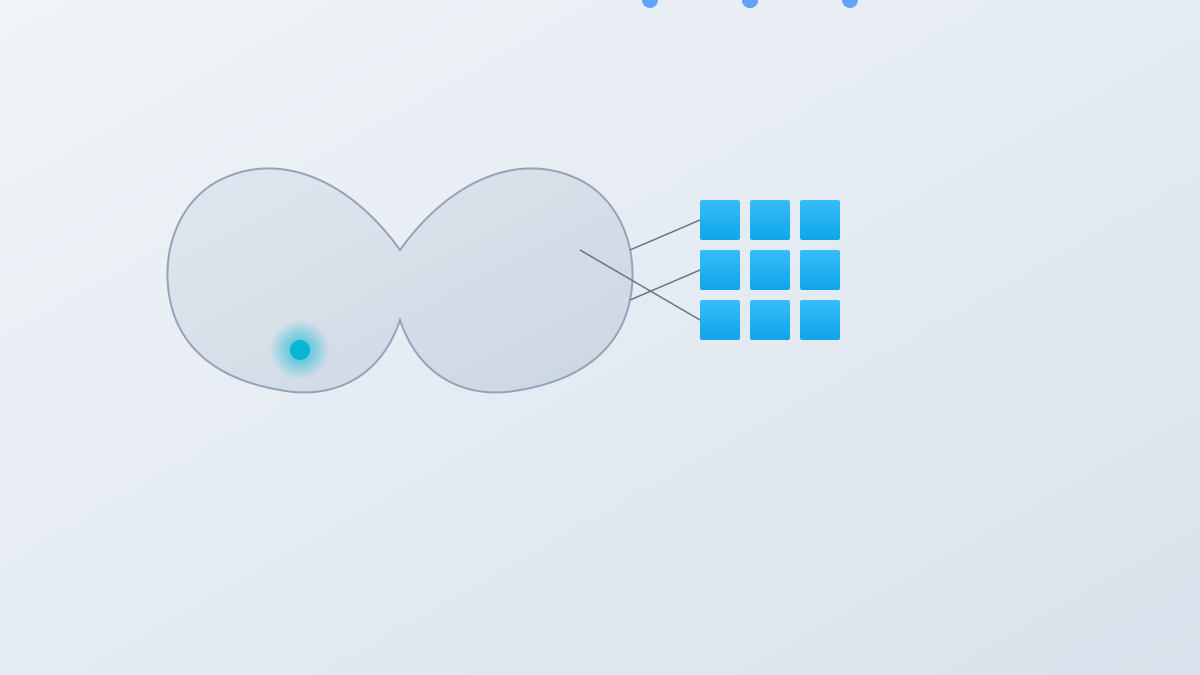
This project adopts a classic CNN architecture, extracting hierarchical features of brain images through multi-layer convolution operations. The core components of the network include:

Convolutional Layer: Uses learnable filters to scan the input image, extracting low-level features such as edges and textures, as well as more complex shape and structure information. In medical image analysis, convolutional layers can capture key pathological features such as brain tissue atrophy and white matter lesions.

Pooling Layer: Reduces the spatial dimension of feature maps through downsampling operations, reducing computational complexity while enhancing the translation invariance of features. This is particularly important for processing medical images from different scanning devices and parameters.

Activation Function: Introduces nonlinear transformation, enabling the network to learn complex decision boundaries. The ReLU activation function is widely used in medical imaging networks, effectively alleviating the gradient vanishing problem.

Fully Connected Layer: Maps the extracted high-dimensional features to the final classification output, realizing the transformation from feature space to decision space.

6

Section 06

Implementation of the Binary Classification System

The project uses a binary classification framework, dividing input brain images into two categories:

  1. Healthy control group: Brain images of normal aging
  2. Mild dementia group: Image samples in the early stage of the disease

This design focuses on the most clinically valuable early screening scenarios and avoids the problem of ambiguous category boundaries in multi-classification tasks.

7

Section 07

Preprocessing Workflow of Medical Images

Brain image data needs to undergo strict preprocessing before entering the network:

Standardization: Unifies the grayscale range of different scanning devices to eliminate the impact of device differences. Z-score standardization is usually used to make the data follow a standard normal distribution.

Spatial Registration: Aligns brain images of different individuals to a standard template space to ensure the consistency of anatomical structures. This is a necessary step for group-level analysis.

Noise Suppression: Medical images often contain various noise sources, including device noise and motion artifacts. Gaussian filtering or non-local mean denoising is used to improve the signal-to-noise ratio.

Data Augmentation: In the training phase, transformations such as rotation, flipping, and scaling are used to expand the dataset, improving the model's generalization ability and alleviating the problem of medical data scarcity.

8

Section 08

Hierarchical Process of Feature Learning

The feature learning of CNN shows obvious hierarchical characteristics:

  • Shallow network: Learns low-level visual features such as edges and corners
  • Middle network: Combines low-level features to form intermediate representations such as textures and shapes
  • Deep network: Integrates intermediate features to capture semantic-level pathological patterns

In the dementia detection task, deep features may correspond to diagnostic imaging markers such as hippocampal atrophy, ventricular enlargement, and cortical thinning.


