Zing Forum

Reading

AI for Drought Relief: How Artificial Intelligence Addresses the Global Drought Crisis

This article introduces an open-source project that uses artificial intelligence to monitor, predict, and mitigate the impacts of drought, exploring its technical pathways and social significance in the context of climate change.

干旱监测人工智能气候变化卫星遥感时间序列预测开源项目灾害预警
Published 2026-05-01 20:37Recent activity 2026-05-01 20:50Estimated read 8 min
AI for Drought Relief: How Artificial Intelligence Addresses the Global Drought Crisis
1

Section 01

Introduction to the AI Drought Relief Project: Using AI to Address the Global Drought Crisis

This article introduces the open-source project AI for Drought, which integrates multi-source data (satellite remote sensing, meteorological stations, hydrological models, etc.) with advanced machine learning algorithms to build an intelligent system for drought monitoring, prediction, and impact mitigation. It supports scenarios such as agricultural early warning and water resource management, and promotes global efforts to address drought challenges under climate change through open-source collaboration.


2

Section 02

The Global Drought Crisis and the Context of Climate Change

Drought is one of the world's most costly and deadly natural disasters. According to UN data, drought has affected over 2.6 billion people globally in the past 50 years, with economic losses exceeding hundreds of billions of dollars. It is characterized by 'silent' development, cumulative and delayed impacts, and difficulty in early warning. Climate change has intensified the frequency, intensity, and duration of droughts, posing severe challenges to food security, water resource management, and ecosystem stability.

3

Section 03

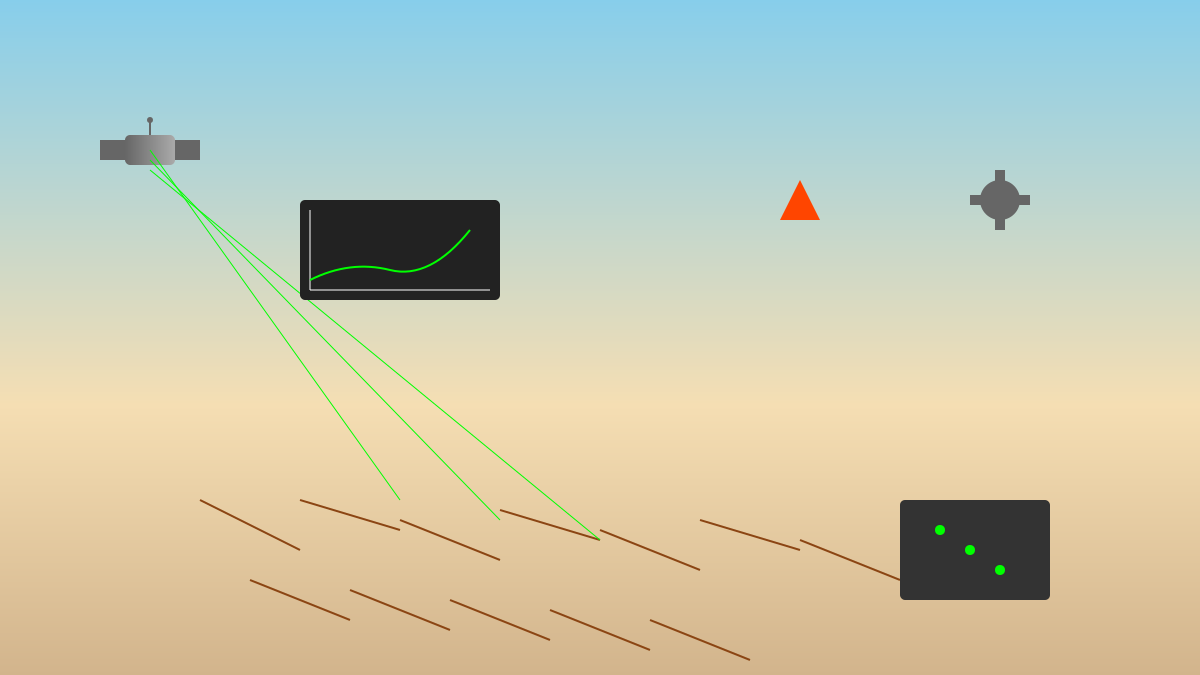
Technical Architecture of AI Drought Relief: Multi-source Data Fusion and Intelligent Models

Data Layer: Comprehensive Perception

  • Satellite Remote Sensing Data: Uses MODIS, Landsat, Sentinel, etc., to monitor vegetation health index (NDVI), land surface temperature (LST), soil moisture, etc., suitable for remote areas.
  • Meteorological and Hydrological Data: Integrates parameters such as precipitation and temperature, and couples with hydrological models to simulate water cycles.
  • Socio-economic Data: Integrates population distribution, agricultural output value, etc., to support vulnerability analysis.

Model Layer: Intelligent Analysis

  • Drought Index Calculation: Implements internationally recognized indices such as SPI, SPEI, VHI, and SWSI.
  • Machine Learning Prediction: Uses RNN/LSTM, CNN, spatiotemporal fusion models (e.g., ConvLSTM), and ensemble learning.
  • Impact Assessment Model: Evaluates the impact of drought on agricultural production, water supply, etc.
4

Section 04

Application Scenarios of AI Drought Relief: From Early Warning to Decision Support

  • Agricultural Drought Early Warning: Monitors crop growth and soil moisture, provides early risk warnings, and helps farmers adjust irrigation and other measures.
  • Water Resource Management: Provides data support for reservoir scheduling, groundwater extraction, etc., to optimize resource allocation during drought periods.
  • Disaster Response: Quickly assesses affected areas and populations to support rescue plan formulation.
  • Climate Change Adaptation: Analyzes historical patterns and future scenarios to provide a basis for long-term strategies (e.g., adjustment of planting structures).
5

Section 05

Open-source Ecosystem and Solutions to Technical Challenges

Open-source Ecosystem

  • Open Code and Data: Code is hosted on GitHub with a permissive license; some datasets and pre-trained models are open.
  • Community-driven: Welcomes contributors from multiple fields to advance the project through discussions and code contributions.
  • Reproducible Research: Provides complete experimental workflows and evaluation benchmarks to ensure result reproducibility.

Technical Challenges and Solutions

  • Data Quality: Uses spatiotemporal interpolation and deep learning to fill gaps in satellite data.
  • Label Scarcity: Uses semi-supervised learning and transfer learning to leverage limited labeled data.
  • Model Generalization: Improves cross-region performance through domain adaptation and multi-task learning.
  • Real-time Performance: Optimizes data processing workflows to implement automated pipelines.
6

Section 06

Global Pilot Cases: Practical Applications of the AI Drought Relief Project

  • Horn of Africa: Assists local institutions in monitoring seasonal droughts and supports food security early warning systems.
  • Australia: Collaborates with meteorological bureaus to improve drought monitoring networks and provides data support for agricultural policies.
  • California: Participates in state-level drought assessments and supports water resource allocation decisions.
7

Section 07

Future Outlook and Conclusion: Technology Empowering Climate Resilience

Future Directions

  • Integrate more data sources (IoT sensors, drone imagery).
  • Develop more refined local-scale prediction models.
  • Establish a global drought monitoring network to promote international cooperation.
  • Explore coupling with climate models to assess long-term change trends.

Conclusion

AI for Drought demonstrates the power of technology for good. Through open-source collaboration and innovation, it is expected to build a more climate-resilient future, enabling technology to serve human well-being and protect vulnerable groups.

