Zing Forum

Reading

Neural Networks for Diabetes Prediction: A Practical Guide to Classification Models in Medical AI

Exploring the technical implementation of neural networks for diabetes risk prediction, covering data preprocessing, model architecture design, training optimization, and best practices for medical AI applications.

糖尿病预测医疗AI神经网络二分类机器学习可解释AI类别不平衡临床决策支持
Published 2026-05-13 17:56Recent activity 2026-05-13 18:10Estimated read 8 min
Neural Networks for Diabetes Prediction: A Practical Guide to Classification Models in Medical AI
1

Section 01

[Introduction] Neural Networks for Diabetes Prediction: Core Overview of Classification Model Practice in Medical AI

This article focuses on the technical practice of neural networks for diabetes prediction, exploring the entire workflow of using neural networks for diabetes risk prediction—including technical details like data preprocessing, model architecture design, and training optimization. It also covers key considerations in medical AI applications (such as interpretability, class imbalance handling, privacy protection, and ethical fairness), aiming to provide practical references for medical AI developers working on diabetes prediction projects.


2

Section 02

Background: Challenges in Diabetes Prediction and the Value of AI

Diabetes is a serious global chronic disease affecting over 500 million people, with projections to reach 700 million by 2045. Early identification of high-risk groups is key to prevention, but traditional assessments rely on experience and limited indicators, making large-scale screening difficult. AI (especially machine learning) can analyze multi-dimensional data to identify complex patterns and assist decision-making. Diabetes prediction is a typical binary classification problem, often using the Pima Indian Dataset. It faces challenges like class imbalance (far more healthy people than patients), data quality (missing values, measurement errors), privacy compliance (HIPAA/GDPR), and interpretability (doctors need to understand decision-making basis).

3

Section 03

Methods: Neural Network Model Design and Training Optimization Strategies

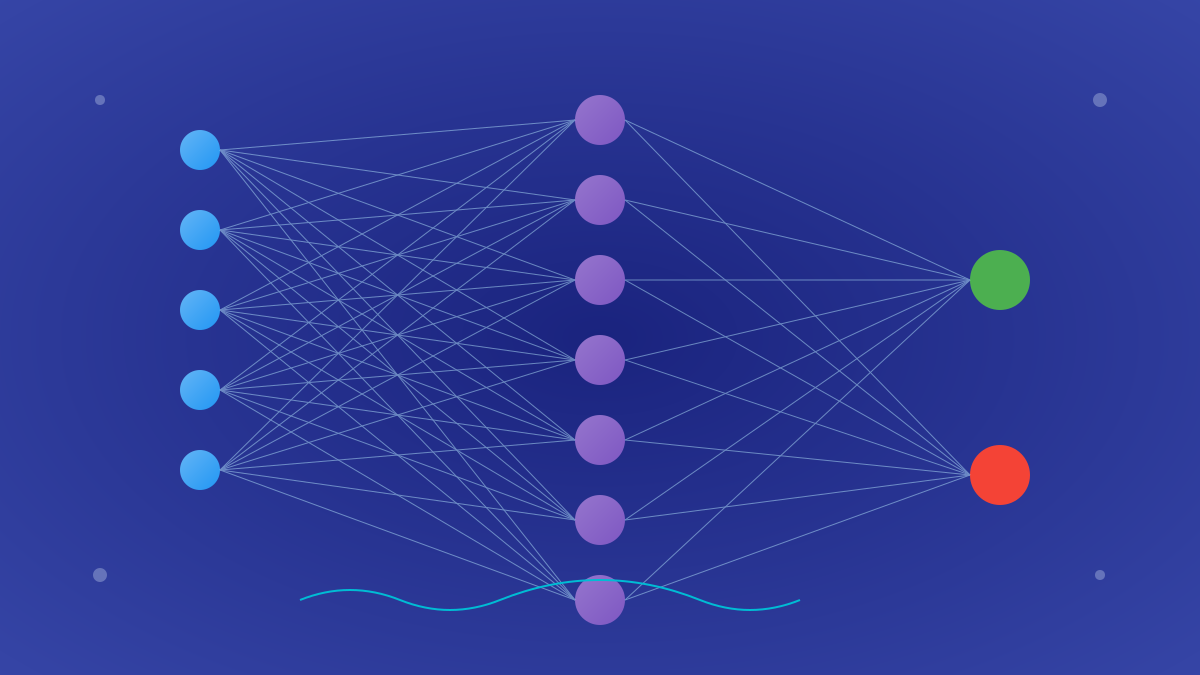
Neural networks have advantages such as learning non-linear relationships, reducing the need for feature engineering, end-to-end learning, and strong scalability. Model architecture design: Input layer dimension is determined by the number of features (8 neurons for the Pima Dataset), requiring feature standardization; hidden layer design (number of layers, number of neurons, activation functions like ReLU/Sigmoid); output layer uses Sigmoid activation to output probabilities, with binary cross-entropy as the loss function; regularization techniques (Dropout, L1/L2, early stopping) to prevent overfitting. Training workflow: Data splitting (stratified sampling for training/validation/test sets), optimizer selection (SGD with momentum, Adam, etc.), batch size adjustment, class imbalance handling (oversampling like SMOTE, undersampling, class weights, focal loss).

4

Section 04

Evidence: Model Performance Evaluation and Key Indicator Analysis

Accuracy is easily misleading by class imbalance, so we need to use precision (TP/(TP+FP)), recall (TP/(TP+FN)), and F1 score (harmonic mean) derived from the confusion matrix. ROC curves and AUC evaluate discriminative ability, while PR curves are more effective for imbalanced data. Custom indicators for medical scenarios: cost-sensitive accuracy, clinical utility curves, calibration curves (checking consistency between predicted probabilities and actual frequencies).

5

Section 05

Clinical Integration: Model Interpretability and Human-Machine Collaboration

Interpretability methods include feature importance (permutation importance, SHAP values), local explanations (LIME, counterfactual explanations), and attention mechanisms (weight visualization). Clinical integration requires human-machine collaboration: AI provides predictions and risk scores, doctors make final decisions; decision support systems (DSS) are integrated into workflows; feedback loops continuously improve the model.

6

Section 06

Deployment and Ethics: Key Considerations for Medical AI Implementation

Deployment aspects: Model serialization (pickle/joblib, ONNX, TensorFlow SavedModel), inference serviceization (Flask/FastAPI, model servers like TensorFlow Serving), edge deployment (quantization, TensorFlow Lite), monitoring and maintenance (data drift detection, performance tracking, A/B testing). Ethical aspects: Fairness (checking group performance differences, bias handling), privacy protection (differential privacy, federated learning, data desensitization), transparency (model documentation, usage instructions, audit logs), human supervision (AI assists rather than replaces doctors).

7

Section 07

Future Directions: Potential of Multimodal Fusion and Federated Learning

Expansion directions include multimodal fusion (integrating physiological indicators, medical images, genomics, lifestyle data), time-series modeling (RNN/Transformer for longitudinal electronic health records, survival analysis to predict onset time), personalized intervention recommendations (diet/exercise plans, reinforcement learning optimization), and federated learning (multi-center collaborative training without sharing data).

8

Section 08

Conclusion: Value and Practical Insights of Medical AI in Diabetes Prevention

The May-Twelve project demonstrates the basic practice of neural network-based diabetes classification. Medical AI applications need to balance technical, medical, and ethical dimensions. Although neural networks have advantages in complex pattern recognition, successful deployment requires attention to data quality, interpretability, fairness, and privacy. AI is expected to play a greater role in diabetes prevention and chronic disease management. Diabetes prediction is an ideal entry project for medical AI, reflecting core technologies and unique medical challenges.

