Zing Forum

Reading

Large Language Model-Based Lithium Battery Degradation Diagnosis System: AI Empowering Battery Engineering Analysis

This article introduces an innovative large language model diagnosis system that can automatically analyze lithium battery degradation data under different operating conditions, extract cycle-level features, perform statistical analysis, and generate structured, readable engineering insight reports, providing an intelligent analysis tool for battery R&D and maintenance.

大语言模型锂电池退化诊断特征工程电池工程机器学习电化学分析预测性维护能源存储
Published 2026-05-09 16:26Recent activity 2026-05-09 16:33Estimated read 6 min
Large Language Model-Based Lithium Battery Degradation Diagnosis System: AI Empowering Battery Engineering Analysis
1

Section 01

Large Language Model-Based Lithium Battery Degradation Diagnosis System: AI Empowering Battery Engineering Analysis (Introduction)

This article introduces an innovative large language model diagnosis system that can automatically analyze lithium battery degradation data under different operating conditions, extract cycle-level features, perform statistical analysis, and generate structured engineering insight reports. It addresses the problem that traditional battery analysis methods rely on professional equipment and domain knowledge and are difficult to automate on a large scale, providing an intelligent analysis tool for scenarios such as battery R&D and maintenance.


2

Section 02

Research Background and Motivation

Lithium batteries are widely used in electric vehicles, consumer electronics, and other fields, but they have the problem of irreversible degradation. Accurately diagnosing their state is a key challenge for the industry. Traditional analysis methods rely on experimental techniques such as electrochemical impedance spectroscopy and are difficult to automate on a large scale. The growth of massive battery data requires efficient insight extraction, and the text understanding and generation capabilities of large language models provide new possibilities for cross-domain knowledge integration, which is expected to break down the barriers between data and knowledge.

3

Section 03

System Architecture and Core Technical Innovations

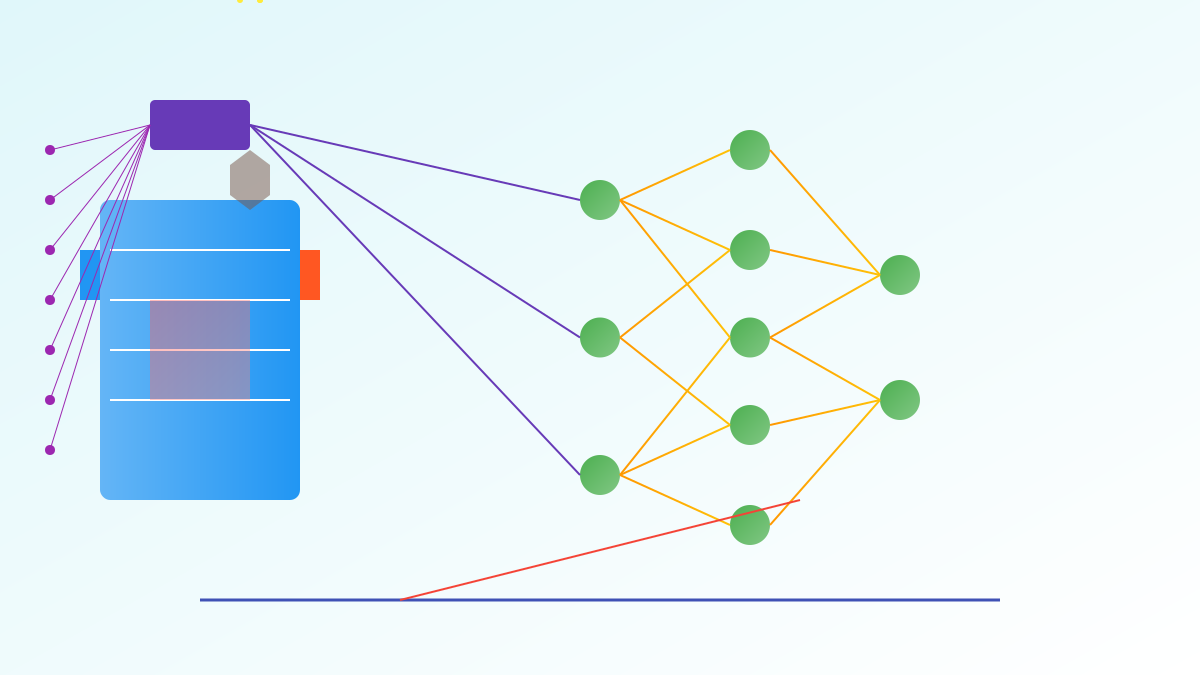
The system adopts a layered architecture: data collection and preprocessing (importing multi-format data and verifying anomalies), feature engineering (converting raw signals into features with physical meaning), statistical analysis (multi-dimensional feature analysis to identify key factors), and insight generation (LLM converts results into structured reports). Core innovations include cycle-level feature extraction (capturing early degradation signals with fine granularity), multi-condition degradation modeling (quantifying the contribution of factors such as temperature and rate), and LLM-driven dynamic report generation (adjusting content focus according to data characteristics).

4

Section 04

Technical Implementation Details

The backend is built based on the Python ecosystem, using Pandas/NumPy for data processing, SciPy/Statsmodels for time-series analysis, and Scikit-learn for machine learning implementation. The LLM is served via the OpenAI API or local Llama models, with prompt engineering ensuring output quality. The data pipeline is modular to support batch/stream processing. Visualization uses Plotly/Matplotlib to generate interactive charts, which can be embedded in reports or exported separately.

5

Section 05

Application Scenarios and Value

R&D phase: Quickly analyze test data to accelerate iteration; Production link: Integrate into quality inspection processes to evaluate product health; Energy storage stations: Monitor battery status to predict lifespan and optimize strategies; Academic research: Standardize analysis processes to improve efficiency and result credibility.

6

Section 06

Limitations and Improvement Directions

LLM has hallucination issues (requires confidence assessment and manual review); Insufficient domain adaptability (needs domain adaptive technology optimization); Data privacy issues (needs federated learning or differential privacy technology protection).

7

Section 07

Industry Implications and Outlook

This system reconstructs the way engineers interact with data, lowering the threshold for professional analysis, improving efficiency, and precipitating domain knowledge. In the future, it can integrate multi-modal data such as electrochemical images and combine digital twin technology to achieve the leap from diagnosis to prediction.

