Zing Forum

Reading

Neural Network for Liver Cirrhosis Risk Diagnosis: From Discovery to Action in Medical AI

A liver cirrhosis risk prediction model built with TensorFlow/Keras, using the Discovery-to-Action (DTA) strategy, with a focus on the clinical impact of false positives and false negatives

医疗AI肝硬化诊断神经网络TensorFlow临床决策支持假阳性假阴性
Published 2026-06-11 16:45Recent activity 2026-06-11 17:03Estimated read 6 min
Neural Network for Liver Cirrhosis Risk Diagnosis: From Discovery to Action in Medical AI
1

Section 01

Introduction to the Neural Network Project for Liver Cirrhosis Risk Diagnosis

This project builds a liver cirrhosis risk prediction model using TensorFlow/Keras, adopting the "Discovery-to-Action (DTA)" strategy to transform data insights into reliable clinical decision support. It focuses on the high-risk nature of medical AI, especially the clinical impact of false positives/negatives on patients, and demonstrates the complete process of medical AI from development to deployment.


2

Section 02

Liver Cirrhosis Background and the Mission of Medical AI

Liver cirrhosis is an end-stage liver disease, with common causes including chronic viral hepatitis and alcoholic liver disease. It is asymptomatic in the early stage, and traditional diagnosis relies on invasive liver biopsy, which carries risks. When medical AI is used for disease diagnosis, errors can affect patients' lives, so core principles must be followed: transforming data insights into clinical decision support, not just model training.

3

Section 03

DTA Methodology and Technical Implementation Details

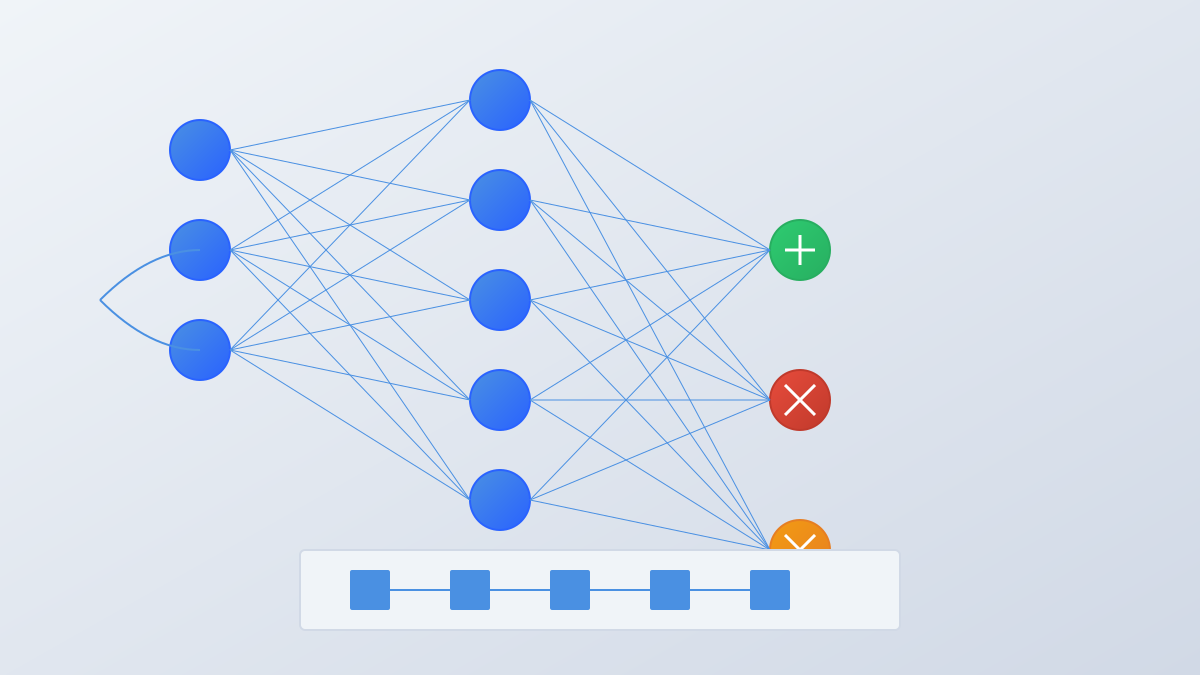
DTA Methodology is divided into four phases: 1. Discovery (data exploration + clinical knowledge integration); 2. Development (data preprocessing, model construction, validation); 3. Deployment (clinical evaluation, error analysis); 4. Action (decision support design, continuous monitoring). Technical Implementation: A neural network is built using TensorFlow/Keras, with the input layer corresponding to feature dimensions, 2-4 fully connected hidden layers (64-256 neurons, ReLU/LeakyReLU), regularization using Dropout/L2/BatchNorm; handling class imbalance with class weights or Focal Loss, and optimizer selection of Adam + learning rate scheduling.

4

Section 04

Clinical Evaluation and Error Cost Analysis

Medical AI needs to go beyond accuracy; core metrics include sensitivity (reducing missed diagnoses), specificity (reducing misdiagnoses), PPV/NPV (prediction reliability considering prevalence), ROC curve and AUC (overall discrimination ability). False negative risks: delayed treatment, disease progression; false positive risks: patient anxiety, unnecessary tests. Trade-off strategies: prioritize high sensitivity in screening scenarios, high specificity in diagnostic confirmation; output probabilities instead of binary predictions, and manually review uncertain cases.

5

Section 05

Interpretability Requirements and Methods for Medical AI

Reasons medical AI needs interpretability: regulatory requirements (FDA, etc.), clinical acceptance (doctor trust), error diagnosis analysis. Interpretability methods: feature importance (SHAP values), attention mechanism visualization, rule extraction, counterfactual explanations (e.g., "If platelet count is 20 higher, the prediction would be low risk").

6

Section 06

Best Practices and Recommendations for Medical AI Development

Unique Considerations: Data privacy (HIPAA/GDPR), interdisciplinary collaboration (data scientists + clinicians + ethicists), strict validation (multi-center external validation, prospective trials), cautious deployment (assist decision-making rather than replace doctors). Recommendations for Developers: Understand the clinical context, communicate with users, pay attention to limitations, and improve documentation and auditing.

7

Section 07

Project Summary and the Value of Medical AI

This project demonstrates the complete process of medical AI from data exploration to clinical deployment, emphasizing the importance of "Action" in the DTA strategy (model training is just the beginning; it needs to be integrated into clinical workflows). It provides a reference framework for developers, serves as a decision support tool for clinicians, and reflects that medical AI is a complex systems engineering involving ethics and law.

