Zing Forum

Reading

AI Image Detection System: Multimodal Neural Network for Generative Image Recognition

A comprehensive AI image detection project that combines four technologies—PRNU noise analysis, ELA error level analysis, frequency domain feature extraction, and metadata detection—to accurately distinguish between real photos and AI-generated images using three independent neural network models.

AI图像检测深度伪造CNNPRNUELA频域分析元数据生成式AI图像取证
Published 2026-06-01 13:12Recent activity 2026-06-01 13:23Estimated read 7 min
AI Image Detection System: Multimodal Neural Network for Generative Image Recognition
1

Section 01

Introduction / Main Floor: AI Image Detection System: Multimodal Neural Network for Generative Image Recognition

A comprehensive AI image detection project that combines four technologies—PRNU noise analysis, ELA error level analysis, frequency domain feature extraction, and metadata detection—to accurately distinguish between real photos and AI-generated images using three independent neural network models.

3

Section 03

Problem Background

The advancement of generative AI image technology has brought risks of 'Deepfake' and misinformation spread. Traditional manual review is inefficient and struggles to handle massive content. Therefore, developing an automated AI image detection system has become an urgent need.

However, AI image detection faces many challenges:

  • Diverse generation technologies: Images generated by different models (diffusion models, GANs, autoregressive models) have distinct features
  • Post-processing interference: Operations like compression, cropping, and filters can destroy generation traces
  • Adversarial attacks: Malicious attackers can bypass detection in targeted ways
  • Variation in real images: Real photos themselves have huge differences in style and quality

A single detection method is difficult to handle these complex situations; a multi-dimensional, complementary detection strategy is needed.

4

Section 04

System Architecture Overview

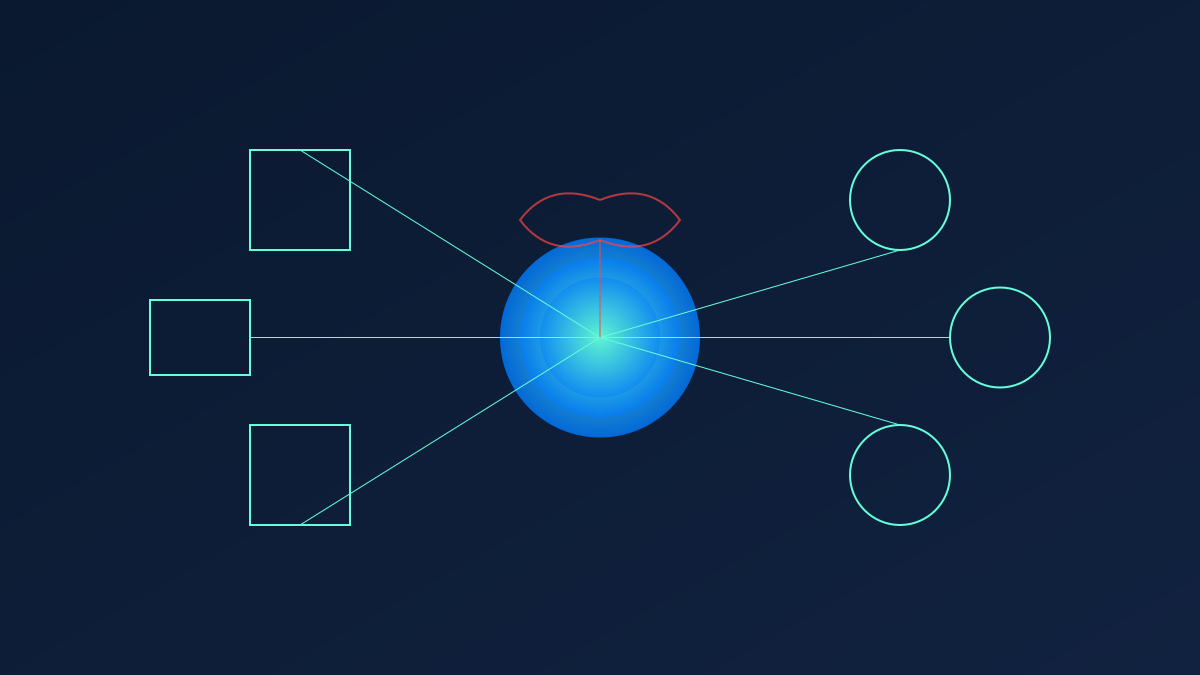
This project adopts a multi-module fusion architecture, combining four complementary analysis technologies:

Module Technology Detection Dimension
PRNU Photo Response Non-Uniformity Noise Camera Sensor Fingerprint
ELA Error Level Analysis JPEG Compression Artifacts
FREQ Frequency Domain Analysis FFT/DCT Features
Metadata Metadata Parsing EXIF Information and Tool Signatures

The four modules run independently, and the final comprehensive judgment result is obtained by fusing the scores of each module through weighted average.

5

Section 05

PRNU: Photo Response Non-Uniformity Noise Analysis

PRNU (Photo Response Non-Uniformity) is an inherent characteristic of digital camera sensors. Each pixel has slight differences in light response, forming a unique 'sensor fingerprint'. Real photos must carry the PRNU features of the shooting device, while AI-generated images do not have this physical-level noise pattern.

PRNU Analysis Process:

  1. Extract the noise residual of the image
  2. Compare with the PRNU reference pattern of known cameras
  3. Calculate the correlation score

This method is very effective for detecting fully synthetic AI images, but may be affected by re-compression and geometric transformations.

6

Section 06

ELA: Error Level Analysis

ELA (Error Level Analysis) is a classic technology for detecting image tampering. Its principle is: re-compress the image, compare it with the original image, and calculate the error level of each pixel. The error distribution of real images is usually relatively uniform, while tampered areas (including AI-generated areas) show abnormal error characteristics.

For AI-generated images, ELA can detect:

  • Unnatural texture boundaries
  • Abnormal compression artifacts
  • Noise characteristics different from real photos
7

Section 07

FREQ: Frequency Domain Feature Analysis

Frequency domain analysis converts images to the frequency domain through Fourier Transform (FFT) and Discrete Cosine Transform (DCT) to analyze their frequency distribution characteristics. Studies show that AI-generated images often exhibit different patterns in the frequency domain compared to real photos:

  • High-frequency components: AI images may lack the high-frequency details of real photos
  • Spectral distribution: Different generation models leave unique 'signatures' in the frequency domain
  • Periodic artifacts: Some generation technologies produce detectable periodic patterns in the frequency domain
8

Section 08

Metadata: Metadata Detection

Metadata detection makes judgments by analyzing the EXIF information and file structure characteristics of images:

  • EXIF integrity: AI-generated images usually lack complete EXIF information from camera shooting
  • Software signatures: Detect processing traces of editing software like Photoshop and GIMP
  • AI tool markers: Some AI tools embed specific metadata markers in files
  • Abnormal file structure: Analyze inconsistencies in JPEG segment structure