Zing Forum

Reading

AI-Powered Weed Detection and Precision Spraying System: Practical Exploration of Agricultural Intelligence

An agricultural automation project based on computer vision and deep learning that enables real-time identification of field weeds and precision spraying, reducing pesticide use and increasing crop yields.

人工智能农业杂草检测计算机视觉深度学习精准农业TensorFlow边缘计算可持续发展
Published 2026-05-28 13:40Recent activity 2026-05-28 13:49Estimated read 6 min
AI-Powered Weed Detection and Precision Spraying System: Practical Exploration of Agricultural Intelligence
1

Section 01

AI-Powered Weed Detection and Precision Spraying System: Practical Exploration of Agricultural Intelligence (Introduction)

This project is an agricultural automation system based on computer vision and deep learning, enabling real-time identification of field weeds and precision spraying, aiming to reduce pesticide use and increase crop yields. Maintained by atharva-ai-ds, it was released on the GitHub platform on May 28, 2026. The tech stack includes TensorFlow, OpenCV, etc., with the core being efficient deployment via edge computing.


2

Section 02

Project Background and Agricultural Pain Points

Traditional weed management relies on manual identification and full-scale herbicide spraying, which has pain points such as high labor costs and severe environmental issues: globally, over 2 million tons of agricultural herbicides are used annually, and spraying in non-target areas leads to soil pollution, water source damage, and ecological imbalance; manual weeding is inefficient and cannot meet the needs of large-scale modern agriculture. Precision agriculture technology uses AI + computer vision + automated control to achieve precise weed identification and targeted removal, aligning with the concept of sustainable development and reducing production costs.

3

Section 03

Technical Architecture and Model Optimization Strategies

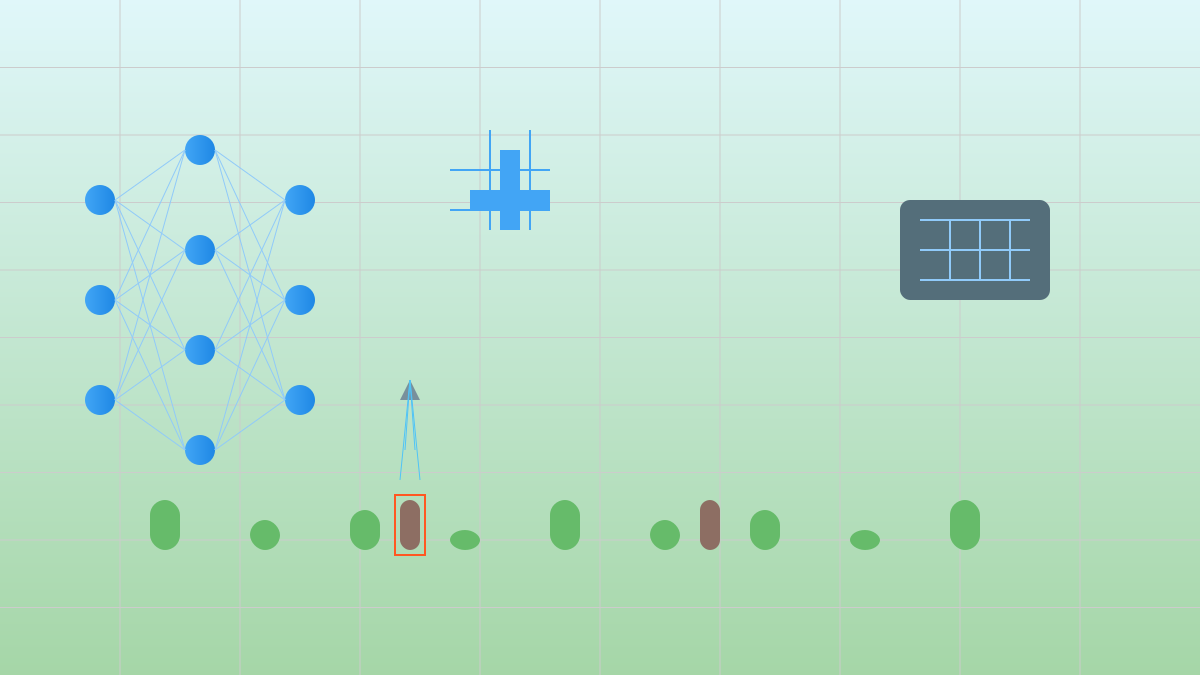
Technical Architecture: Developed using Python, core dependencies include TensorFlow/Keras and OpenCV. Components include data collection and preprocessing (format conversion, data augmentation), CNN deep learning model, model lightweight tools (TensorFlow Lite conversion), target detection and localization module, and main control program (integrating the entire process). Optimization Strategies: Use data augmentation such as random rotation, flipping, and brightness adjustment to handle complex field environments; adopt model quantization technology to balance accuracy and efficiency, enabling the system to run in real time on embedded devices; fine-grained classification labels support differentiated processing strategies.

4

Section 04

Practical Application Scenarios and Effect Data

Deployment Scenarios: Agricultural machinery or drone platforms equipped with cameras. Workflow: Camera captures images → preprocessing → TensorFlow Lite model inference → calculate position when weeds are detected → control spraying device to release herbicides precisely. Effect Data: Pesticide usage reduced by 60%-90%; reduced chemical procurement and labor costs; reduced soil and water pollution; automated operation efficiency far exceeds manual work, adapting to large-scale production.

5

Section 05

Technical Expansion and Future Direction Suggestions

  1. Multimodal perception: integrate infrared and multispectral sensor data to improve robustness in complex weather conditions;
  2. Model upgrade: explore advanced target detection networks such as YOLO and EfficientDet to enhance real-time detection accuracy;
  3. Intelligent strategy: introduce reinforcement learning to dynamically adjust spraying strategies based on weed density and crop growth stages;
  4. IoT collaboration: build a multi-node operation network to realize large-scale intelligent monitoring and management.
6

Section 06

Project Summary and Insights

This project is an important practice of precision agriculture technology, demonstrating the value of transforming deep learning into agricultural solutions, balancing production efficiency and environmental protection. The open-source project provides references for agricultural practitioners and technical developers, promoting the popularization and innovation of intelligent agriculture. With the improvement of edge computing performance and the accumulation of agricultural data, such systems are expected to be widely applied, contributing to global food security and sustainable agricultural development.