Zing Forum

Reading

Video Large Language Model Evaluation Framework: Unified Benchmarking Drives Multimodal AI Development

video-llm-evaluation-harness is a comprehensive evaluation framework designed specifically for video understanding large language models, providing standardized test benchmarks to help researchers and developers objectively compare the performance of different video LLMs.

视频理解大语言模型多模态AI评估框架基准测试视频问答开源工具
Published 2026-06-05 14:14Recent activity 2026-06-05 14:26Estimated read 7 min
Video Large Language Model Evaluation Framework: Unified Benchmarking Drives Multimodal AI Development
1

Section 01

Video Large Language Model Evaluation Framework: Unified Benchmarking Drives Multimodal AI Development (Introduction)

This article introduces the open-source project video-llm-evaluation-harness, a comprehensive evaluation framework designed specifically for video understanding large language models. It aims to address the lag in standardization of evaluation methods in the current video LLM field, providing a unified test benchmark to help researchers objectively compare the performance of different models. The framework features standardization and extensibility, covering multi-dimensional evaluation metrics and diverse task types, and serves as an important infrastructure to promote the healthy development of the multimodal AI field.


2

Section 02

The Rise of Multimodal AI and the Dilemma of Video LLM Evaluation

With models like GPT-4V and Gemini acquiring visual capabilities, the evolution of AI toward multimodality has accelerated. Video understanding, as a key field, has seen rapid iterations of models such as Video-LLaMA and Video-ChatGPT, but the standardization of evaluation methods lags severely: different teams use different datasets, metrics, and protocols, making it difficult or even misleading to compare model performance. video-llm-evaluation-harness was created to address this problem.

3

Section 03

Framework Design Philosophy and Core Architecture

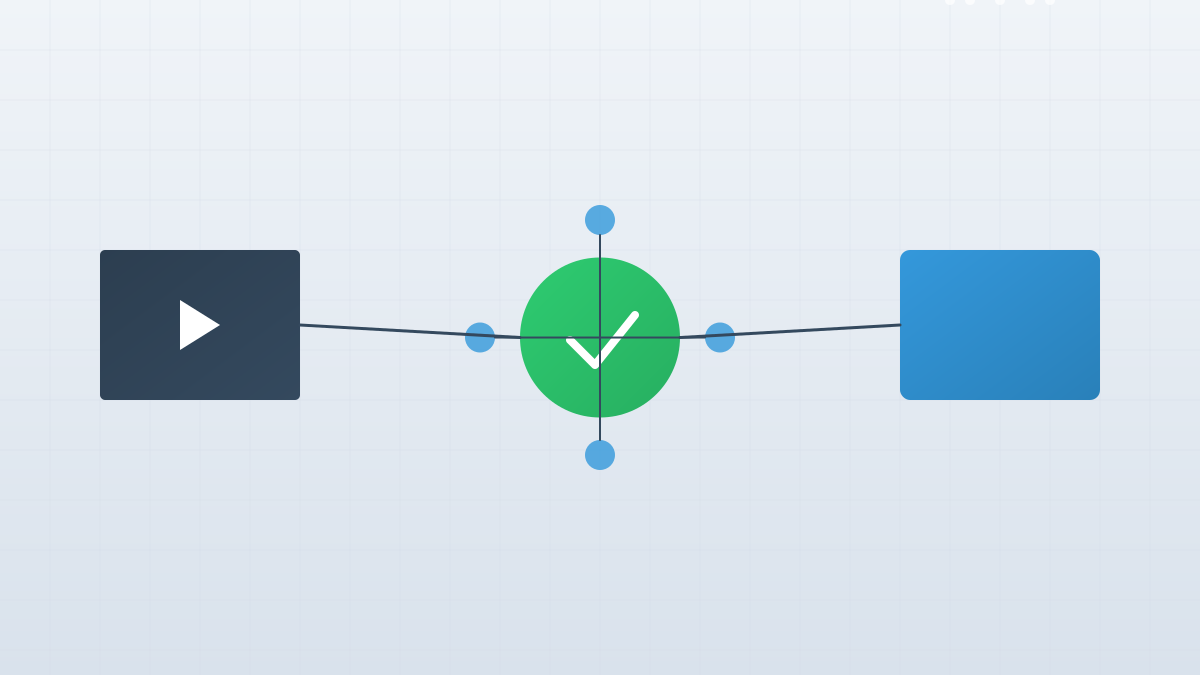
The core philosophy of the framework is "standardization" and "extensibility", adopting a modular architecture (components such as data loading, model interface, inference execution, and metric calculation). The unified evaluation protocol includes: input standardization (video preprocessing), prompt template specification, output parsing; multi-dimensional evaluation metrics cover accuracy (exact match, semantic similarity), temporal understanding (action sequence, event localization), open-ended generation (BLEU, ROUGE, etc.), and robustness testing (stability under different video quality conditions).

4

Section 04

Supported Datasets and Task Types

The framework pre-integrates multiple mainstream datasets, covering various tasks:

  • Video Question Answering: MSVD-QA, MSRVTT-QA, ActivityNet-QA (tests object recognition, temporal reasoning, etc.);
  • Video Caption Generation: MSVD, MSRVTT (evaluates the ability to generate accurate and fluent descriptions);
  • Temporal Localization and Action Recognition: ActivityNet Captions, DiDeMo (localizes events, recognizes action sequences);
  • Long Video Understanding: MovieNet, YouCook2 (handles videos longer than several minutes).
5

Section 05

Technical Implementation Details

The technical features of the framework include:

  • Model interface abstraction: supports API models (GPT-4V, Gemini), open-source models (Video-LLaMA, etc.), and custom models;
  • Distributed evaluation: multi-GPU parallel processing, supports resuming from breakpoints, reducing large-scale testing time;
  • Result visualization: automatically generates performance comparison reports, error case analysis, and supports ablation experiments.
6

Section 06

Application Value and Community Impact

The value of the framework is reflected in:

  • Promoting research standardization: establishing a unified evaluation system to make model comparisons more reliable;
  • Lowering evaluation thresholds: out-of-the-box use allows researchers to focus on model innovation rather than engineering implementation;
  • Facilitating model iteration: through error analysis and multi-dimensional metrics, helping developers identify weak points and guide improvement directions.
7

Section 07

Limitations and Future Plans

Current challenges: incomplete dataset coverage, difficulty of automatic evaluation metrics to capture subjective feelings, high computational resource requirements. Future directions: integrate manual evaluation interfaces, support real-time video stream evaluation, add multilingual video understanding, evaluate model efficiency metrics (inference speed, memory usage).

8

Section 08

Summary

video-llm-evaluation-harness is a much-needed standardized evaluation tool in the video LLM field. Against the backdrop of rapid model iterations, reliable evaluation benchmarks are crucial for distinguishing real progress. This framework is not only a technical tool but also an infrastructure to promote the healthy development of the field, worthy of researchers' attention and participation. As multimodal AI develops, such frameworks will play a greater role in ensuring technical transparency and comparability.

