Zing Forum

Reading

AI Agent Optimizes LEO Satellite Communication: Adaptive Modulation Technology Achieves Over 25% Performance Improvement

A generative AI agent built using LangChain and RAG technologies dynamically switches between LR-FHSS and LoRa modulation schemes by real-time analysis of satellite geometric parameters, achieving a packet error rate reduction of over 25% in LEO satellite communication scenarios while keeping decision latency within 500 milliseconds.

LEO卫星AI智能体自适应调制LangChainRAGLR-FHSSLoRa卫星通信机器学习
Published 2026-06-07 04:15Recent activity 2026-06-07 04:19Estimated read 8 min
AI Agent Optimizes LEO Satellite Communication: Adaptive Modulation Technology Achieves Over 25% Performance Improvement
1

Section 01

Introduction: AI Agent Optimizes LEO Satellite Communication, Adaptive Modulation Achieves Over 25% Performance Improvement

Project Core Information

Core Achievements

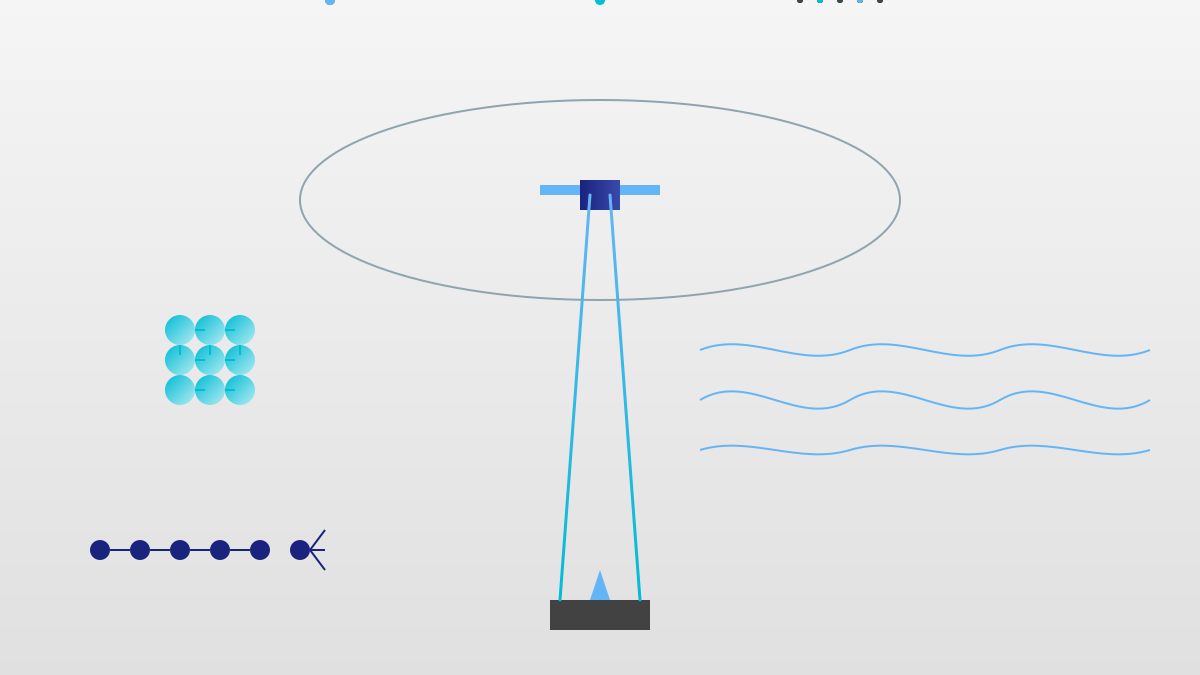
A generative AI agent built using LangChain and RAG technologies dynamically switches between LR-FHSS and LoRa modulation schemes by real-time analysis of satellite geometric parameters (elevation angle, Doppler shift), achieving the following in LEO satellite communication scenarios:

  1. Packet error rate reduced by over 25%
  2. Decision latency controlled within 500 milliseconds

This project provides a reference AI solution for dynamic channel optimization in LEO satellite communication.


2

Section 02

Technical Challenges of LEO Satellite Communication

Low Earth Orbit (LEO) satellites have the advantages of low transmission latency and high bandwidth potential, but their fast-moving nature (about 27,000 km/h) brings two major challenges:

  1. Severe Doppler shift fluctuations: Relative motion causes carrier synchronization difficulties
  2. Continuous change in signal incident angle: Significant signal attenuation/fading at low elevation angles

Traditional fixed modulation schemes are difficult to adapt to dynamic environments, while LoRa (long-range, low-power consumption, SF7-12) and LR-FHSS (frequency hopping enhanced anti-interference, DR8/9 high-speed mode) each have applicable scenarios, requiring dynamic switching to balance reliability and efficiency.

3

Section 03

Design and Training Strategy of the AI Agent

Architecture Design

  • Based on LangChain framework: Provides tool calling and memory mechanisms
  • Integrates RAG technology: Builds a communication scenario knowledge base and supports similar case retrieval

Input and Output

  • Input: Satellite elevation angle (reflects atmospheric penetration depth), Doppler shift amount
  • Output: Binary decision (LR-FHSS DR8/9 or LoRa SF7-12)

Training and Data

  • Dataset: 1000+ communication scenario CSVs covering the entire transit process (rise to fall)
  • Training strategy: Supervised pre-training (historical optimal decisions) + online reinforcement learning (explore better strategies)
  • Role of RAG: Retrieve similar cases in unknown scenarios to reduce labeled data dependency
4

Section 04

System Architecture and Real-Time Performance Assurance

Core Components

  1. Real-time data stream processing: Receives telemetry data, extracts and preprocesses geometric parameters
  2. AI decision engine: Encapsulates LangChain agent and RAG retrieval logic
  3. REST API interface: Provides standardized access (query recommended configurations, decision explanations)
  4. Real-time dashboard: Monitors satellite trajectory, channel quality, decision history

Performance Optimization

  • Model quantization and pruning: Adapt to edge devices for fast operation
  • Cache precomputation: Prepare candidate decisions in advance to handle predictable satellite position changes
  • Overall decision latency ≤500ms (including RAG retrieval overhead)
5

Section 05

Actual Performance Evaluation Results

Key Indicator Improvements

  1. Packet Error Rate (PER): Reduced by over 25% compared to fixed modulation schemes, improving data transmission success rate
  2. Decision latency: Completes channel input to modulation decision within 500ms
  3. Energy consumption: On-demand modulation switching saves terminal energy consumption by 20-30% (significant for IoT devices)

Tests covered simulation environments and real LEO links, verifying the practicality of the solution.

6

Section 06

Application Prospects and Industry Significance

Open Source Value

Provides an AI optimization example for LEO satellite communication, supporting cumulative swarm intelligence (evolving from massive terminal experiences)

Transferability

  • Extend to other modulation technologies: such as 5G NR MCS selection, DVB-S2X ACM
  • Adapt to dynamic scenarios: High Altitude Platform Communication (HAPS), UAV communication

Industry Benefits

  • Operators: Improve spectrum efficiency and user capacity
  • Terminal manufacturers: Easily integrate AI capabilities via REST API
7

Section 07

Summary and Outlook

LEO satellite communication is moving towards large-scale commercialization, and dynamic channel optimization is a core challenge. This project integrates LangChain, RAG, and reinforcement learning to achieve a balance between performance and interpretability.

The 25%+ PER improvement and sub-second latency prove the practical value of AI technology. In the future, with dataset expansion and model evolution, it is expected to play a greater role in satellite internet construction and help realize the vision of global seamless connectivity.

