Zing Forum

Reading

AI Supply Chain Intelligence Platform: End-to-End Logistics Analysis and Prediction System

An end-to-end supply chain analysis platform integrating machine learning, generative AI, PostgreSQL, and Streamlit, supporting freight delay prediction, demand forecasting, weather risk assessment, and AI assistant interaction.

supply chainmachine learningdemand forecastinglogisticsRAGStreamlitPostgreSQLweather APIGenerative AI
Published 2026-06-13 18:42Recent activity 2026-06-13 18:52Estimated read 7 min
AI Supply Chain Intelligence Platform: End-to-End Logistics Analysis and Prediction System
1

Section 01

[Introduction] AI Supply Chain Intelligence Platform: End-to-End Logistics Analysis and Prediction System

This article introduces an end-to-end supply chain analysis platform integrating machine learning, generative AI, PostgreSQL, and Streamlit. It supports freight delay prediction, demand forecasting, weather risk assessment, and AI assistant interaction, helping enterprises transition from passive response to proactive prediction, optimize inventory planning, reduce logistics delays, and improve operational efficiency. The project was developed by Sneha Kate, an AI and data science enthusiast with a B.Sc. in Statistics, and released on GitHub in 2025.


2

Section 02

Project Background: The Need for Intelligent Supply Chain Management

Against the backdrop of globalized trade and complex logistics networks, traditional supply chain management relies on experience-based judgment and post-hoc analysis, making it difficult to respond to emergencies and dynamic market demands. Addressing this pain point, this project builds a comprehensive solution integrating machine learning prediction, real-time data analysis, and generative AI assistants. Its core goal is to help enterprises optimize operations through data-driven insights.

3

Section 03

System Architecture and Core Technology Stack

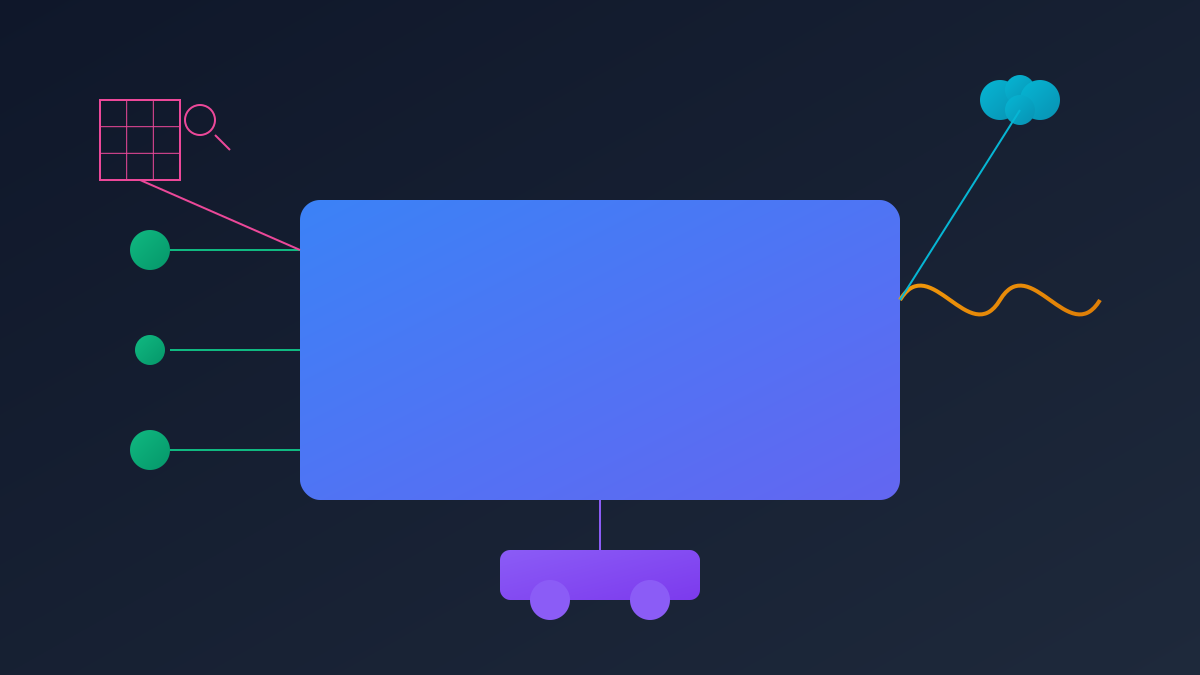
The platform uses a combination of Python ecosystem technologies:

  • Data processing layer: Pandas, NumPy, Scikit-Learn
  • Data storage layer: PostgreSQL
  • Visualization and interaction layer: Streamlit, Matplotlib, Power BI
  • AI capability layer: Google Gemini API (integrated with RAG architecture)
  • External integration: Weather API provides real-time meteorological data The project has a modular structure, including directories like app, database, data, models, etc., following best practices in data science.
4

Section 04

Detailed Explanation of Core Function Modules

  1. Freight Delay Prediction: Train ML models based on historical data to predict freight delays and output confidence levels; results are stored in PostgreSQL.
  2. Interactive Analysis Dashboard: Display visual indicators such as total freight volume, delay rate, and distribution trends via Streamlit.
  3. Demand Forecasting: Use time series analysis + ML algorithms to predict future demand and assist in inventory planning.
  4. Weather Risk Assessment: Integrate weather API data to classify risk levels (low/medium/high) based on indicators like temperature/precipitation.
  5. AI Supply Chain Assistant: An intelligent Q&A system based on the RAG architecture, combining LLM reasoning with business knowledge bases to avoid hallucinations.
5

Section 05

Practical Application Value: Multi-dimensional Empowerment of Enterprise Operations

  • Operational Optimization: Identify delay risks in advance to reduce customer complaints and cost losses.
  • Inventory Management: Accurate demand forecasting avoids overstocking or stockouts, optimizing capital turnover.
  • Risk Control: Weather risk assessment enhances the ability to respond to uncontrollable factors.
  • Decision Support: The AI assistant lowers the threshold for data analysis, allowing non-technical users to gain insights through natural language.
6

Section 06

Future Development Directions: Expanding Capabilities and Scenarios

Project plans include:

  • Real-time freight tracking (from batch processing to real-time).
  • Introduce advanced time series/deep learning models to improve prediction accuracy.
  • Build multi-agent systems to handle complex scenarios.
  • Expand supplier risk assessment dimensions.
  • Route optimization engine (integrating geographic and traffic data).
  • Cloud deployment to support large-scale data and concurrency.
7

Section 07

Technical Highlights and Learning Value

  • Multi-technology Stack Integration: Organic combination of ML prediction, database storage, web display, and generative AI.
  • RAG Architecture Practice: Provides reusable references for enterprise knowledge Q&A systems.
  • External Data Integration: Weather API expands the system's capability boundaries.
  • End-to-End Completeness: Covers the entire chain from data processing → model training → application deployment. For data science practitioners, it is an excellent reference project covering the full workflow.

