Zing Forum

Reading

AgroDrone: AI-Powered Autonomous Agricultural Drone Swarm and Satellite Collaborative Crop Disease Monitoring System

Explore how the AgroDrone project integrates artificial intelligence, Internet of Things (IoT), low-orbit satellite imagery, and multi-rotor drone swarms to build a real-time, precision agricultural health monitoring system with zero human intervention.

精准农业无人机群卫星遥感作物病害监测人工智能物联网边缘计算智慧农业
Published 2026-05-02 13:45Recent activity 2026-05-02 13:51Estimated read 7 min
AgroDrone: AI-Powered Autonomous Agricultural Drone Swarm and Satellite Collaborative Crop Disease Monitoring System
1

Section 01

AgroDrone Project Overview: AI-Powered Drone Swarm and Satellite Collaborative Crop Disease Monitoring System

The AgroDrone project integrates artificial intelligence, Internet of Things (IoT), low-orbit satellite imagery, and multi-rotor drone swarms to build a real-time, precision agricultural health monitoring system with zero human intervention. It aims to address pain points in traditional agricultural monitoring such as limited coverage, insufficient real-time performance, and high labor costs, enabling large-scale and regular crop disease monitoring.


2

Section 02

Project Background: Global Agricultural Challenges and the Need for Precision Agriculture

Global agriculture faces challenges such as climate change, accelerated spread of pests and diseases, and labor shortages. Crop diseases cause 20% to 40% of global food losses each year (even higher in developing countries). Traditional manual inspections cannot meet large-scale needs, and existing precision agriculture solutions rely on fixed sensors or manually operated drones, which have issues like limited coverage, insufficient real-time performance, and high labor costs. Hence, the AgroDrone project was proposed.

3

Section 03

System Architecture: Hierarchical Collaborative Monitoring System

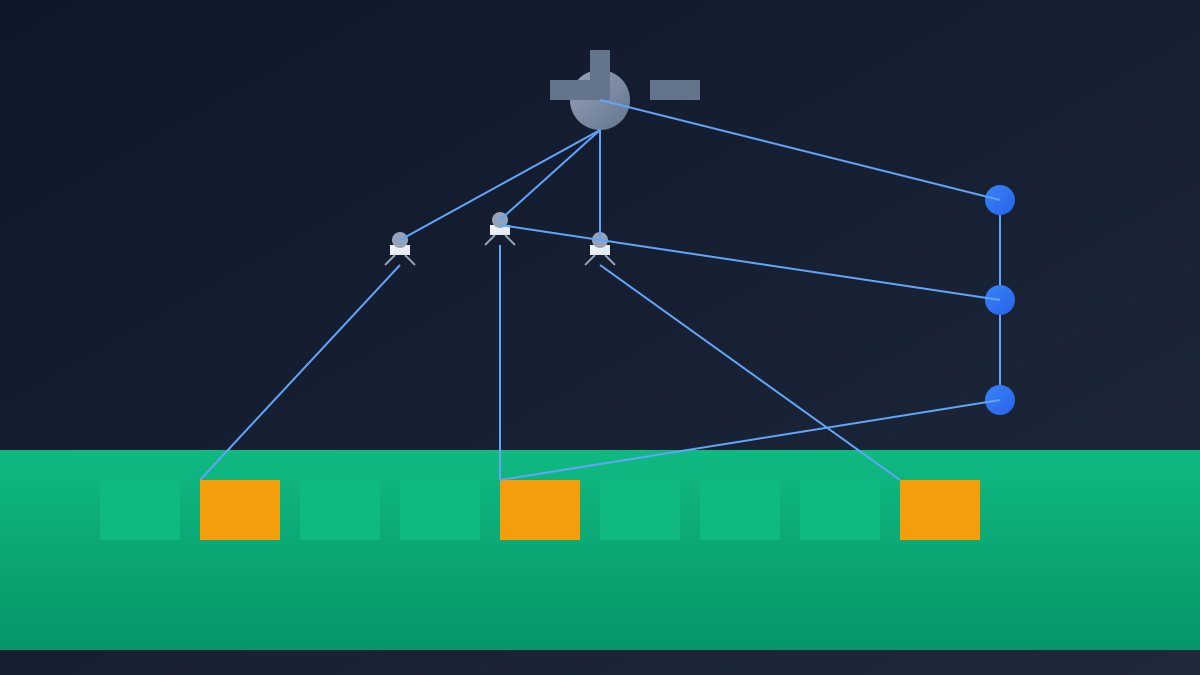
The core innovation of the AgroDrone system lies in integrating four types of technologies: artificial intelligence (image recognition, decision-making), Internet of Things (IoT) (device communication and synchronization), low-orbit satellites (wide-area macro data), and multi-rotor drone swarms (fine-grained inspection). It adopts a hierarchical monitoring architecture: satellites handle macro anomaly detection, drone swarms conduct micro precision diagnosis, and an AI hub forms a closed-loop monitoring-diagnosis-alert system.

4

Section 04

Core Technical Mechanism: Collaborative Operation of Satellites, Drones, and AI

Satellite Layer: Macro Anomaly Detection

Low-orbit satellites acquire multispectral images with high revisit frequency, analyze vegetation indices like NDVI to identify areas with abnormal growth.

Drone Swarm Layer: Micro Precision Diagnosis

After satellites detect anomalies, they dispatch drone swarms equipped with high-resolution cameras, multispectral sensors, etc., enabling autonomous path planning, collaborative operation, and edge computing (onboard AI processes images in real time).

AI Diagnosis Engine

The deep learning model is trained on tens of thousands of labeled images, can identify dozens of diseases, has leading accuracy, and possesses continuous learning capabilities.

5

Section 05

Autonomous Operation Mode: 'Set It and Forget It' with Zero Human Intervention

AgroDrone achieves fully autonomous operation:

  • Autonomous takeoff and landing: automatically executed based on task plans and weather
  • Intelligent charging and battery swapping: automatically return to the nest for processing when battery is low
  • Autonomous task allocation: generate optimal inspection plans based on farmland maps, crop stages, etc.
  • Autonomous anomaly response: automatically notify farmers and recommend prevention and control plans when suspected diseases are found This mode enables large-scale, regular, and unmanned monitoring.
6

Section 06

Application Value: Multiple Benefits in Economy, Ecology, Society, and Technical Demonstration

Economic Benefits: Early detection of diseases reduces losses by over 50% and cuts costs by reducing blind use of pesticides. Ecological Benefits: Precision application reduces chemical pollution and promotes sustainable agriculture. Social Benefits: Alleviates labor shortages and frees farmers to focus on high-value decisions. Technical Demonstration: Demonstrates the integrated application of multi-agent systems, space-air-ground integration, and edge AI in agriculture, providing a replicable paradigm.

7

Section 07

Future Outlook and Challenges: Opportunities and Issues in Commercial Deployment

Challenges:

  • Regulatory adaptation: Different drone airspace regulations across countries require compliance solutions
  • Cost control: High initial investment requires business models suitable for small-scale farmers
  • Extreme environment adaptability: Need to optimize for the impact of harsh weather like strong winds and heavy rains

Outlook: The popularization of 5G/6G, reduced satellite costs, and improved AI efficiency will promote the space-air-ground integration model to become mainstream, supporting global food security.

