Zing Forum

Reading

Agentic Writer: A Multi-Agent Collaborative Novel Writing Pipeline

An open-source project that streamlines AI writing processes. It enables end-to-end novel generation from idea to final draft through collaboration among four agents—Architect, Writer, Editor, and Reviewer—supporting both CLI and visual Studio interaction modes.

AI写作多智能体系统小说生成Pydantic AICopilotKitAG-UIPython创意AI
Published 2026-05-28 04:42Recent activity 2026-05-28 04:49Estimated read 8 min
Agentic Writer: A Multi-Agent Collaborative Novel Writing Pipeline
1

Section 01

Introduction: Agentic Writer—A Multi-Agent Collaborative Novel Writing Pipeline

Agentic Writer is an open-source project that enables end-to-end novel generation from idea to final draft through collaboration among four agents—Architect, Writer, Editor, and Reviewer. It supports both CLI (Command Line Interface) and visual Studio interaction modes, aiming to address the limitations of existing AI writing tools in long-form creation.


2

Section 02

Background: The Evolution Dilemma of AI Writing Tools

With the widespread adoption of large language models, AI-assisted writing tools have emerged in abundance, but most remain at the level of "one-time dialogue generation". They face the following limitations in long-form novel creation:

  • Lack of overall planning: Difficulty maintaining plot coherence across chapters
  • Quality control challenges: No systematic editing and review processes
  • Restricted format output: Tedious conversion from text to publishable formats
  • Fragmented interaction experience: CLI and visual interfaces are not interconnected

Agentic Writer draws on the CI/CD concept from software development, treating novel creation as a pipeline project and introducing systematic quality control mechanisms to address these pain points.

3

Section 03

Core Architecture and Technical Implementation

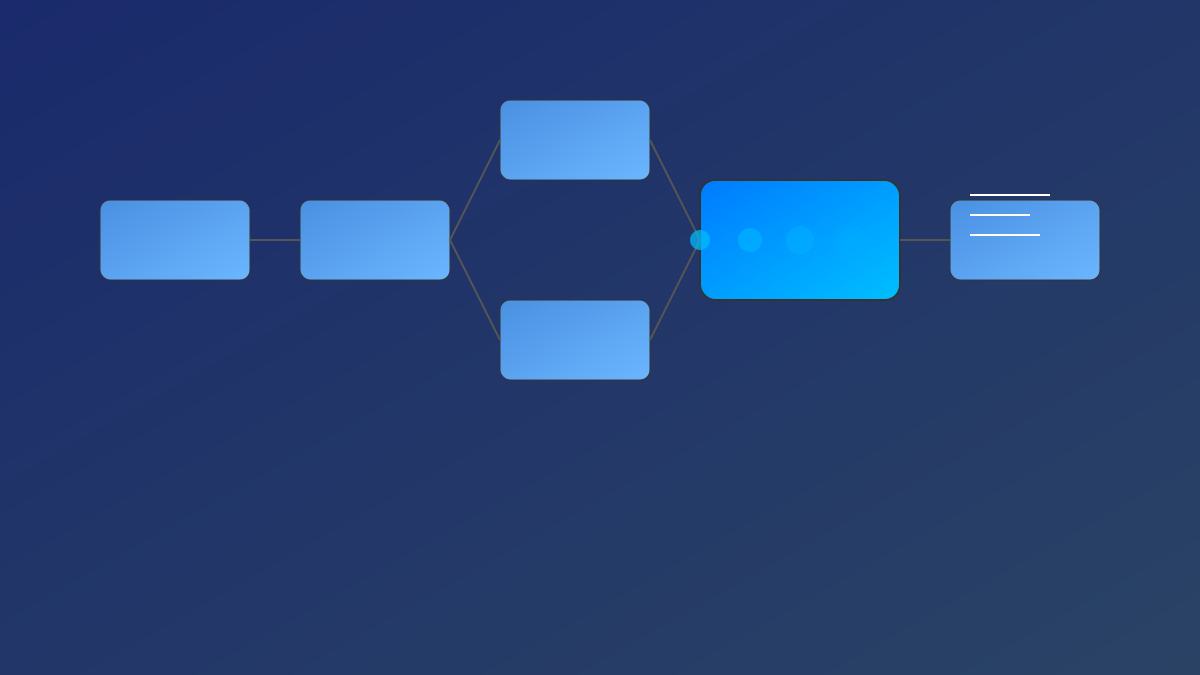
Core Architecture: Four-Agent Collaborative Pipeline

  1. Architect: Designs plot twists, chapter blueprints, and sets word count ranges (supports flash/short story/novella formats)
  2. Writer: Generates content chapter by chapter according to the blueprint
  3. Editor: Checks coherence, unifies style, optimizes expression
  4. Reviewer: Conducts adversarial vulnerability checks, triggers rewrites, and scores quality

Technical Implementation

  • Tech Stack: Python ecosystem (Pydantic AI, Typer, FastAPI, Next.js+CopilotKit, AG-UI)
  • Dual-Mode Architecture:
    • CLI Mode: Suitable for technical users; start processes via commands (e.g., agentic-writer generate --slug my-story --pitch "time travel mystery story" --format novella)
    • Studio Mode: Visual interface supporting real-time progress tracking, token consumption display, manuscript preview, and thread persistence
  • Output Formats: Markdown, DOCX, PDF
Format Number of Chapters Target Word Count
Flash fiction 1 chapter + preface 600-2,500 words
Short story 7 chapters + preface 7,000-16,000 words
Novella 16 chapters + preface 28,000-52,000 words
4

Section 04

System Design and Quality Assurance

C4 Architecture Diagrams

  • System Context Diagram: Shows interactions between the author, Agentic Writer system, OpenAI API, GitHub Pages site, and output storage
  • Container Diagram: Details boundaries of CLI container, Studio frontend/backend, story pipeline core, artifact/thread storage, etc.
  • Component and Dynamic Diagrams: Show internal component interactions of the Studio API and pipeline execution order

Testing and Quality Assurance

Uses Gherkin syntax for BDD tests covering:

  • Architect's plot planning function
  • Writer's chapter generation quality
  • Editor's review and optimization capabilities
  • Reviewer's adversarial check logic
  • Export format correctness

This engineering testing is rare in creative AI projects, reflecting the emphasis on quality.

5

Section 05

Application Scenarios and Project Features

Application Scenarios

  • Novel authors: Quickly generate frameworks to break through creative bottlenecks
  • Content creators: Batch produce short stories (for blogs/podcast scripts)
  • Writing education: Demonstrate structured creation processes
  • AI researchers: Study multi-agent collaboration in creative tasks

Project Features

  1. Process-oriented thinking: Shifts creation from single-generation to systematic engineering
  2. Specialized roles: Clear division of agent labor improves quality
  3. Dual-mode interaction: CLI for efficiency, Studio for intuitiveness
  4. Real-time visibility: AG-UI protocol makes processes transparent
  5. Rigorous engineering: Type safety, BDD testing, and C4 documentation meet professional development standards
6

Section 06

Limitations and Future Outlook

Current Limitations

  • Model dependency: Mainly supports OpenAI models; adaptation for other LLMs needs improvement
  • Language support: Prompt engineering may be optimized for English
  • Creative control: User intervention timing and methods need optimization

Future Directions

  • Add EPUB and other e-book export formats
  • Collaborative editing features (multi-person creation)
  • Fine-grained creative control (intervene and modify at any stage)
  • Version control system integration
7

Section 07

Conclusion

Agentic Writer represents the evolutionary direction of AI-assisted creation tools—shifting from "one-time dialogue" to "systematic pipeline". By introducing best practices from software engineering (modular design, CI/CD concept, automated testing), it provides new possibilities for literary creation in the AI era.

For developers, writers, and researchers, it is not only a usable tool but also an architectural example worth learning from.

